
Book: You Can't Do Business with Hitler
Overview
Olin Miller’s 1941 book You Can’t Do Business with Hitler is a brisk, polemical brief aimed at American readers who still believed commerce could moderate Nazi Germany or keep the United States out of war. Written on the cusp of full American entry into World War II, it argues that the Third Reich treats trade not as a neutral exchange but as a weapon to extract resources, break competitors, and soften targets for political domination. Miller contends that contracts, credit, and clearing arrangements are instruments of coercion in a system where power trumps law, and that the hope of “business as usual” with Berlin is both naive and dangerous.
Historical and economic context
Miller situates Nazi economic policy in the trajectory from Weimar crisis management to the New Plan and the Four-Year Plan, showing how Germany moved toward autarky, cartelization, and state direction of industry. Bilateral clearing agreements, blocked currency accounts, barter deals, and discriminatory licensing became the architecture of trade, allowing Berlin to siphon foreign goods while delaying or denying real payment. Synthetic substitutes, strategic stockpiling, and tight control over raw materials served rearmament and prepared the economy for war, while trade missions doubled as political probes.
Core argument
The book’s core claim is stark: a regime built on aggression and deceit cannot be tamed by market ties. In Miller’s telling, commerce under Hitler is subordinated to strategy. Negotiations are used to buy time, split adversaries, and map dependencies; contracts are honored only when they serve immediate German needs. When leverage shifts, prices, terms, and even ownership are imposed by fiat. Appeasement fails because it misreads the purpose of trade in a dictatorship that treats economics as an extension of force. The only dependable counter is coordinated pressure, tight export controls, denial of strategic materials, and robust support for those resisting Nazi expansion.
Evidence and examples
Miller draws on diplomatic dispatches, press accounts, and business testimony to show a pattern repeated across Europe. In Austria and Czechoslovakia, commercial overtures and clearing deals preceded political subjugation and the takeover of plants and banks. In the Balkans and Scandinavia, trade concessions yielded chronic arrears, dependence on German markets, and vulnerability to intimidation. After occupation, managers faced Party oversight, forced deliveries, and the stripping of inventory at controlled prices. Industrial giants such as I.G. Farben exemplify how cartel agreements and patent-sharing were used to dominate sectors and starve foreign competitors of inputs and know-how. American and British firms with German subsidiaries encountered trapped earnings, licensing hurdles, and demands to align production with Reich priorities, illustrating that private negotiations offered little protection once political leverage was applied.
Implications for the United States
For Miller, the lesson for American business is immediate. Neutrality premised on trade is a mirage when the counterparty treats commerce as cover for war-making. Continued sales of oil, metals, machine tools, rubber substitutes, and other strategic goods free German resources to be turned into armaments. He argues for embargoes on critical materials, preclusive buying to keep scarce resources out of Nazi hands, tighter financial controls to prevent evasion through intermediaries, and full material support for Britain and other frontline states. The book champions mobilizing American industry as an “arsenal” whose output is more decisive than any bargain struck across a conference table.
Style, audience, and relevance
Miller writes in an accessible, journalist’s register, translating technical mechanisms like clearing accounts and exchange controls into concrete consequences for exporters, bankers, and shippers. He addresses business leaders tempted by short-term sales and the wider public inclined toward isolation, pairing moral urgency with practical caution. While not an academic economics text, its synthesis is forceful: when a dictatorship fuses state, party, and industry, trade ceases to be a sphere of trust. The book’s immediate purpose was to close the American debate over doing business with the Reich; its enduring point is broader, authoritarian systems that instrumentalize commerce will treat contracts as tactics, not commitments, and the only reliable hedge is collective resolve backed by economic power.
Citation Formats
APA Style (7th ed.)
You can't do business with hitler. (2025, August 22). FixQuotes. https://fixquotes.com/works/you-cant-do-business-with-hitler/
Chicago Style
"You Can't Do Business with Hitler." FixQuotes. August 22, 2025. https://fixquotes.com/works/you-cant-do-business-with-hitler/.
MLA Style (9th ed.)
"You Can't Do Business with Hitler." FixQuotes, 22 Aug. 2025, https://fixquotes.com/works/you-cant-do-business-with-hitler/. Accessed 2 Apr. 2026.
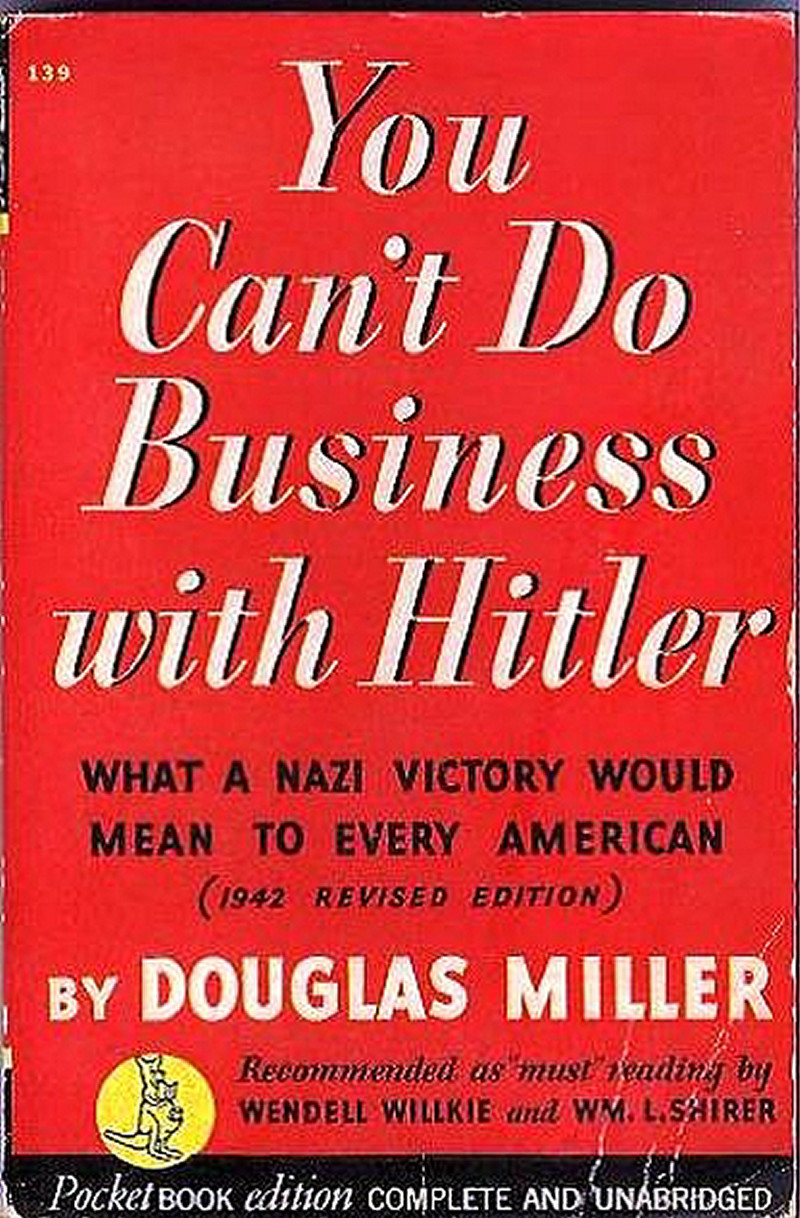
You Can't Do Business with Hitler
This book is a series of thirteen scripts that were broadcasted on the radio warning the Americans about the deceitful methods used by the Germans to involve the United States in their war.
- Published1941
- TypeBook
- GenreNon-Fiction, War, History
- LanguageEnglish
About the Author

Olin Miller
Olin James Miller, an influential American writer and humorist, known for his witty essays and satirical observations.
View Profile