
Book: Zweites Buch
Overview
Adolf Hitler’s Zweites Buch, dictated in 1928 but unpublished in his lifetime, is a sequel in spirit to Mein Kampf that concentrates on foreign policy, geopolitics, and economic strategy. It elaborates a program of territorial expansion and racial hierarchy, framed as a response to Germany’s perceived demographic and resource constraints. The manuscript circulated privately among Nazi insiders and was not made public until the early 1960s, when historians identified it in captured records, giving scholars a clearer view of Hitler’s stated aims before taking power.
Context and Purpose
Composed after electoral setbacks for the Nazi Party, the text seeks to refine strategy and reassure followers about long-term objectives. Hitler presents what he calls “laws” of history: a social-Darwinist struggle among races and states for space and resources. He insists that Germany’s survival requires more land for a growing population, and that this necessity overrides legal or moral objections. The book devotes relatively little space to domestic politics compared with Mein Kampf, instead placing Germany’s future in a global contest among great powers.
Lebensraum and the East
The central argument is the pursuit of Lebensraum in Eastern Europe, especially in Soviet territory. Hitler rejects overseas colonies as impractical and strategically vulnerable for a continental power without commanding sea strength. He contends that only the fertile lands to the east can secure food, raw materials, and strategic depth. The Slavic peoples are denigrated through racist claims, and the book contemplates conquest and subjugation as acceptable means to achieve German expansion. This vision anticipates later Nazi aggression and the catastrophic violence of the Second World War.
Enemies, Allies, and the Balance of Power
France is cast as Germany’s immediate continental adversary, allegedly bent on keeping Germany weak after the Treaty of Versailles. Britain is treated with ambivalence: Hitler courts the idea of an arrangement with London, provided Germany directs its expansion eastward and avoids challenging the British Empire at sea, yet he also allows for eventual rivalry. Italy is presented as a potential partner against France, and Southeastern Europe is eyed as an economic and political sphere of influence. Austria’s incorporation into a greater German state appears as a natural and desirable step.
The United States and Global Competition
Hitler assesses the United States as a rising power whose continental scale and resources make it formidable. While he disparages the U.S. through racist stereotypes, he recognizes its industrial and organizational strengths and speculates about long-term collision with Europe. The analysis combines admiration of scale with bigoted dismissals of American society, reflecting his broader mix of strategic calculation and extremist ideology.
Economics, Autarky, and Trade
A sustained critique of export-led growth runs through the book. Hitler argues that reliance on global markets and raw materials is a trap that leaves Germany exposed to naval blockade and price shocks. Instead he urges acquisition of continental resources to move toward autarky. He dismisses tariffs and commercial diplomacy as secondary to territorial expansion, and he treats population policy and land conquest as the true foundation of prosperity and power.
Antisemitism and Ideological Themes
The manuscript reiterates virulent antisemitism and conspiracy theories, tying “Jewish influence” to both finance capitalism and Marxism in a contradictory polemic. It merges this bigotry with pseudo-scientific racial doctrine and a celebration of struggle and war as engines of history. The text is explicit about subordinating law, treaties, and humanitarian norms to racial aims.
Significance
Zweites Buch is important because it records, years before 1933, Hitler’s intention to overturn the European order by force, to wage a war of expansion in the East, and to reshape the continent along racial lines. Although it added little to Nazi public propaganda at the time, its later publication provided direct evidence of the regime’s premeditated goals and the ideological roots of the ensuing crimes.
Adolf Hitler’s Zweites Buch, dictated in 1928 but unpublished in his lifetime, is a sequel in spirit to Mein Kampf that concentrates on foreign policy, geopolitics, and economic strategy. It elaborates a program of territorial expansion and racial hierarchy, framed as a response to Germany’s perceived demographic and resource constraints. The manuscript circulated privately among Nazi insiders and was not made public until the early 1960s, when historians identified it in captured records, giving scholars a clearer view of Hitler’s stated aims before taking power.
Context and Purpose
Composed after electoral setbacks for the Nazi Party, the text seeks to refine strategy and reassure followers about long-term objectives. Hitler presents what he calls “laws” of history: a social-Darwinist struggle among races and states for space and resources. He insists that Germany’s survival requires more land for a growing population, and that this necessity overrides legal or moral objections. The book devotes relatively little space to domestic politics compared with Mein Kampf, instead placing Germany’s future in a global contest among great powers.
Lebensraum and the East
The central argument is the pursuit of Lebensraum in Eastern Europe, especially in Soviet territory. Hitler rejects overseas colonies as impractical and strategically vulnerable for a continental power without commanding sea strength. He contends that only the fertile lands to the east can secure food, raw materials, and strategic depth. The Slavic peoples are denigrated through racist claims, and the book contemplates conquest and subjugation as acceptable means to achieve German expansion. This vision anticipates later Nazi aggression and the catastrophic violence of the Second World War.
Enemies, Allies, and the Balance of Power
France is cast as Germany’s immediate continental adversary, allegedly bent on keeping Germany weak after the Treaty of Versailles. Britain is treated with ambivalence: Hitler courts the idea of an arrangement with London, provided Germany directs its expansion eastward and avoids challenging the British Empire at sea, yet he also allows for eventual rivalry. Italy is presented as a potential partner against France, and Southeastern Europe is eyed as an economic and political sphere of influence. Austria’s incorporation into a greater German state appears as a natural and desirable step.
The United States and Global Competition
Hitler assesses the United States as a rising power whose continental scale and resources make it formidable. While he disparages the U.S. through racist stereotypes, he recognizes its industrial and organizational strengths and speculates about long-term collision with Europe. The analysis combines admiration of scale with bigoted dismissals of American society, reflecting his broader mix of strategic calculation and extremist ideology.
Economics, Autarky, and Trade
A sustained critique of export-led growth runs through the book. Hitler argues that reliance on global markets and raw materials is a trap that leaves Germany exposed to naval blockade and price shocks. Instead he urges acquisition of continental resources to move toward autarky. He dismisses tariffs and commercial diplomacy as secondary to territorial expansion, and he treats population policy and land conquest as the true foundation of prosperity and power.
Antisemitism and Ideological Themes
The manuscript reiterates virulent antisemitism and conspiracy theories, tying “Jewish influence” to both finance capitalism and Marxism in a contradictory polemic. It merges this bigotry with pseudo-scientific racial doctrine and a celebration of struggle and war as engines of history. The text is explicit about subordinating law, treaties, and humanitarian norms to racial aims.
Significance
Zweites Buch is important because it records, years before 1933, Hitler’s intention to overturn the European order by force, to wage a war of expansion in the East, and to reshape the continent along racial lines. Although it added little to Nazi public propaganda at the time, its later publication provided direct evidence of the regime’s premeditated goals and the ideological roots of the ensuing crimes.
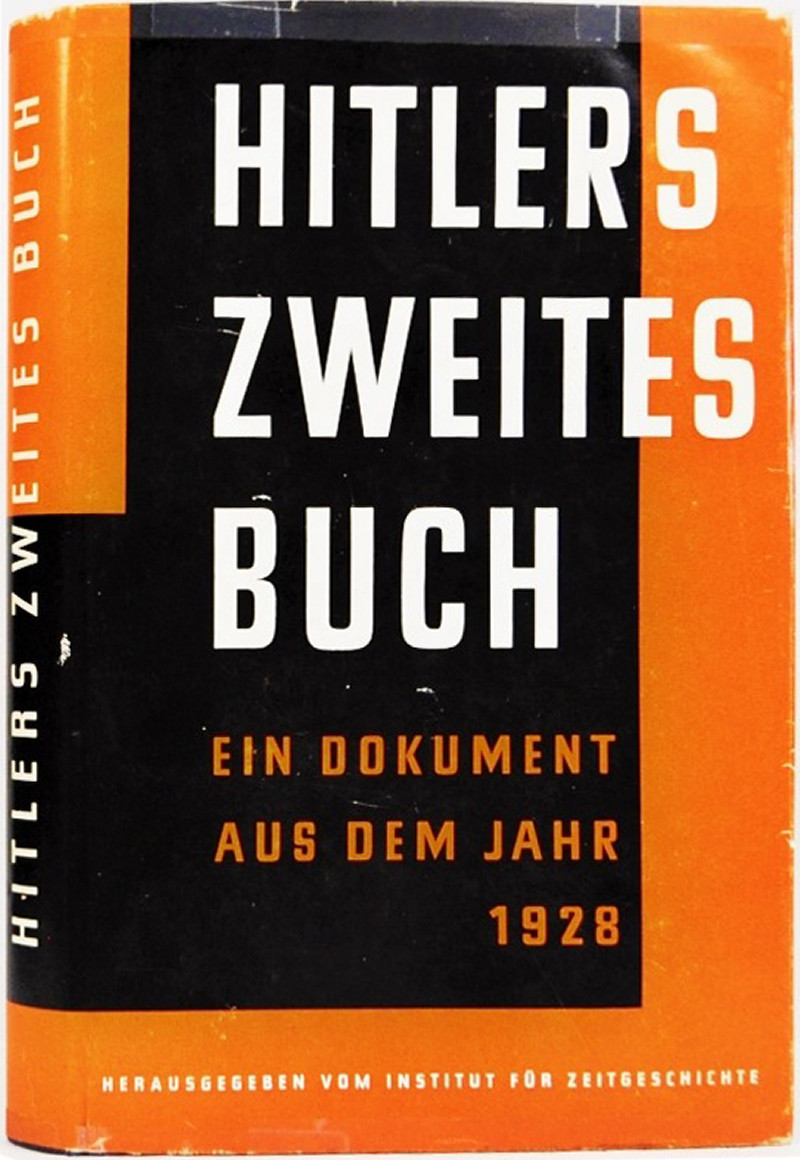
Zweites Buch
Zweites Buch, also known as Hitler's Secret Book, is an unpublished sequel to Mein Kampf by Adolf Hitler. The book contains a further elaboration of his political ideas and plans, as well as his thoughts on foreign policy.
- Publication Year: 1928
- Type: Book
- Genre: Political manifesto
- Language: German
- View all works by Adolf Hitler on Amazon
Author: Adolf Hitler

More about Adolf Hitler
- Occup.: Criminal
- From: Germany
- Other works:
- Mein Kampf (1925 Book)