
Blaise Pascal Biography Quotes 94 Report mistakes
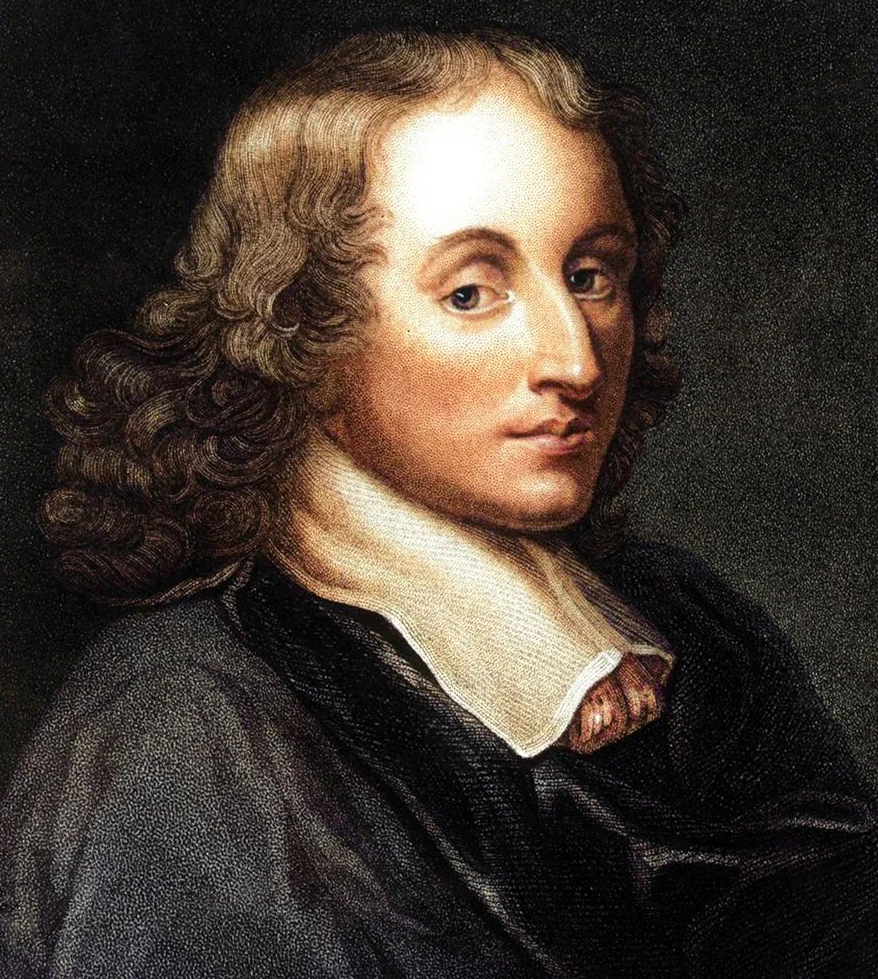
| 94 Quotes | |
| Occup. | Philosopher |
| From | France |
| Born | June 19, 1623 Clermont-Ferrand, France |
| Died | August 19, 1662 Paris, France |
| Cause | Stomach Cancer |
| Aged | 39 years |
| Cite | |
Citation Formats
APA Style (7th ed.)
Blaise pascal biography, facts and quotes. (2026, February 1). FixQuotes. https://fixquotes.com/authors/blaise-pascal/
Chicago Style
"Blaise Pascal biography, facts and quotes." FixQuotes. February 1, 2026. https://fixquotes.com/authors/blaise-pascal/.
MLA Style (9th ed.)
"Blaise Pascal biography, facts and quotes." FixQuotes, 1 Feb. 2026, https://fixquotes.com/authors/blaise-pascal/. Accessed 6 Mar. 2026.
Early Life and Background
Blaise Pascal was born on 19 June 1623 in Clermont-Ferrand, in the Auvergne region of France, into the professional, upwardly mobile world of the robe nobility. His father, Etienne Pascal, was a magistrate and tax official; his mother, Antoinette Begon, died when Blaise was young, leaving a household defined by precocious talent and carefully managed fragility. Pascal grew up amid the pressures of early modern French state-building, when learned expertise could translate into office, patronage, and influence - but also when religious conflict, plague, and war made existence feel contingent.In 1631 Etienne moved the family to Paris, seeking an environment worthy of his son and daughters (Gilberte and Jacqueline). Pascal was sickly throughout his life, prone to pain and exhaustion, and that bodily vulnerability would later give his thought its distinctive urgency: knowledge was not an ornament but a lifeline. Even as a child, he showed a fierce independence of mind, and the household became both refuge and laboratory - a place where affection, discipline, and intellectual ambition were tightly interwoven.
Education and Formative Influences
Etienne educated Blaise at home, wary of a schooling that might blunt originality, and introduced him to the mathematical salons of Paris, including the circle around Marin Mersenne where Descartes and other leading minds circulated. Pascal discovered geometry early and, as family accounts tell it, reinvented elementary propositions before being formally taught them, a mythic origin story that matched the era's fascination with genius. The young Pascal absorbed the new mechanical philosophy and the emerging ideal of demonstrative proof, but he also learned how brittle prestige could be in a culture of patronage, controversy, and doctrinal policing.Career, Major Works, and Turning Points
By his late teens Pascal had produced serious work in mathematics, including the 1640 Essay on Conics (with the theorem that still bears his name) and, soon after, the invention of the Pascaline, an adding machine designed to help his father with tax calculations at Rouen. In the 1640s he conducted decisive experiments on vacuum and atmospheric pressure, building on Torricelli and challenging scholastic explanations, and later formulated the arithmetic triangle and key results in probability through correspondence with Pierre de Fermat (1654), laying foundations for modern decision theory. The decisive inward turning came in the mid-1650s: his sister Jacqueline entered the Jansenist convent of Port-Royal, and after Pascal's intense "night of fire" experience in 1654 he committed himself to a rigorist Catholic piety. His public voice then emerged in the Lettres provinciales (1656-1657), brilliant satirical defenses of Port-Royal against Jesuit casuistry, and his final years were spent drafting the fragments later published as the Pensees, an unfinished apologetic that became a monument of French prose. He died in Paris on 19 August 1662, only 39, after years of worsening illness.Philosophy, Style, and Themes
Pascal lived at the hinge between two certainties: the new science that could measure pressure, predict trajectories, and calculate odds, and the old religious universe in which salvation, sin, and grace were ultimate realities. His inner life registers as a continual negotiation between intellectual mastery and existential fear. He could describe cosmic insignificance without despairing of mental dignity: “Through space the universe encompasses and swallows me up like an atom; through thought I comprehend the world”. The sentence is not a celebration of autonomy but a diagnosis of the human condition - grandeur and wretchedness in the same breath, a mind capable of infinity trapped in a finite body.That psychological double vision drove both his theology and his rhetoric. Pascal distrusted systems that pretended to total knowledge; he preferred the fragment, the sudden reversal, the argument that exposes motives. “All of our reasoning ends in surrender to feeling”. In his hands this is not anti-intellectualism but a claim about the hidden springs of belief: people are moved by habit, fear, love, and the desire to be at peace with themselves, long before they assent to syllogisms. Hence his famous analysis of diversion and restlessness, and his sharp moral anthropology: “All men's miseries derive from not being able to sit in a quiet room alone”. The quiet room is the place where the self must meet its limits, and where, for Pascal, the question of God ceases to be theoretical. His style mirrors that ethic - concise, cutting, alternately tender and severe - because he wrote to pierce defenses, not to decorate thought.
Legacy and Influence
Pascal's influence is unusually cross-grained: mathematicians and scientists claim him for probability theory, projective geometry, and experimental physics; philosophers claim him as a founding analyst of modern subjectivity; and writers cite the Pensees and Provinciales as models of French clarity and polemical force. Later thinkers from Voltaire to Kierkegaard and Nietzsche argued with him because he refused comfortable compromises between reason and faith: he honored rational inquiry while insisting that human beings are not reducible to it. That tension - between calculation and longing, proof and confession, public controversy and private terror - is why Pascal remains a central biographical figure for the modern West, a mind whose brilliance never shielded him from the need to be saved.Our collection contains 94 quotes written by Blaise, under the main topics: Witty One-Liners - Ethics & Morality - Wisdom - Truth - Justice.
Other people related to Blaise: Pierre Charron (Philosopher), Roberto Rossellini (Director)
Frequently Asked Questions
- Blaise Pascal school: Educated at home by his father, no formal school attendance.
- Blaise Pascal family: Grew up with his father Étienne Pascal and sister Jacqueline Pascal.
- Blaise Pascal inventions in Computer: Conceptual influence on computer science through the Pascal programming language.
- Blaise Pascal pronunciation: Pronounced as 'Blaze Pass-kal'.
- Blaise Pascal contributions to mathematics: Development of Pascal's Triangle and probability theory.
- What is Blaise Pascal famous for: Famous for contributions to mathematics, physics, and philosophy.
- Blaise Pascal inventions: Pascaline, a mechanical calculator.
- How old was Blaise Pascal? He became 39 years old
Blaise Pascal Famous Works
- 1670 Pensées (Philosophical Text)
- 1657 De l'Esprit géométrique (Essay)
- 1657 Les Provinciales (Epistolary Satire)
- 1657 Lettres provinciales (Epistolary Satire)
- 1654 Traité du triangle arithmétique (Mathematical Treatise)
Source / external links