
David Hilbert Biography Quotes 16 Report mistakes
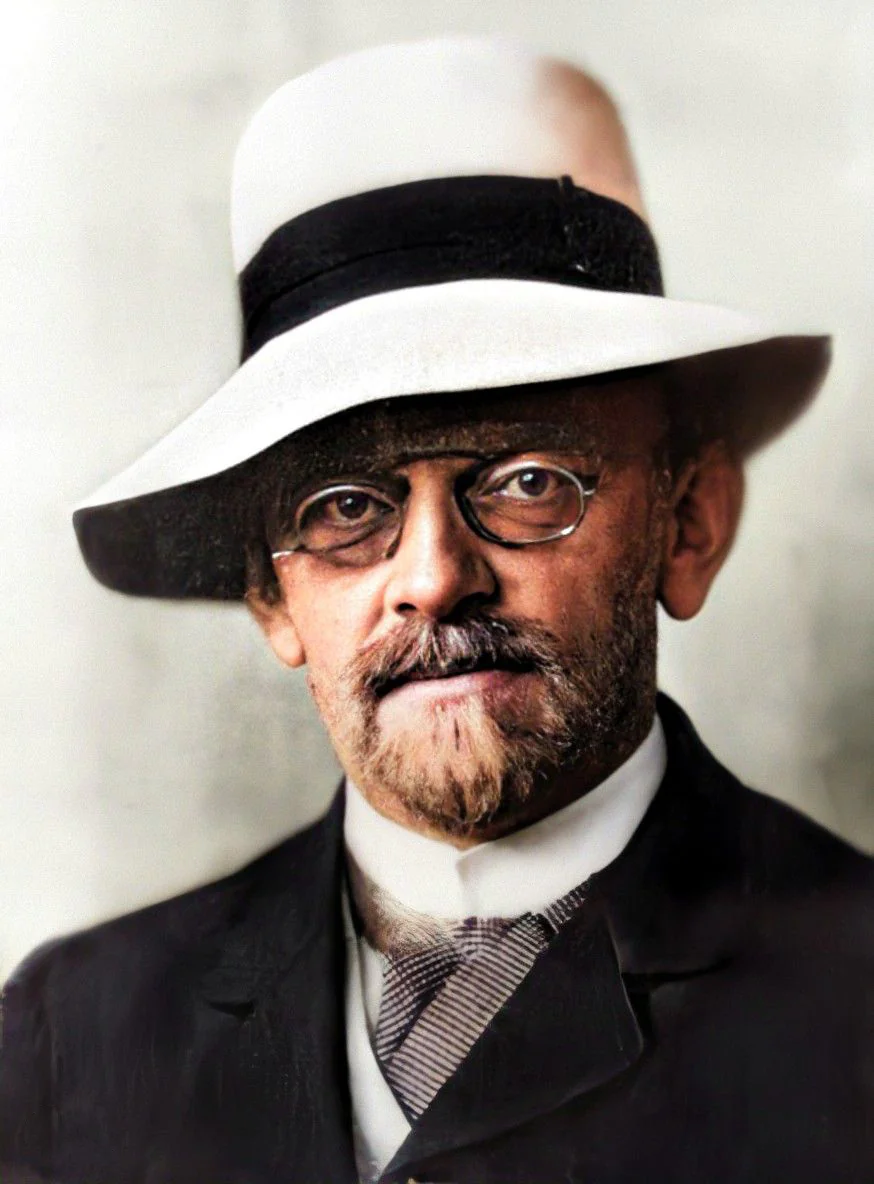
| 16 Quotes | |
| Occup. | Mathematician |
| From | Germany |
| Born | January 23, 1862 Königsberg or Wehlau, Province of Prussia (today Znamensk, Kaliningrad Oblast, Russia) |
| Died | February 14, 1943 Göttingen, Germany |
| Cause | Natural causes |
| Aged | 81 years |
| Cite | |
Citation Formats
APA Style (7th ed.)
David hilbert biography, facts and quotes. (2026, February 11). FixQuotes. https://fixquotes.com/authors/david-hilbert/
Chicago Style
"David Hilbert biography, facts and quotes." FixQuotes. February 11, 2026. https://fixquotes.com/authors/david-hilbert/.
MLA Style (9th ed.)
"David Hilbert biography, facts and quotes." FixQuotes, 11 Feb. 2026, https://fixquotes.com/authors/david-hilbert/. Accessed 2 Apr. 2026.
Early Life and Background
David Hilbert was born on January 23, 1862, in Konigsberg, East Prussia, a port city whose mix of trade, bureaucracy, and scholarship gave talented children a clear ladder into the learned professions. His father worked in the courts; the household valued discipline and civic respectability, but Hilbert's temperament leaned toward quiet intensity rather than public display. Even as a boy he was less drawn to rhetorical brilliance than to the pleasure of tightening an argument until it could not slip.Konigsberg's intellectual atmosphere mattered. The city carried the long shadow of Kant, and its schools cultivated exactness in language and thought. Hilbert grew up as Germany was consolidating into an industrial empire, with universities becoming national instruments of prestige. This was a time when mathematics was expanding from classical calculation into abstract structures, and the young Hilbert - methodical, competitive in private, and unusually fearless about abstraction - sensed that the future belonged to those who could organize whole territories of knowledge, not merely solve isolated puzzles.
Education and Formative Influences
Hilbert studied at the University of Konigsberg, where he formed lifelong ties with Hermann Minkowski and encountered the rigorous style descending from Weierstrass and the emerging structural viewpoint associated with Dedekind and Cantor. His early work in invariant theory brought him into contact with the era's central question: whether algebra could be put on foundations as firm as geometry. The habit he acquired in these years was to distrust ad hoc calculation and instead seek proofs that revealed why a phenomenon had to be true - a preference that later made him both a creator of new fields and an architect of methods.Career, Major Works, and Turning Points
After appointments in Konigsberg, Hilbert moved in 1895 to the University of Gottingen, soon the world's most influential mathematical center. He produced the Basis Theorem (1888) and then reshaped algebraic number theory with his Report on Algebraic Number Fields (1897), a synthesis so clarifying that it became a map for the subject. In 1900, at the Paris International Congress of Mathematicians, he announced his famous list of 23 problems, a programmatic wager that the future of mathematics could be steered by well-chosen questions. His later work ranged widely: axiomatizing geometry in Foundations of Geometry (1899), pioneering integral equations and what came to be called Hilbert space, and in 1915 formulating the variational ideas related to general relativity at nearly the same moment as Einstein. The First World War, the rise of modern physics, and the subsequent Weimar turmoil did not stop him; rather, they sharpened his desire for certainty, culminating in his formalist program and the metamathematical push for consistency proofs. The Nazi seizure of German academic life devastated Gottingen; Jewish colleagues and students were expelled, and Hilbert, aging and increasingly isolated, watched the institution he helped build lose its soul. He died on February 14, 1943, in Gottingen.Philosophy, Style, and Themes
Hilbert's inner drive was not mere ambition but a craving for intelligibility - a belief that mathematical truth should be made public, portable, and teachable. He demanded conceptual economy: the goal was not to dazzle with technique but to expose a skeleton that could carry many bodies. “The art of doing mathematics consists in finding that special case which contains all the germs of generality”. That sentence captures his psychology: he hunted for the lever point where a single, clean example unlocks a whole theory, turning creativity into a disciplined search for the right abstraction.At the same time, Hilbert was fascinated by the infinite and unwilling to surrender it to philosophical doubt. “No one shall expel us from the paradise that Cantor has created for us”. The defiance here is revealing: he treated foundational anxiety as a challenge to be met with sharper axioms and proofs, not a reason to retreat. Yet his defense of infinity went hand in hand with a hard-edged view of formal reasoning, sometimes summarized in his willingness to treat mathematics as a rule-governed manipulation of symbols: “Mathematics is a game played according to certain simple rules with meaningless marks on paper”. For Hilbert, this was less cynicism than strategy - by separating meaning from form, he hoped to secure mathematics against paradox through consistency and clarity, even if later results would expose limits to that dream.
Legacy and Influence
Hilbert's influence is structural: he changed what mathematicians considered a complete explanation, elevated problems into a governing technology of research, and gave entire domains - functional analysis, axiomatic geometry, algebraic number theory, and mathematical physics - their modern vocabulary and standards of rigor. His program for foundations set the agenda that produced both triumphs in proof theory and the shock of Godel's incompleteness theorems, which clarified the boundaries of Hilbert's aspirations while preserving his central insight that mathematics can study its own methods. Even in the shadow of Gottingen's destruction under Nazism, Hilbert's model of a unified, question-driven, axiom-conscious mathematics continued to spread, shaping 20th-century science and the way mathematicians still think about what it means to understand.Our collection contains 16 quotes written by David, under the main topics: Wisdom - Deep - Knowledge - Reason & Logic - Science.
Other people related to David: John von Neumann (Mathematician), Richard Courant (Mathematician)
David Hilbert Famous Works
- 1924 Methoden der mathematischen Physik (Book)
- 1921 Hilbert's Program (Philosophy)
- 1899 Grundlagen der Geometrie (Book)
- 1897 Zahlbericht (Report)
Source / external links