
Ellen Ochoa Biography Quotes 2 Report mistakes
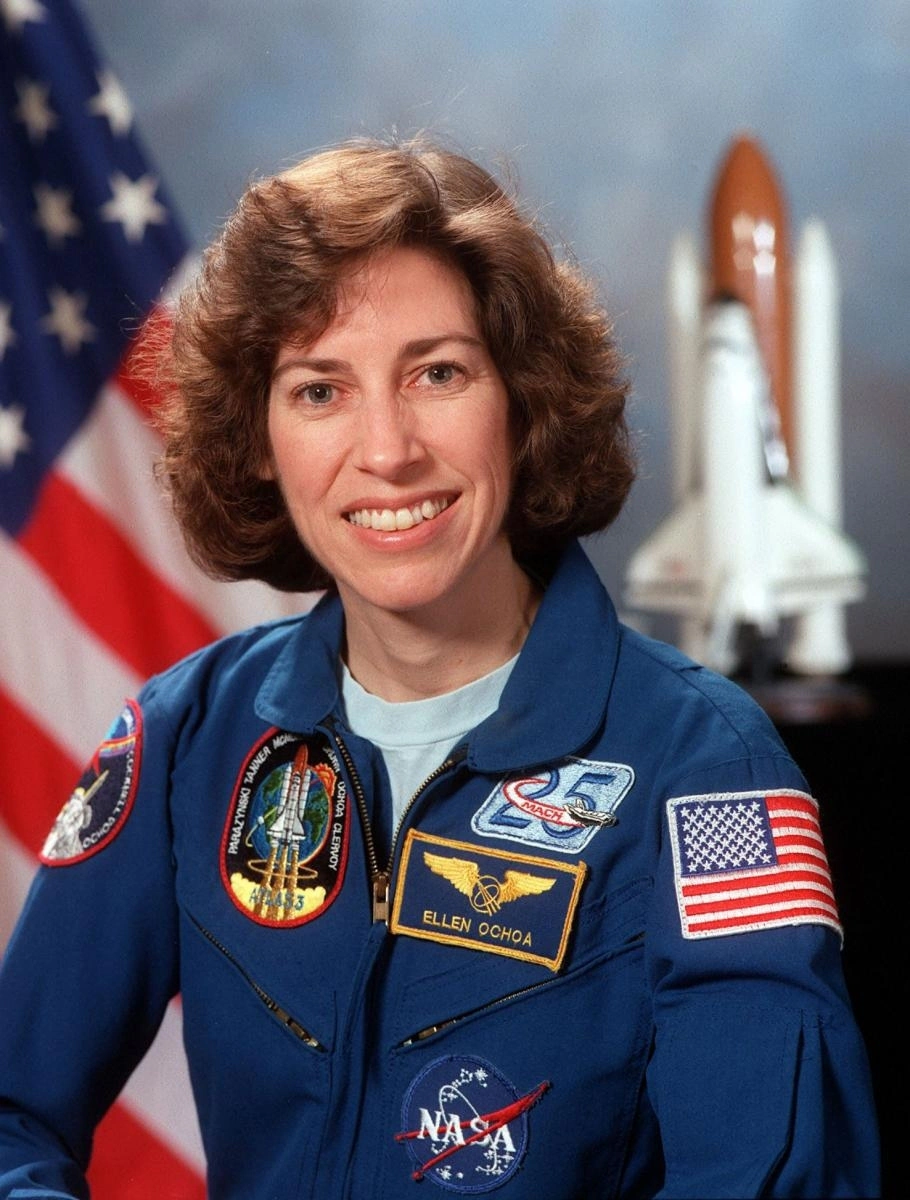
| 2 Quotes | |
| Occup. | Astronaut |
| From | USA |
| Born | May 10, 1958 Los Angeles, California, U.S. |
| Age | 67 years |
| Cite | |
Citation Formats
APA Style (7th ed.)
Ellen ochoa biography, facts and quotes. (2026, February 11). FixQuotes. https://fixquotes.com/authors/ellen-ochoa/
Chicago Style
"Ellen Ochoa biography, facts and quotes." FixQuotes. February 11, 2026. https://fixquotes.com/authors/ellen-ochoa/.
MLA Style (9th ed.)
"Ellen Ochoa biography, facts and quotes." FixQuotes, 11 Feb. 2026, https://fixquotes.com/authors/ellen-ochoa/. Accessed 1 Apr. 2026.
Early Life and Background
Ellen Lauri Ochoa was born on May 10, 1958, in Los Angeles, California, and grew up largely in the nearby city of La Mesa after her parents divorced. In the churn of postwar Southern California - a region shaped by aerospace, defense contracts, and the romance of spaceflight - the idea of engineering was not abstract. It was in the air, in local industries, and in the national imagination that followed Apollo and, later, the early Space Shuttle era.She came of age as a Mexican American girl in a period when the sciences were opening unevenly, often through personal grit more than institutional welcome. The surrounding culture offered mixed signals: the country celebrated astronauts as national icons, yet few looked like her and fewer still came from households without inherited professional networks. That gap between public myth and private access became a quiet driver in her life - a determination to be judged by competence, not novelty, and to turn barriers into problems to be solved.
Education and Formative Influences
Ochoa attended San Diego State University, earning a B.S. in physics in 1980, then moved into electrical engineering at Stanford University, completing an M.S. in 1981 and a Ph.D. in 1985. Stanford placed her at the intersection of rigorous theory and experimental practice, and she gravitated toward optics and signal processing - fields that rewarded patience, precision, and an ability to translate elegant mathematics into devices that worked in the world.Career, Major Works, and Turning Points
After Stanford, Ochoa joined NASA's Ames Research Center in California as a research engineer, building a reputation in optical systems and image-processing technologies, including work that contributed to patents in optical inspection and guidance. Selected as an astronaut candidate in 1990, she entered the astronaut corps as the Shuttle program matured from experimental spectacle to operational infrastructure. In 1993 she became the first Hispanic woman in space on STS-56 aboard Discovery, followed by STS-66 (1994), STS-96 (1999), and STS-110 (2002), amassing nearly 1, 000 hours in orbit and helping deploy and assemble components of the International Space Station during its formative construction phase. Her later pivot from flight to leadership culminated in her appointment as director of Johnson Space Center in 2013, making her the first Hispanic person and second woman to lead NASA's human spaceflight hub, where she guided the center through the post-Shuttle transition, early Commercial Crew development, and renewed emphasis on deep-space exploration.Philosophy, Style, and Themes
Ochoa's inner life reads as the disciplined refusal to let identity become either a limitation or a substitute for excellence. Her public statements consistently redirect attention from biography to behavior, not to erase heritage but to define it through contribution. “What everyone in the astronaut corps shares in common is not gender or ethnic background, but motivation, perseverance, and desire - the desire to participate in a voyage of discovery”. The sentence is revealing not only as an ethic of teamwork, but as self-portrait: she frames belonging as earned through sustained effort, a mindset forged in labs where results are mercilessly measurable and in crews where reliability is a life-support system.Education, in her telling, is less credential than lever - the tool that converts curiosity into authority. “I tell students that the opportunities I had were a result of having a good educational background. Education is what allows you to stand out”. That emphasis reflects an engineer's psychology: progress is built, not wished into being, and the building blocks are skills, mentors, and the habit of preparation. Her style is notably non-theatrical. In an era that often mythologized astronauts as lone heroes, she represented the Shuttle generation's reality - complex missions executed by specialists, where humility and exactness mattered more than bravado.
Legacy and Influence
Ochoa's legacy is twofold: concrete and symbolic. Concretely, she helped carry NASA through the operational middle age of the Shuttle and into the station-building years, then shaped institutional priorities as a center director during a pivotal reorganization of American human spaceflight. Symbolically, her career widened the image of who could occupy the cockpit and the conference room without reducing her to a mascot; she modeled a version of representation grounded in technical depth, calm leadership, and insistence that opportunity becomes durable only when matched by mastery.Our collection contains 2 quotes written by Ellen, under the main topics: Perseverance - Study Motivation.
Source / external links