
Emo Philips Biography Quotes 35 Report mistakes
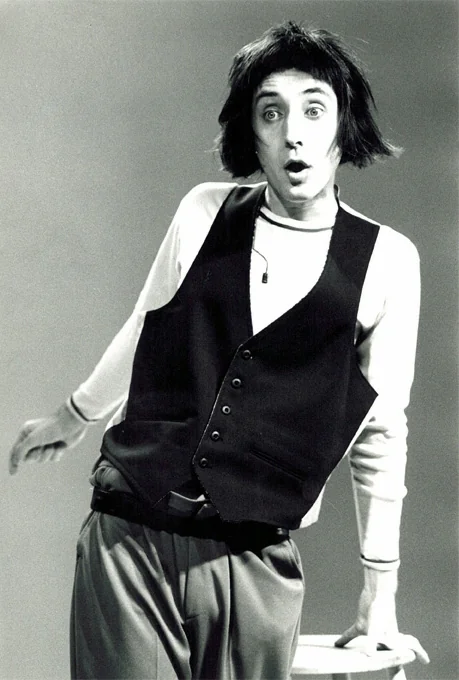
| 35 Quotes | |
| Born as | Philips Soltanoff |
| Occup. | Comedian |
| From | USA |
| Born | February 7, 1956 Chicago, Illinois, U.S. |
| Age | 70 years |
| Cite | |
Citation Formats
APA Style (7th ed.)
Emo philips biography, facts and quotes. (2026, February 2). FixQuotes. https://fixquotes.com/authors/emo-philips/
Chicago Style
"Emo Philips biography, facts and quotes." FixQuotes. February 2, 2026. https://fixquotes.com/authors/emo-philips/.
MLA Style (9th ed.)
"Emo Philips biography, facts and quotes." FixQuotes, 2 Feb. 2026, https://fixquotes.com/authors/emo-philips/. Accessed 7 Mar. 2026.
Early Life and Background
Emo Philips was born Philips Soltanoff on February 7, 1956, in the United States, and grew up in a postwar culture that sold cheerfulness as civic duty while privately fermenting anxieties about politics, sex, faith, and technology. That tension - the bright surface and the unease beneath it - became the basic emotional engine of his comedy. Long before he was widely known, he cultivated an outsider's stance: soft-voiced, carefully enunciated, and angled slightly away from conventional masculinity, he turned his own oddness into a vantage point rather than a wound.His early life is often described through the persona he later perfected: a cherubic, wide-eyed innocence that keeps colliding with adult facts. Yet the innocence is strategic, not naive. It allows him to stage moral puzzles and social hypocrisies without sounding preachy; he can sound like a child asking an honest question while landing a punchline that exposes the audience's complicity. In an era when stand-up was increasingly about swagger, Philips built power from the opposite direction - fragility, precision, and an unnervingly cheerful willingness to say the unsayable.
Education and Formative Influences
Philips attended college (often reported as a liberal-arts environment) during the 1970s, when American comedy was being reshaped by nightclub circuits, late-night television, and the aftershocks of Vietnam and Watergate. The period rewarded sharp personal voices and a distrust of official narratives, and Philips absorbed both: the logical games of wordplay and the cultural critique of satire. He drew on the lineage of deadpan and one-liners while pushing it into a more theatrical, character-based delivery, turning jokes into miniature parables whose premises sound wholesome until they tip into theological, political, or erotic absurdity.Career, Major Works, and Turning Points
Emerging from the comedy-club ecosystem and becoming a familiar presence through television appearances and recorded performances, Philips established himself as one of stand-up's most distinctive stylists: a one-liner comic who nonetheless built a coherent worldview. His work circulated through albums and specials that highlighted the same signature: meticulously constructed sentences, a tone of friendly confession, and a surreal moral geometry where every assumption gets flipped. Beyond stand-up, he became a recognizable character actor and voice performer, including a memorable turn as the fanatical cleric in the film UHF (1989), which amplified his cult status and demonstrated that his persona could function as narrative character, not just stage device.Philosophy, Style, and Themes
Philips' comedy is built on a paradox: he sounds gentle, even bashful, while his mind moves like a trap. The voice suggests vulnerability; the structure is ruthless. He favors jokes that begin as familiar social observations and then veer into a logical corner the listener did not realize existed. That tight construction is not mere cleverness - it is a philosophy of survival. When he says, “Some mornings, it's just not worth chewing through the leather straps”. the laugh comes from the cartoon image, but the psychology underneath is a statement about depression and endurance: the world can feel like bondage, and the only freedom left is the ability to narrate it.A second recurring theme is the clash between modern systems and the human desire to be exceptional. Philips loves making institutions - governments, religions, even machines - look simultaneously terrifying and ridiculous, because that is how they often feel to ordinary people. “A computer once beat me at chess, but it was no match for me at kick boxing”. is a small manifesto: technology may outperform you in the arena it defines, but the person can always change the arena. Likewise, “When I was a kid I used to pray every night for a new bicycle. Then I realised that the Lord doesn't work that way so I stole one and asked Him to forgive me”. compresses his favorite moral kink - faith and ethics as bureaucracies that can be gamed - while revealing a character who wants innocence and advantage at the same time. His persona, perpetually "good", becomes the vehicle for admitting what polite society prefers to deny.
Legacy and Influence
Philips endures as a comedian's comedian: a writer-performer whose cadence, syntax, and persona proved that stand-up could be both meticulously authored and wildly strange without sacrificing accessibility. His influence can be traced in later alt-comedy and in performers who use character voice to smuggle in darker material - turning neurosis, theology, and social critique into compact jokes that reward close listening. More than a collection of one-liners, his body of work models an inner life in which anxiety is transmuted into form: if the world is incoherent, the sentence can still be perfect, and the laugh can still feel like a small, private absolution.Our collection contains 35 quotes written by Emo, under the main topics: Witty One-Liners - Puns & Wordplay - Dark Humor.
Source / external links