
George Lopez Biography Quotes 21 Report mistakes
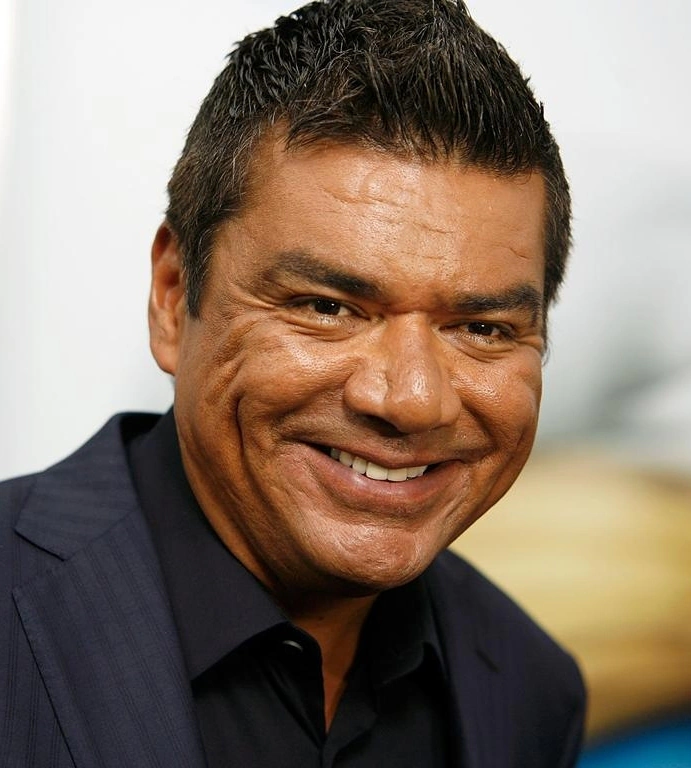
| 21 Quotes | |
| Occup. | Comedian |
| From | USA |
| Born | April 23, 1961 Mission Hills, Los Angeles, California, U.S. |
| Age | 64 years |
| Cite | |
Citation Formats
APA Style (7th ed.)
George lopez biography, facts and quotes. (2026, February 11). FixQuotes. https://fixquotes.com/authors/george-lopez/
Chicago Style
"George Lopez biography, facts and quotes." FixQuotes. February 11, 2026. https://fixquotes.com/authors/george-lopez/.
MLA Style (9th ed.)
"George Lopez biography, facts and quotes." FixQuotes, 11 Feb. 2026, https://fixquotes.com/authors/george-lopez/. Accessed 26 Mar. 2026.
Early Life and Background
George Edward Lopez was born on April 23, 1961, in Mission Hills, a working-class neighborhood in the San Fernando Valley of Los Angeles. His earliest sense of the world was shaped by absence and improvisation: his father, a migrant worker, left when George was still a baby, and his mother, pushed by economic strain and limited options, soon disappeared from his daily life as well. That double abandonment became the emotional motor of his later comedy - not as confession for its own sake, but as a disciplined way to convert humiliation into timing and grief into a story you could survive by retelling.He was raised primarily by his maternal grandmother, Benita Gutierrez, whose house provided routine, food, and the hard clarity of expectations. Lopez has often described that home as loving but strict, and the dynamic fostered his lifelong sensitivity to class signals - the clothes you wore, the way you spoke, and the unspoken rules of who gets heard. Growing up Mexican American in a city that sold dreams while rationing access to them, he learned early to read rooms for danger and opportunity, a skill that later became a comedian's radar for tension and release.
Education and Formative Influences
Lopez attended local Los Angeles area schools and came of age during the 1970s, when the aftershocks of the Chicano Movement met the realities of recession, policing, and limited representation on mainstream television. Comedy offered both an escape hatch and a form of cultural counter-reporting, and he gravitated to voices that proved race and pain could be made legible to mass audiences without being softened into politeness. Richard Pryor in particular modeled a kind of radical honesty - the idea that vulnerability could be a weapon if it was shaped with craft - and Lopez developed the habit of writing relentlessly, studying recordings, and treating stand-up less as inspiration than as a job.Career, Major Works, and Turning Points
Lopez began performing stand-up in the late 1970s and built his reputation through clubs and television appearances, eventually becoming one of the most visible Latino comedians in the United States. His major mainstream breakthrough came with the ABC sitcom "George Lopez" (2002-2007), which he co-created and starred in, centering a Latino working family with a specificity rarely granted network airtime. The show and his stand-up specials broadened his reach, while later projects such as "Lopez Tonight" (2009-2011) and "Lopez" (2016-2017) reflected both the appetite for his voice and the industry's shifting economics from broadcast to cable and streaming. Parallel to entertainment, he became publicly associated with health advocacy after a kidney transplant in 2005, an episode that reframed his public persona around gratitude, responsibility, and the complicated bonds of family.Philosophy, Style, and Themes
Lopez's comedy is built on a tight braid of autobiography, social observation, and the ritualized teasing of family life. He returns obsessively to what it meant to be raised by a grandmother, to grow up without parents who stayed, and to learn masculinity under pressure - themes that can easily turn sentimental, but in his hands become percussive, joke-dense narratives. His stage persona often performs toughness while disclosing tenderness, and that tension is the point: laughter becomes a socially acceptable form of crying in public. Even his recollections of beginnings emphasize compulsion rather than glamour - “It was June 4, 1979, the first time I went on stage. I didn't know I could do it but I knew I couldn't not do it. I quit everything in my life and this was the one thing I couldn't quit”. The psychology is clear: stand-up is not merely a career choice but a structure he built to keep chaos from returning.His style is confrontational without being purely cynical. He uses ethnic and generational stereotypes as recognizable stage furniture, then rearranges them to expose power: who gets mocked, who gets to mock, and what that reveals about belonging. He can turn the American ideal of unity into a barbed diagnosis - “It's a great day in America when white people, black people and Latinos can all come together and pick on another minority”. Yet he is not trapped in old binaries; he speaks to a country where identities overlap and categories blur, insisting on the complexity of modern community: “It's not even about black and white anymore, because so many people are from mixed backgrounds and mixed ethnicities, and it's just a great time to be able to pull all that together”. Taken together, these lines show an artist who uses jokes to negotiate shame into solidarity, and anger into a kind of citizenship.
Legacy and Influence
Lopez helped normalize Latino family life as a central American story rather than a side plot, and his success on network television proved that Spanish-surnamed leads could carry broad audiences without surrendering cultural specificity. He opened doors for later Latino comics and actors by demonstrating the commercial viability of narratives rooted in immigrant households, working-class struggle, and bilingual sensibilities, while also modeling the risks of representation - the pressure to stand in for millions and to translate pain into palatable entertainment. His enduring influence lies in that translation: he made abandonment, class anxiety, and racial contradiction speakable in living rooms and theaters, and in doing so helped expand who gets to be the default voice of American comedy.Our collection contains 21 quotes written by George, under the main topics: Witty One-Liners - Motivational - Never Give Up - Love - Sarcastic.
Source / external links