
George Meredith Biography Quotes 22 Report mistakes
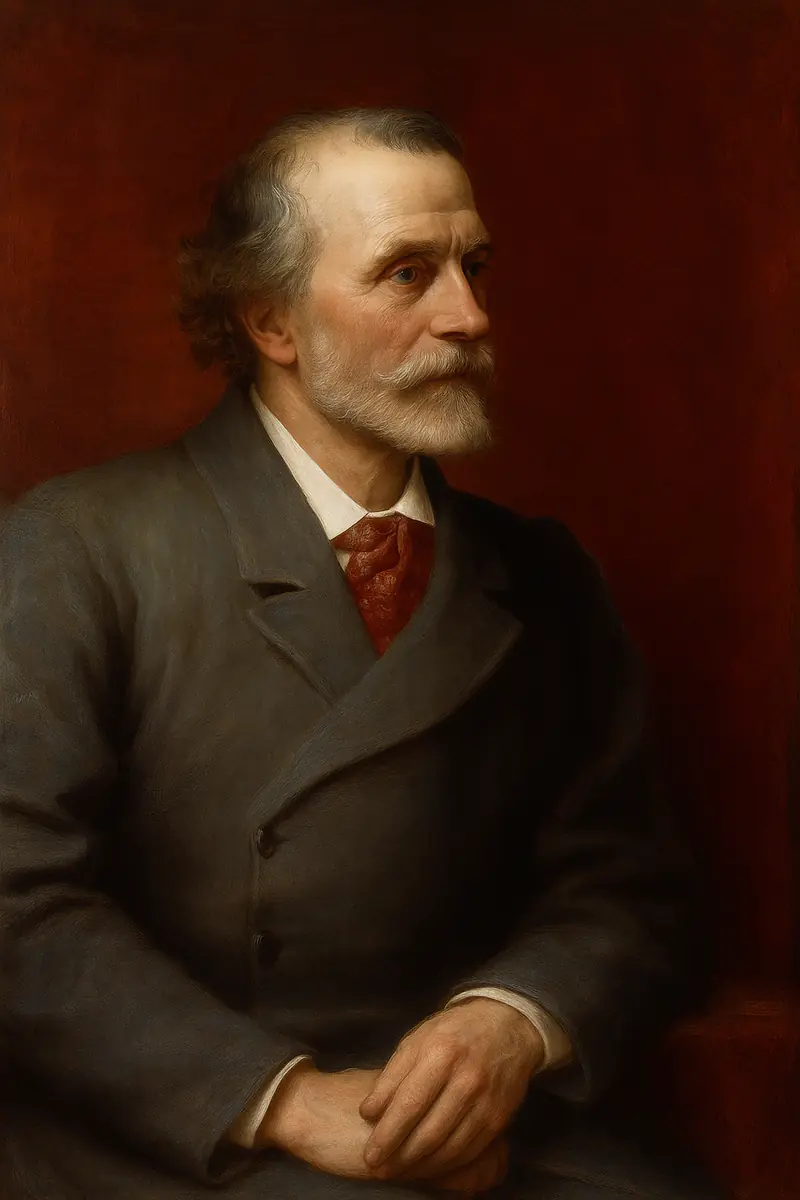
Attr: George Frederic Watts
| 22 Quotes | |
| Occup. | Novelist |
| From | England |
| Spouses | Mary Ellen Peacock (1849–1861) Marie Vulliamy (1864–1886) |
| Born | February 12, 1828 Portsmouth, England |
| Died | May 18, 1909 Box Hill, Surrey, England |
| Aged | 81 years |
George Meredith was born on February 12, 1828, at Portsmouth, Hampshire, into a world shaped by naval England, expanding print culture, and the aftershocks of Romanticism. His father, Augustus Meredith, was a tailor and outfitter to the armed services, and the family stood close enough to respectability to value education, yet near enough to precarity to feel the pressure of earning. The tensions between aspiration and constraint - social, financial, and emotional - would later harden into Meredith's trademark comedy: not lightness, but an intelligence that insists on consequences.
His early life carried a quiet fracture. His mother died when he was very young, and his father later remarried. The loss and rearrangement of intimacy gave him, even before authorship, a habit of watching how people rationalize desire and how families re-script loyalty. Meredith's fiction would return obsessively to the distance between what characters say in public and what they mean in private, as if he had learned early that the deepest facts are rarely spoken directly.
Education and Formative Influences
Meredith was educated at the Moravian School in Neuwied on the Rhine in Germany, an experience that broadened his sense of European culture and sharpened his ear for psychological nuance. Back in England he was briefly articled to a solicitor, but his ambitions pulled toward letters, and by his early twenties he had entered literary London. The encounter with German discipline, English legalism, and metropolitan journalism helped form the dual engine of his work: philosophical abstraction paired with a forensic interest in motive.
Career, Major Works, and Turning Points
In 1849 he married Mary Ellen Peacock, daughter of the satirist Thomas Love Peacock; the marriage deteriorated painfully and her long separation from him became one of the defining wounds of his inner life. Meredith published Poems (1851) and his first novel, The Shaving of Shagpat (1856), but his reputation grew slowly, shadowed by what many readers found a difficult, compressed style. He supported himself through editing and as a reader for Chapman and Hall, while producing the novels on which his standing rests: The Ordeal of Richard Feverel (1859), Evan Harrington (1861), Rhoda Fleming (1865), Vittoria (1867), The Adventures of Harry Richmond (1871), Beauchamp's Career (1875), The Egoist (1879), and Diana of the Crossways (1885). After his second marriage, in 1864, to Marie Vulliamy, he settled at Box Hill in Surrey; there he lived through bereavement again when she died in 1885, and he became a revered elder of letters, appointed to the Order of Merit in 1905, before his death on May 18, 1909.
Philosophy, Style, and Themes
Meredith called his method "the Comic Spirit": comedy as moral perception, a secular conscience that catches self-deception in the act. His sentences can feel like tightened wire - elliptical, allusive, demanding - because he wanted reading to mimic thinking, with its jumps, hesitations, and sudden cruel clarities. He distrusted easy pessimism, treating cynicism as a pose rather than a verdict on life: "Cynicism is intellectual dandyism". That line is less epigram than self-diagnosis; Meredith knew how tempting it is, after disappointment, to turn style into armor.
Across his major novels, love is never merely romance - it is a laboratory for power, pride, and social performance. The Egoist anatomizes male self-regard with surgical patience, while Diana of the Crossways turns a politically alert heroine into a study of how public talk can punish private feeling. Meredith's hunger was for ethical realism without nihilism, and he repeatedly asked what anyone can know for certain amid modern complexity: "Ah, what a dusty answer gets the soul when hot for certainties in this our life!" Yet he insisted that pain could be transmuted into insight rather than merely endured: "There is nothing the body suffers the soul may not profit by". In that tension - skepticism toward certainty, insistence on moral growth - lies the psychological pulse of his work.
Legacy and Influence
Meredith never became a mass novelist in the Victorian manner; his difficulty was part of his integrity, and his influence moved through writers who valued intelligence over immediacy. He helped set the stage for modern psychological fiction, influencing figures such as Thomas Hardy and later modernists who prized interior scrutiny and tonal irony. His best books remain a training in moral attention - how ego manufactures narratives, how society edits feeling, how comedy can be a stern kind of love - and his life, marked by private loss and public late recognition, mirrors his central claim that character is made not by certainty, but by the disciplined work of seeing.
Our collection contains 22 quotes who is written by George, under the main topics: Witty One-Liners - Motivational - Wisdom - Truth - Love.
Frequently Asked Questions
- George Meredith novels: The Ordeal of Richard Feverel; Evan Harrington; Beauchamp's Career; The Egoist; Diana of the Crossways; The Amazing Marriage.
- George Meredith pronunciation: George Meredith: JORJ MERR-ih-dith (IPA: /dʒɔːrdʒ ˈmɛrɪdɪθ/).
- George Meredith poems: Modern Love (1862), Poems and Lyrics of the Joy of Earth (1883), Ballads and Poems of Tragic Life (1887), A Reading of Earth (1888).
- George Meredith Osho: Osho occasionally quoted or mentioned Meredith, especially lines from his poetry (often from Modern Love), in talks on love, mind, and relationships.
- The Egoist George Meredith: A 1879 novel by George Meredith satirizing self-absorbed Sir Willoughby Patterne and his courtship, with sharp psychological and social insight.
- George Meredith famous works: The Egoist (1879), Diana of the Crossways (1885), The Ordeal of Richard Feverel (1859), The Shaving of Shagpat (1856), Modern Love (1862).
- How old was George Meredith? He became 81 years old
George Meredith Famous Works
- 1895 The Amazing Marriage (Novel)
- 1891 One of Our Conquerors (Novel)
- 1885 Diana of the Crossways (Novel)
- 1879 The Egoist (Novel)
- 1875 Beauchamp's Career (Novel)
- 1871 The Adventures of Harry Richmond (Novel)
- 1865 Rhoda Fleming (Novel)
- 1862 Modern Love (Poetry)
- 1861 Evan Harrington (Novel)
- 1859 The Ordeal of Richard Feverel (Novel)
- 1856 The Shaving of Shagpat (Novel)
Source / external links