
Groucho Marx Biography Quotes 61 Report mistakes
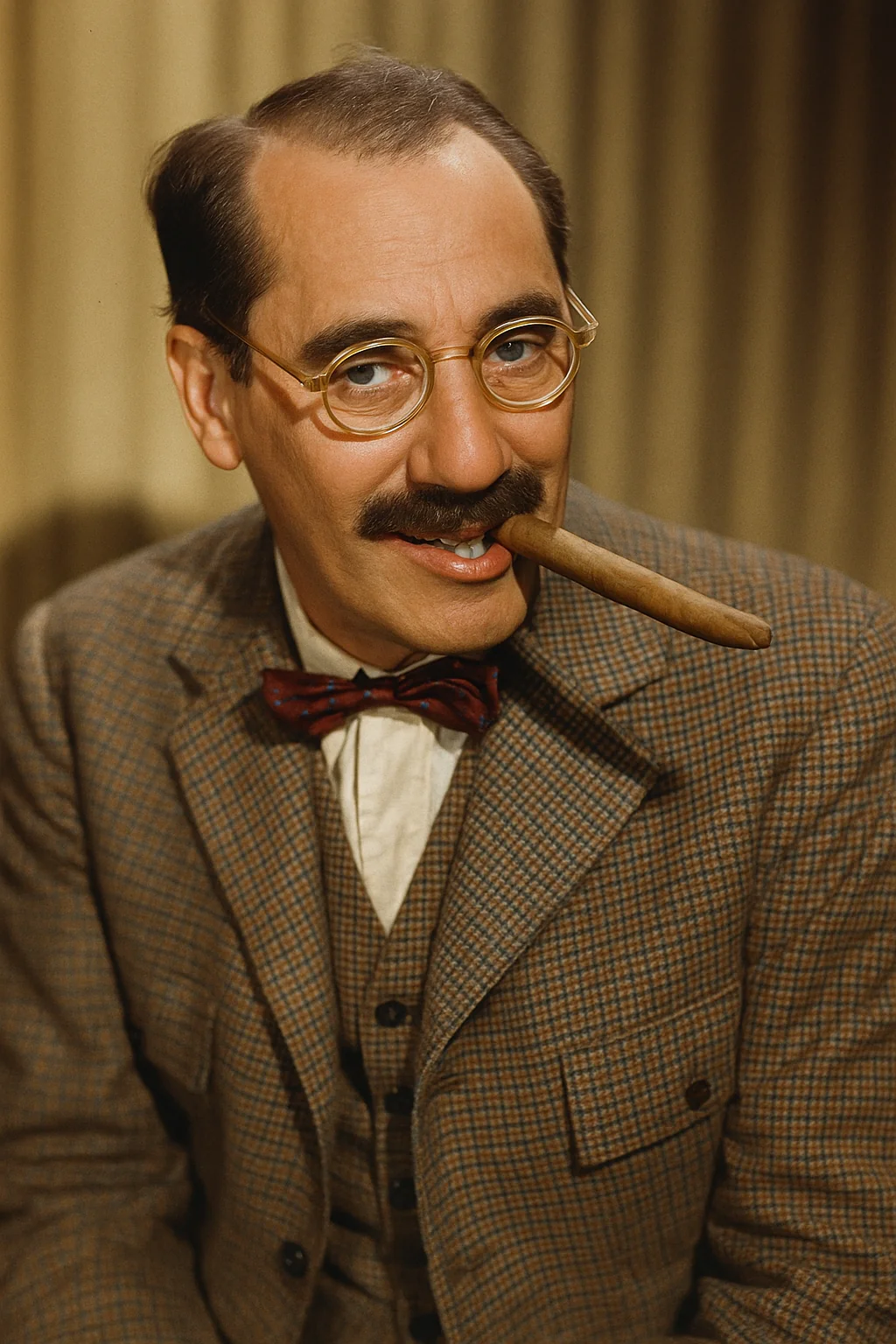
| 61 Quotes | |
| Occup. | Comedian |
| From | USA |
| Spouses | Ruth Johnson (1920-1942) Kay Marvis Gorcey (1945-1951) Eden Hartford (1954-1969) |
| Born | October 2, 1890 New York City, USA |
| Died | August 19, 1977 Los Angeles, California, USA |
| Cause | Pneumonia |
| Aged | 86 years |
| Cite | |
Citation Formats
APA Style (7th ed.)
Groucho marx biography, facts and quotes. (2026, February 1). FixQuotes. https://fixquotes.com/authors/groucho-marx/
Chicago Style
"Groucho Marx biography, facts and quotes." FixQuotes. February 1, 2026. https://fixquotes.com/authors/groucho-marx/.
MLA Style (9th ed.)
"Groucho Marx biography, facts and quotes." FixQuotes, 1 Feb. 2026, https://fixquotes.com/authors/groucho-marx/. Accessed 25 Mar. 2026.
Early Life and Background
Julius Henry Marx was born on October 2, 1890, on Manhattan's Upper East Side, New York City, into a German-Jewish immigrant family whose precarious finances and crowded tenements sharpened his appetite for speed, wit, and escape. His father, Simon "Frenchie" Marx, drifted between jobs as a tailor and cutter; his mother, Minnie Schoenberg Marx, was the family engine - ambitious, theatrical, and determined to push her boys onstage. In a city roiling with new arrivals, vaudeville posters, Yiddish theaters, and streetwise banter, young Julius absorbed a survivalist humor that treated dignity as negotiable and language as a weapon.He grew up amid a noisy sibling constellation - Leonard (Chico), Adolph/Arthur (Harpo), Milton (Gummo), and Herbert (Zeppo) - where rivalry doubled as rehearsal. The family nickname "Groucho" arrived later, but the personality was already present: a child who learned that the quickest way to control a room was to disrupt it. New York at the turn of the century offered little cushion for the poor, and the Marx household converted instability into performance - a constant improvisation that would become Julius's lifelong method.
Education and Formative Influences
Groucho left formal schooling young, working odd jobs before being pulled fully into show business; his education became the stage and the city. Early tours in juvenile singing acts and then in the brothers' developing vaudeville routines taught him timing, the discipline of repetition, and the value of a persona that could outtalk any setback. The era's popular entertainments - minstrel leftovers, musical comedy, insult humor, and the rapid-fire patter of urban immigrant neighborhoods - fused into the verbal style he refined: fast, argumentative, skeptical of authority, and always alert to the crowd's shifting temperature.Career, Major Works, and Turning Points
By the 1910s the Marx Brothers were a formidable vaudeville draw, and in the 1920s they conquered Broadway with "I'll Say She Is" (1924) and especially "The Cocoanuts" (1925) and "Animal Crackers" (1928), where Groucho's greasepaint mustache, cigar, and arched eyebrows crystallized into a modern comic mask. Hollywood widened their reach: "The Cocoanuts" (1929) and "Animal Crackers" (1930) captured the stage anarchy on film; "Monkey Business" (1931) and "Horse Feathers" (1932) weaponized campus and class satire; and "Duck Soup" (1933) delivered political farce so sharp it initially confounded box office expectations during the Depression. After the brothers' style shifted at MGM in "A Night at the Opera" (1935) and "A Day at the Races" (1937) toward more structured plots, Groucho's individual career expanded through radio and then television: "You Bet Your Life" (radio 1947-1960; TV 1950-1961) turned his mock-authoritarian interviewing into a weekly demonstration of how a single ad-libbed question could topple social pretenses. Late-life memoirs and correspondence, including "Groucho and Me" (1959), kept his voice in print even as age, illness, and personal losses tightened his circle, ending with his death in Los Angeles on August 19, 1977.Philosophy, Style, and Themes
Groucho's comedy is often described as nonsense, but its engine is psychological: a refusal to be pinned down. He cultivated the posture of the unreliable narrator, the man who will contradict himself to stay free, turning inconsistency into a kind of sovereignty. “Those are my principles, and if you don't like them... well, I have others”. The line is funny because it is brazen, but it also reveals a deeper tactic: he treats fixed identity as a trap laid by institutions - employers, critics, polite society - and slips the snare through sheer verbal velocity.His cynicism about status was never merely social climbing in reverse; it was a defense against rejection, a way to control the terms of belonging. “I refuse to join any club that would have me as a member”. Behind the paradox sits a man shaped by insecurity and show-business precarity, suspicious of praise because praise can be withdrawn. Even his playful approach to mortality reads like an athlete's bluff against decline: “I intend to live forever, or die trying”. In films and on "You Bet Your Life", he used insult, flirtation, and mock logic to puncture pomposity - politicians in "Duck Soup", professors in "Horse Feathers", high society in "Animal Crackers" - but the target was always the same: any system demanding reverence rather than laughter.
Legacy and Influence
Groucho Marx helped define 20th-century American comedy as an art of interruption - the punchline as sabotage, the wisecrack as social critique. His persona influenced generations of stand-ups and satirists, from late-night hosts to political comedians who learned that authority can be undone by a single well-aimed question. The Marx Brothers' best films remain a template for anarchic ensemble comedy, while "You Bet Your Life" anticipated the modern talk-show cadence: conversational, combative, and built on the thrill of spontaneity. More than a collection of jokes, Groucho left a method - language used at high speed to turn anxiety into control, and control into laughter - that still shapes how America laughs at power, class, and itself.Our collection contains 61 quotes written by Groucho, under the main topics: Witty One-Liners - Meaning of Life - Live in the Moment - Divorce.
Other people related to Groucho: Woody Allen (Director), Elaine Dundy (Novelist), William Peter Blatty (Writer)
Frequently Asked Questions
- Groucho Marx songs: Hooray for Captain Spaulding; Lydia the Tattooed Lady; Hello, I Must Be Going; Whatever It Is, I’m Against It
- Groucho Marx spouse: Ruth Johnson, Kay Marvis, Eden Hartford
- Groucho Marx without makeup: Without the greasepaint, he looked fairly ordinary, often with a real mustache later
- Groucho Marx glasses: Round horn-rims; inspired the novelty “Groucho glasses” with brows and mustache
- Groucho Marx Brothers: Chico, Harpo, Zeppo, and Gummo
- Groucho Marx cause of death: Pneumonia
- How old was Groucho Marx? He became 86 years old
Source / external links