
H. L. Mencken Biography Quotes 124 Report mistakes
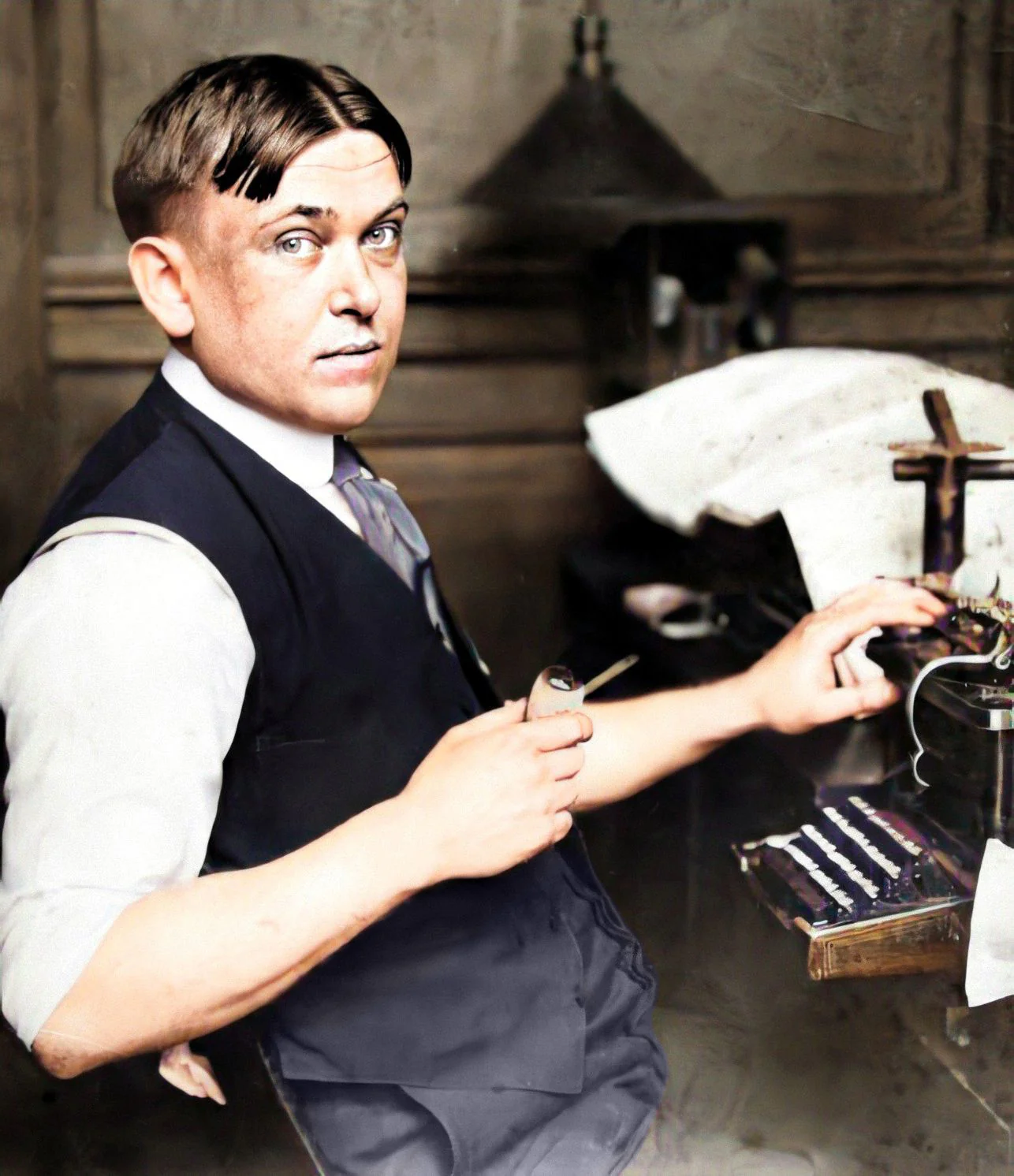
| 124 Quotes | |
| Born as | Henry Louis Mencken |
| Occup. | Writer |
| From | USA |
| Born | September 12, 1880 Baltimore, Maryland, USA |
| Died | January 29, 1956 Baltimore, Maryland, USA |
| Cause | Stroke |
| Aged | 75 years |
| Cite | |
Citation Formats
APA Style (7th ed.)
H. l. mencken biography, facts and quotes. (2026, February 1). FixQuotes. https://fixquotes.com/authors/h-l-mencken/
Chicago Style
"H. L. Mencken biography, facts and quotes." FixQuotes. February 1, 2026. https://fixquotes.com/authors/h-l-mencken/.
MLA Style (9th ed.)
"H. L. Mencken biography, facts and quotes." FixQuotes, 1 Feb. 2026, https://fixquotes.com/authors/h-l-mencken/. Accessed 25 Mar. 2026.
Early Life and Background
Henry Louis Mencken was born on September 12, 1880, in Baltimore, Maryland, a port city that mixed old Federal pieties with the brash confidence of industrial America. His parents were German-American - his father, August Mencken, ran a cigar factory and expected practicality from his son; his mother, Anna (Abhau) Mencken, presided over a household where respectability mattered. The family lived on Hollins Street, close enough to commerce and politics for a keen-eyed boy to watch how slogans, money, and moral talk braided together.Baltimore never left him. Its dialects, parochial feuds, and boosterish hypocrisy became his laboratory, and the self-reliant city life of the Gilded Age made him suspicious of uplifters who claimed to improve mankind. Even as a youth he read omnivorously, nursed a taste for provocation, and cultivated the posture that would later harden into a worldview: that cant, not tragedy, was the great American affliction.
Education and Formative Influences
Mencken attended Baltimore public schools and then the Baltimore Polytechnic Institute, intending to follow the respectable path toward engineering until his father died in 1899 and family finances drew him back toward work. He became a reporter at the Baltimore Morning Herald and soon the Baltimore Sun, teaching himself style in the newsroom and sharpening his ear for what Americans said versus what they meant. In private he devoured Nietzsche, Darwin, Huxley, and the European realists, absorbing a hard-edged skepticism and a delight in iconoclasm that made the progressive era's moral certainties look, to him, like updated forms of the old Puritan lash.Career, Major Works, and Turning Points
By the 1910s Mencken had become a national voice: critic, polemicist, and stylist with a gift for turning indignation into music. His early books included The Philosophy of Friedrich Nietzsche (1908) and a run of literary criticism that culminated in The American Language (1919), a landmark study that treated American English not as a fallen version of British speech but as a living engine of invention. With George Jean Nathan he co-founded The Smart Set and later The American Mercury (1924), magazines that promoted writers such as Theodore Dreiser, Sinclair Lewis, and Eugene O'Neill while waging war on censorship, boosterism, and what he called the "booboisie". A defining public moment came in 1925 when he covered the Scopes "Monkey Trial" in Dayton, Tennessee, portraying it as a clash between modern inquiry and rural fundamentalism - a spectacle that made him famous and, in parts of the country, notorious. In later years he published memoiristic volumes and, after a disabling stroke in 1948 limited his speech and writing, receded into private life; he died in Baltimore on January 29, 1956.Philosophy, Style, and Themes
Mencken's inner life was built around a journalist's appetite for fact and a satirist's rage at pretense. He distrusted mass movements not because he romanticized elites in any simple way, but because he saw how crowds convert fear into righteousness. That suspicion crystallized in his scalding summaries of popular government: “Democracy is a pathetic belief in the collective wisdom of individual ignorance”. The line is not merely contempt; it is a psychological confession that he feared the tyranny of the well-intentioned, the way moral passion can become permission to persecute. His attention returned again and again to the machinery of belief - churches, reform leagues, patriotic clubs - and to the pleasures such machinery forbids.His prose style married precision to insult, with a showman's timing that made argument feel like theater. He wrote as if clarity were a moral duty and sentimentality a form of fraud, a stance that shaped his attacks on American prudery: “Puritanism. The haunting fear that someone, somewhere, may be happy”. Beneath the laughter sits a consistent theme: that many public crusades are private anxieties in uniform. Even his skepticism toward policy "solutions" was psychological as much as political - an impatience with tidy narratives and a reporter's memory of unintended consequences: “For every complex problem there is an answer that is clear, simple, and wrong”. Mencken's work returns to the same antagonists - credulity, censorship, tribal piety - and to the same ideal, a fiercely defended intellectual freedom for the individual.
Legacy and Influence
Mencken helped define the voice of modern American cultural criticism: skeptical, vernacular, impatient with euphemism, and alert to the link between language and power. The American Language remains foundational for historians of speech and identity, while his essays and reportage set a template for later polemicists, from newspaper columnists to magazine essayists who treat politics as a study in character. His influence is also a caution: his scorn could flatten complexities, and his blind spots - including periodic prejudices common to his era - complicate any heroic portrait. Yet the enduring Mencken is the craftsman who made American prose sharper and the diagnostician who insisted that behind many public virtues stand private fears, and that the critic's job is to name them plainly.Our collection contains 124 quotes written by L. Mencken, under the main topics: Witty One-Liners - Ethics & Morality - Truth - Wisdom - Dark Humor.
Other people related to L. Mencken: P. J. O'Rourke (Journalist), Albert J. Nock (Philosopher), Paul Elmer More (Critic), James Branch Cabell (Novelist), Van Wyck Brooks (Critic)
Frequently Asked Questions
- h.l. mencken funny quotes: "A cynic is a man who, when he smells flowers, looks around for a coffin."
- h.l. mencken quotes on elections: "Every election is a sort of advance auction sale of stolen goods."
- h.l. mencken last words: H.L. Mencken's last words were reportedly about his disbelief in the afterlife, though the exact phrasing is uncertain.
- H.L. Mencken political views: Mencken held libertarian views, was critical of democracy and government, and often expressed skepticism about the ability of the masses to govern effectively.
- h.l. mencken quotes democracy: "Democracy is the theory that the common people know what they want, and deserve to get it good and hard."
- what is h.l. mencken most famous for: H.L. Mencken is most famous for his satirical writings and as a journalist known for his critiques on American culture and politics.
- How old was H. L. Mencken? He became 75 years old
H. L. Mencken Famous Works
- 1926 Notes on Democracy (Book)
- 1920 Prejudices: Second Series (Book)
- 1919 Prejudices: First Series (Book)
- 1919 The American Language (Book)
- 1918 In Defense of Women (Book)
- 1917 A Book of Prefaces (Book)
Source / external links