
Hubert H. Humphrey Biography Quotes 40 Report mistakes
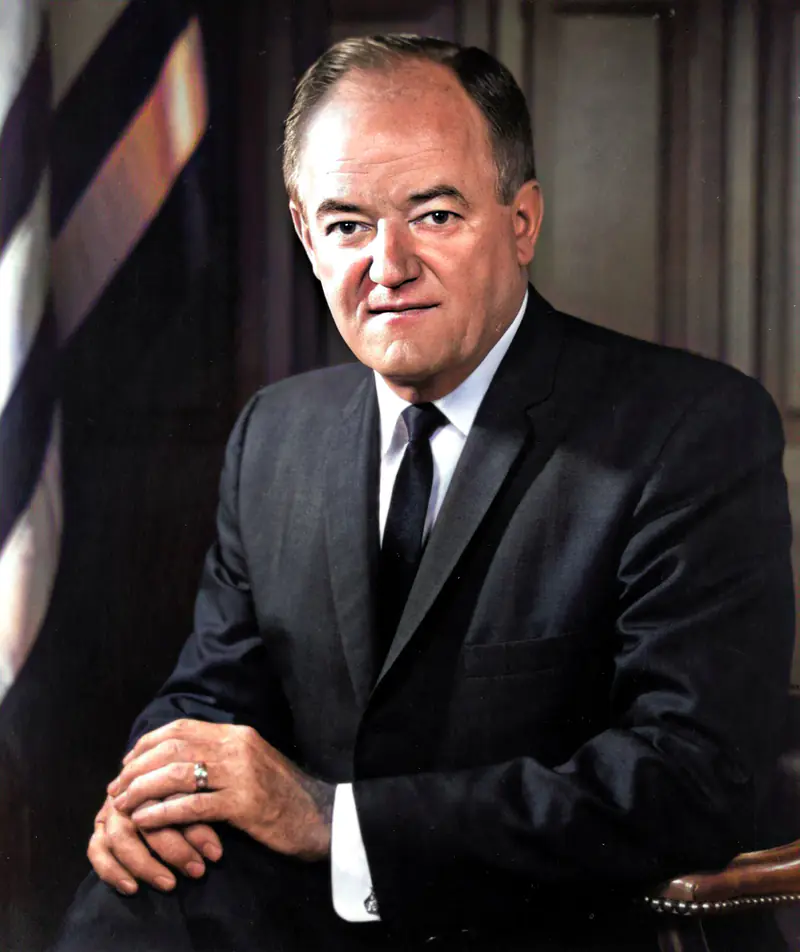
| 40 Quotes | |
| Born as | Hubert Horatio Humphrey Jr. |
| Occup. | Politician |
| From | USA |
| Born | May 27, 1911 Wallace, South Dakota |
| Died | January 13, 1978 |
| Aged | 66 years |
Hubert Horatio Humphrey Jr. was born on May 27, 1911, in Wallace, South Dakota, and grew up on the northern plains during years marked by economic hardship and community resilience. His family moved within South Dakota for business opportunities, and the rhythms of small-town life, including work in a family drugstore, shaped his early understanding of service and civic responsibility. He studied at the University of Minnesota, earning his degree before pursuing graduate work in political science at Louisiana State University. The combination of prairie upbringing, academic training, and the lessons of the Great Depression grounded his belief that government could and should address social and economic inequities.
Rise in Minnesota Politics
Returning to Minnesota, Humphrey became a dynamic organizer and an energetic advocate for liberal reform. In the mid-1940s he helped forge a durable political coalition by bringing together urban labor, farmers, and progressive reformers, a development that became institutionalized in the state's Democratic-Farmer-Labor (DFL) Party. He built a network of allies that would include figures such as Orville Freeman and a young Walter Mondale. Elected mayor of Minneapolis in 1945, he confronted crime, corruption, and discrimination, seeking to modernize city governance and expand opportunity. His insistence on civil rights as both a moral imperative and a practical necessity brought him national attention. At the 1948 Democratic National Convention, he delivered a landmark speech urging the party to leave the shadow of states' rights for the bright sunshine of human rights, aligning himself with President Harry S. Truman's push for a stronger civil rights plank and setting a course for the national party's future.
United States Senate
Humphrey entered the U.S. Senate in 1949 and soon became one of its most tireless and visible liberals. Early friction with senior members gave way to respect as he mastered procedure and legislative strategy. He worked closely with colleagues such as Mike Mansfield and later earned the post of party whip. Within the Senate he pressed for civil rights, labor protections, arms control, and public health initiatives. He was an early and persistent advocate for nuclear test ban efforts, supporting the Limited Test Ban Treaty during the administration of John F. Kennedy and working well with figures on the Foreign Relations Committee. As the civil rights movement accelerated, he collaborated with allies in both chambers to advance key legislation, building bridges to the Johnson administration while engaging civil rights leaders, including Martin Luther King Jr., in the push for federal action. His combination of idealism and procedural savvy became a hallmark of his approach.
Vice Presidency and the Great Society
Chosen by Lyndon B. Johnson as vice president in 1964, Humphrey became a principal advocate for the Great Society. He campaigned vigorously for Medicare, Medicaid, federal aid to education, and the Voting Rights Act of 1965. Within the administration he was a relentless salesman for domestic policy, traveling, speaking, and shepherding priorities on Capitol Hill. Yet the deepening war in Vietnam put him in an excruciating position. Loyal to Johnson and skeptical of a public break with the president, he largely supported administration policy in public even as private doubts grew. This tension shadowed his profile with antiwar Democrats, including Senator Eugene McCarthy, whose challenge in 1968 revealed the party's rupture.
The 1968 Campaign
After Johnson announced he would not seek re-election and following the assassination of Robert F. Kennedy, Humphrey entered a Democratic race already seared by grief and division. He secured the nomination at the tumultuous Chicago convention, where protests and clashes with police under Mayor Richard J. Daley symbolized the fracture between party leaders and a generation demanding change. Humphrey chose Edmund Muskie as his running mate and faced Richard Nixon and third-party candidate George Wallace in the general election. His late-campaign attempt to distance himself from the administration's Vietnam policies narrowed the gap, but he lost the election by a small margin. The experience underscored how war and social upheaval had transformed American politics and the Democratic coalition he had spent decades building.
Return to the Senate
Humphrey returned to the Senate in 1971 and quickly reasserted himself as a legislative force. He concentrated on employment, health, and social policy, promoting a vision of full employment and stable prices that culminated in the Humphrey-Hawkins Act, developed with Representative Augustus Hawkins. Though enacted after his death and adjusted in scope, the law affirmed the principle that the federal government bears responsibility for pursuing jobs and economic stability. Humphrey also mentored a new generation of Democrats, maintaining close ties with allies such as Walter Mondale and working cooperatively with the party's leadership and the administration of President Jimmy Carter on economic and human services legislation.
Final Years and Legacy
Humphrey faced cancer late in life with the same public optimism that had long defined him. He died on January 13, 1978, and was honored in Washington and Minnesota, with tributes from friends and colleagues across the political spectrum, including President Carter and Vice President Mondale. His widow, Muriel Humphrey, was appointed to complete the remainder of his Senate term, a reflection of both his enduring influence and their shared commitment to public service.
Known as the Happy Warrior, Humphrey believed politics could be joyful precisely because it was about expanding human dignity. He helped steer his party toward a national commitment to civil rights, championed the social architecture of the Great Society, and left a legislative record that linked moral purpose to practical action. From the 1948 convention to his work on employment and health policy, he demonstrated how tenacity, coalition-building, and faith in democratic institutions could translate ideals into law. His colleagues often remembered his buoyant energy and generous spirit, and his career stands as a bridge from New Deal liberalism to the modern Democratic agenda, shaped among and alongside figures like Truman, Kennedy, Johnson, King, Mondale, McCarthy, Muskie, and others who defined mid-20th-century American politics.
Our collection contains 40 quotes who is written by Hubert, under the main topics: Witty One-Liners - Motivational - Wisdom - Truth - Justice.
Other people realated to Hubert: Everett Dirksen (Politician), Don Fraser (Politician), George D. Aiken (Politician)
Source / external links