
Malcolm X Biography Quotes 32 Report mistakes
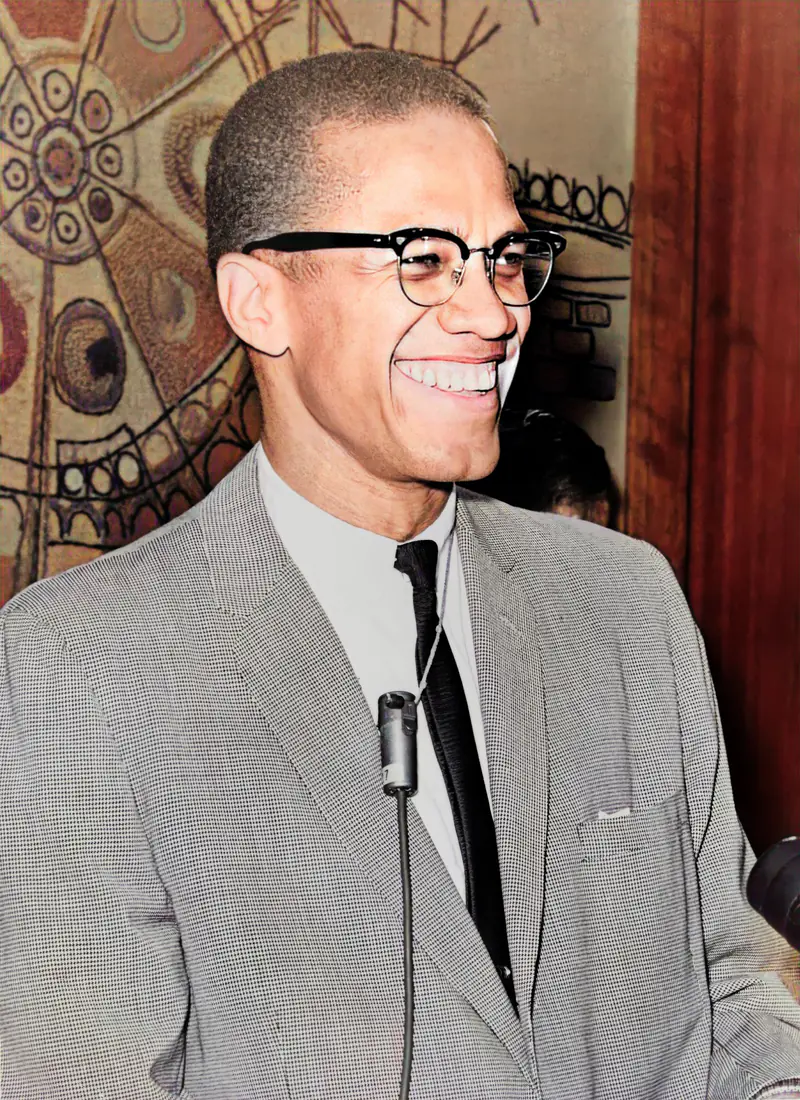
| 32 Quotes | |
| Born as | Malcolm Little |
| Occup. | Activist |
| From | USA |
| Born | May 19, 1925 |
| Died | February 21, 1965 |
| Aged | 39 years |
Malcolm X, born Malcolm Little on May 19, 1925, in Omaha, Nebraska, emerged from a family steeped in ideas of black self-reliance and dignity. His father, Earl Little, was a Baptist lay preacher and outspoken supporter of Marcus Garvey's Universal Negro Improvement Association, while his mother, Louise Norton Little, maintained a disciplined, literate household and instilled pride in African heritage. The family endured threats and violence from white supremacists, prompting moves across the Midwest. After the family settled near Lansing, Michigan, Earl Little died under circumstances officially attributed to a streetcar accident, though many in the community suspected racially motivated violence. The loss and economic precarity left lasting scars. Malcolm and his siblings experienced the pressure of poverty and the weight of institutional neglect, and the family was ultimately broken up by social services as his mother struggled to support her children.
Adolescence, Migration, and Street Years
As a teenager, Malcolm exhibited curiosity and sharp intelligence but collided with the low expectations of segregated schools. He moved to Boston to live with his older half-sister Ella and worked various jobs. Drawn by the energy of urban life, he moved between Boston and New York, immersing himself in the nightlife and hustles of Harlem. Adopting the nickname "Detroit Red" for his hair color and Midwestern roots, he entered a world of petty crime, gambling, and drugs. In 1946 he was arrested and sentenced to prison for burglary. That turning point, born of hardship and street survival, would catalyze a profound transformation.
Prison and Intellectual Awakening
In prison, Malcolm underwent an intense intellectual awakening. He devoured books, explored history and philosophy, and honed a discipline that would define his public life. Influenced by correspondence with siblings who had joined the Nation of Islam, including Reginald and Wilfred, he embraced the Nation's teachings and wrote to its leader, Elijah Muhammad. Rejecting the surname that he associated with slavery, he adopted the initial "X" to signify a lost ancestral name. By the time he was paroled in 1952, he had converted, cultivated a rigorous moral code, and prepared himself for leadership.
Rise in the Nation of Islam
After his release, Malcolm X quickly emerged as a dynamic minister and organizer. He helped establish and expand temples in cities such as Detroit, Boston, and New York, and became minister of the Harlem mosque. His electric oratory, ascetic personal conduct, and relentless work ethic attracted new members and drew media attention. He married Betty Shabazz (then Betty X) in 1958; their partnership anchored his increasingly public life and growing family. Within the Nation, he mentored younger figures while coordinating with established lieutenants; among those moving in related circles were Louis X (later Louis Farrakhan) and John Ali. Malcolm courted controversy through uncompromising critiques of racism, police brutality, and mainstream civil rights strategies. In 1957, his intervention in the aftermath of police violence against a Nation member outside a Harlem precinct showcased his organizational command and his insistence on disciplined self-defense.
Public Profile, Media, and Controversy
National television and print media amplified his visibility. The 1959 documentary The Hate That Hate Produced introduced many Americans to him and the Nation of Islam, spotlighting his rhetorical force and stern critique of American racism. Malcolm debated clergy, journalists, and civil rights leaders, emphasizing black self-respect, separation from oppressive structures, and resistance to violence with the capacity for self-defense. He criticized the slow pace of change and the tactics of nonviolence championed by Martin Luther King Jr., though he also acknowledged the courage of those who faced brutality without retaliation. He labeled the March on Washington a "farce" for its compromises, and he warned that without fundamental change, the ballot would give way to the bullet. His widening profile brought both followers and intense scrutiny from law enforcement; he was monitored by federal and local agencies in an era of political surveillance.
Break with Elijah Muhammad and New Directions
Tensions grew within the Nation of Islam as Malcolm's public presence eclipsed that of many senior officials, and as internal strains mounted over discipline, leadership, and personal conduct. After President John F. Kennedy's assassination, Malcolm's remark that it was a case of "chickens coming home to roost" led to his suspension. In March 1964 he formally broke with Elijah Muhammad, a painful separation from the man he had long revered. Malcolm founded Muslim Mosque, Inc., a religious organization, and later the Organization of Afro-American Unity (OAAU), modeled in part on African liberation movements. He began to reframe his analysis from black nationalism narrowly conceived to a broader human rights framework, while never abandoning the principle of black self-determination. During this period he interacted with other figures across the civil rights landscape, including a brief, cordial encounter with Martin Luther King Jr. during the 1964 legislative battle over civil rights. He also influenced and was in dialogue with younger activists whose ideas would later be associated with Black Power.
Pilgrimage, Internationalism, and Human Rights
In 1964 Malcolm undertook the Hajj to Mecca and traveled widely in the Middle East and Africa. The pilgrimage transformed his religious outlook: seeing Muslims of many races worshiping together led him to embrace Sunni Islam and to adopt the name El-Hajj Malik El-Shabazz. He wrote of recognizing the possibility of racial solidarity across color lines when anchored in justice. He sought to internationalize the African American freedom struggle by appealing to forums beyond the United States, meeting officials and activists in countries including Egypt, Ghana, Nigeria, and Algeria. He argued that U.S. racial oppression violated human rights, not only civil rights, and he urged African and Asian leaders to hold the United States accountable. Back home he delivered major speeches such as "The Ballot or the Bullet", advancing a strategy that combined electoral pressure with community self-defense and economic self-sufficiency. His relationship with public figures like Muhammad Ali, whom he had encouraged as Cassius Clay to embrace Islam, became strained as Malcolm's split from the Nation widened, and Ali chose to remain loyal to Elijah Muhammad at that time.
Assassination
The velocity of Malcolm's political and spiritual evolution alarmed enemies and unsettled former allies. He received threats, and his home was firebombed in February 1965. On February 21, 1965, while preparing to speak at the Audubon Ballroom in Manhattan, he was assassinated. Members of the Nation of Islam were implicated; one assailant, Talmadge Hayer (also known as Mujahid Abdul Halim), confessed, and two other men were later convicted and, decades after the fact, had their convictions vacated. His death at age 39 shocked the movement and left Betty Shabazz widowed with their daughters, including twins born after his murder. The loss rippled through the civil rights and black nationalist communities, altering the trajectory of debates about tactics, identity, and power.
Posthumous Influence and Legacy
Malcolm X's influence expanded after his death. The Autobiography of Malcolm X, based on interviews with Alex Haley and published in 1965, became a cornerstone text for generations seeking clarity about race, dignity, and transformation. His critique of American racism, articulation of black pride, and insistence on human rights shaped the rhetoric of organizations that followed, including groups inspired by community control and self-defense. While his disagreements with figures such as Martin Luther King Jr. were real, the two represented different, intersecting currents: Malcolm forced a reckoning with structural power and the legitimacy of self-defense, while also, in his final year, signaling possibilities of broader coalitions. His journey from Malcolm Little to Malcolm X to El-Hajj Malik El-Shabazz encapsulated a lifelong pursuit of truth, discipline, and justice. Through Betty Shabazz's steadfast stewardship of his legacy and the continuing work of their daughters, along with historians, activists, and artists, Malcolm's words and example remain a touchstone for debates on liberation, faith, and the global dimensions of equality.
Our collection contains 32 quotes who is written by Malcolm, under the main topics: Motivational - Ethics & Morality - Justice - Learning - Freedom.
Other people realated to Malcolm: James A. Baldwin (Author), Maya Angelou (Poet), Denzel Washington (Actor), Ossie Davis (Actor), Redd Foxx (Actor), Eldridge Cleaver (Activist)
Source / external links