
Reggie Lewis Biography Quotes 14 Report mistakes
| 14 Quotes | |
| Born as | Reginald C. Lewis |
| Occup. | Athlete |
| From | USA |
| Born | November 21, 1965 Baltimore, Maryland, USA |
| Died | July 27, 1993 Boston, Massachusetts, USA |
| Cause | Sudden Cardiac Arrest |
| Aged | 27 years |
| Cite | |
Citation Formats
APA Style (7th ed.)
Reggie lewis biography, facts and quotes. (2026, February 11). FixQuotes. https://fixquotes.com/authors/reggie-lewis/
Chicago Style
"Reggie Lewis biography, facts and quotes." FixQuotes. February 11, 2026. https://fixquotes.com/authors/reggie-lewis/.
MLA Style (9th ed.)
"Reggie Lewis biography, facts and quotes." FixQuotes, 11 Feb. 2026, https://fixquotes.com/authors/reggie-lewis/. Accessed 26 Mar. 2026.
Early Life
Reginald C. Lewis, known to the sports world as Reggie Lewis, was born on November 21, 1965, in Baltimore, Maryland. Raised in a city with a deep basketball culture, he grew up watching older players set standards for toughness and teamwork on neighborhood courts and in packed high school gyms. From a young age he carried himself with quiet focus, the kind of temperament that drew coaches to him and made teammates trust him. That blend of modesty and competitiveness guided him through a formative adolescence in Baltimore and set the stage for a career defined as much by leadership as by points and wins.Dunbar High School
Lewis emerged at Paul Laurence Dunbar High School, a program that became a national force under coach Bob Wade. He shared the floor with future NBA players Muggsy Bogues, David Wingate, and Reggie Williams, learning how to win on teams stacked with talent. Those Dunbar squads were celebrated for suffocating defense, unselfish offense, and relentless preparation. In that environment Lewis honed his midrange scoring, his ability to get to the rim without flash, and his disciplined approach on the defensive end. The competitive cauldron at Dunbar taught him to lead by example rather than volume, a trait that would mark every stage of his career.Northeastern University
Choosing Northeastern University in Boston brought Lewis into the orbit of coach Jim Calhoun, who helped channel his quiet intensity into sustained excellence. At Northeastern he grew from promising freshman to program cornerstone, ultimately becoming the school's most prolific scorer while steering the Huskies to multiple NCAA tournament appearances. Calhoun's demanding practices sharpened his footwork and conditioning, and his teammates looked to him late in games because he never seemed rattled. Boston took notice of the poised guard thriving in its college gyms; he volunteered in local neighborhoods, forging relationships that outlasted his college years. By the time he left Northeastern, he had rewritten team record books, raised the profile of the program, and won the confidence of professional scouts impressed by his two-way game and steady temperament.Boston Celtics
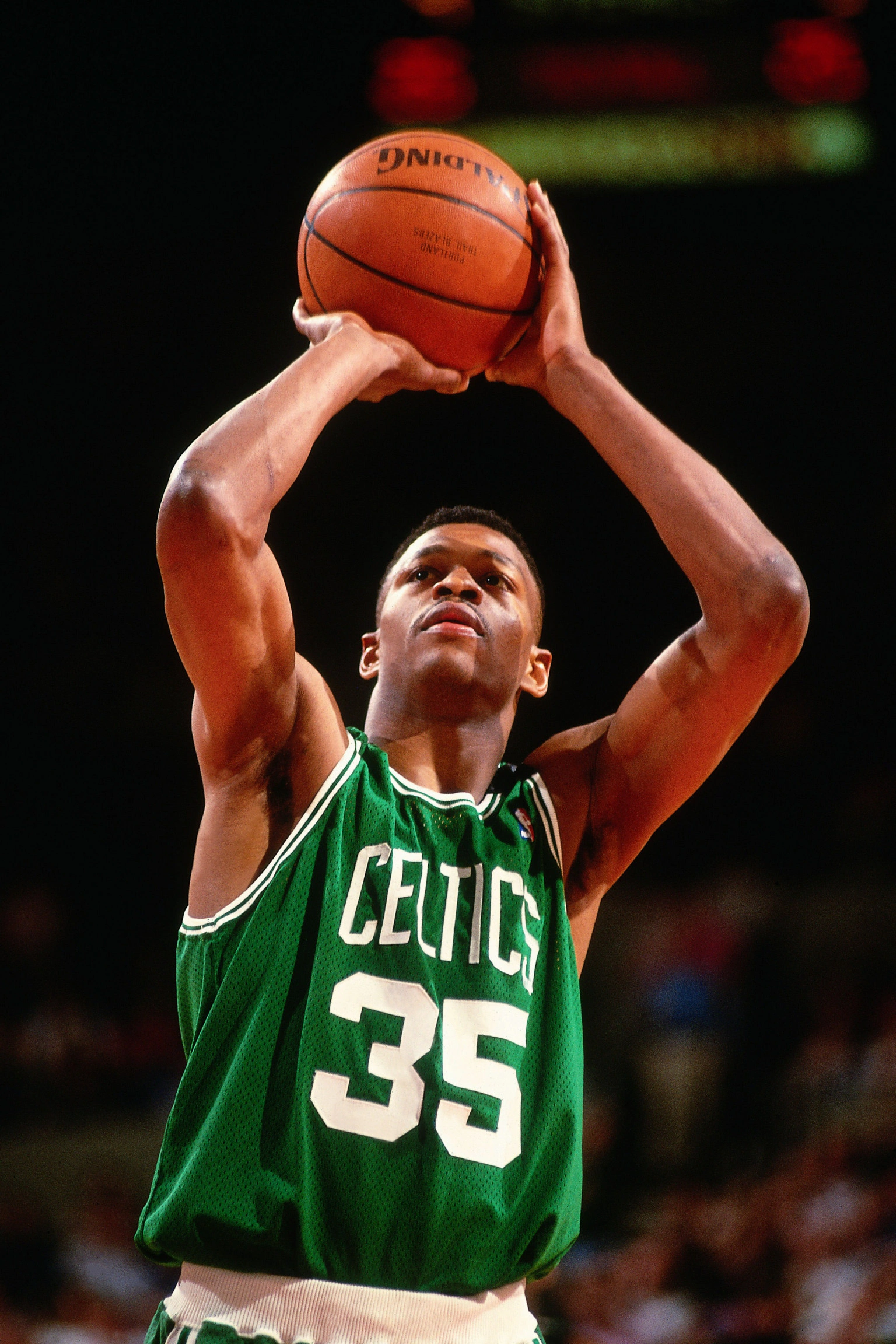
The Boston Celtics selected Lewis in the first round of the 1987 NBA Draft. Entering a storied locker room led by Larry Bird, Kevin McHale, Robert Parish, and veteran guard Dennis Johnson, he absorbed the franchise's exacting standards. In limited minutes as a rookie he studied how champions prepared, and under the guidance of team leaders and coaches he added strength and nuance to his game. By his second and third seasons he had earned a starting role. As injuries and retirements thinned the old guard, Lewis evolved into the franchise's next cornerstone, ultimately becoming team captain after Bird's departure. Under coaches including Chris Ford, he shouldered late-game scoring, guarded top perimeter threats, and stabilized a roster in transition. Teammates like Dee Brown and Brian Shaw flourished alongside him, benefitting from his calm late in tight games.In 1992 Lewis was named an NBA All-Star, recognition of his ascent among the league's elite wings. He averaged strong scoring totals on efficient shooting, attacked closeouts with a crisp first step, and used his length to block or alter shots unusual for a guard. Against elite competition he rarely forced the game; instead he let strategy, spacing, and timing create his opportunities, an approach that endeared him to coaches and suited the Celtics' tradition of intelligent, unselfish basketball.
Playing Style and Leadership
Lewis's game was defined by economy and balance. He scored from the mid-post and elbows, gliding into pull-ups that looked effortless, yet he also attacked the paint and finished through contact without theatrics. On defense he fought over screens, closed angles without fouling, and used anticipation rather than gamble-heavy risks. His voice was subdued, but his routines set the standard in film sessions and practices. In a franchise shaped by Red Auerbach's ethos of team-first basketball, his demeanor fit perfectly. Younger Celtics cited the way he treated staff, interacted with fans, and carried responsibility without complaint as the quiet heartbeat of those early 1990s teams.Health Crisis
On April 29, 1993, during Game 1 of the first-round playoff series against the Charlotte Hornets at the Boston Garden, Lewis crumpled to the floor in the first half after a strong start. The scene stunned teammates and opponents alike. He left the game and underwent evaluations by cardiologists. Specialists offered differing interpretations of his condition and the risks of returning to competition, prompting second and third opinions and intense public scrutiny. While the medical debate unfolded, Lewis stepped away from playoff play and focused on rest and monitored activity.That summer, on July 27, 1993, during an offseason workout at Brandeis University in Waltham, Massachusetts, he collapsed on the court and could not be revived. He was 27 years old. The suddenness of his death, attributed to a structural heart disease consistent with hypertrophic cardiomyopathy, devastated the Celtics organization and the broader basketball community. Coach Chris Ford, team veterans such as McHale and Parish, and former teammates including Dee Brown and Brian Shaw joined Larry Bird and other franchise greats in mourning. His wife, Donna Harris-Lewis, became a central figure in the aftermath, navigating grief while facing complicated questions about medical advice and athlete health. The shock of his passing helped drive broader conversations about cardiac screening, second opinions, and conservatism in return-to-play decisions for athletes.
Legacy
The Celtics retired Lewis's No. 35, raising it to the rafters as a reminder of his leadership and potential. Memorials and tributes across Boston honored his impact beyond the stat sheet. The Reggie Lewis Track and Athletic Center in Roxbury became a community hub, hosting youth meets and community events that reflected his commitment to accessibility and opportunity. Northeastern retired his number and continued to celebrate his achievements with awards and programming that connect current athletes to his standards of preparation and composure. Former rivals and teammates alike spoke of his professionalism, with figures from around the league noting how he competed with intensity but carried himself with humility.Lewis's story remains intertwined with the city of Boston and with the mentors and peers who shaped him: the discipline instilled by Bob Wade at Dunbar; the developmental partnership with Jim Calhoun at Northeastern; the tutelage and example provided by Bird, McHale, and Parish; and the locker room trust he earned from peers like Dee Brown and Brian Shaw. His wife Donna has been instrumental in sustaining philanthropy in his name and in advocating for athlete health awareness. Through remembrance events and ongoing community work, the people who stood alongside him have made his values as visible as his banners.
Personal Character and Community
Even as his fame grew, Lewis remained approachable. He invested time in clinics, school visits, and quiet charitable acts in both Boston and his native Baltimore. Trainers and equipment staff recount small gestures of gratitude that signaled his respect for everyone around the game. Reporters found him measured and thoughtful, teammates found him reliable, and coaches found him coachable. Those qualities help explain why, in a franchise used to legends, he was entrusted with the role of captain at a young age.Enduring Meaning
Reggie Lewis's life bridged eras: the powerhouse Dunbar teams of Baltimore, the ascendant Northeastern program under Jim Calhoun, and a proud Celtics franchise navigating transition. His death cut short a career that already included an All-Star selection and the captaincy of one of sports' most storied teams, but the influence he exerted on people around him continues to resonate. For many in Boston, his jersey in the rafters stands for a standard as much as an individual: play the right way, prepare relentlessly, lead quietly, and honor the game and community in equal measure.Our collection contains 14 quotes written by Reggie, under the main topics: Motivational - Sports - Training & Practice - Perseverance - Confidence.
Source / external links