
Sandra Day O'Connor Biography Quotes 34 Report mistakes
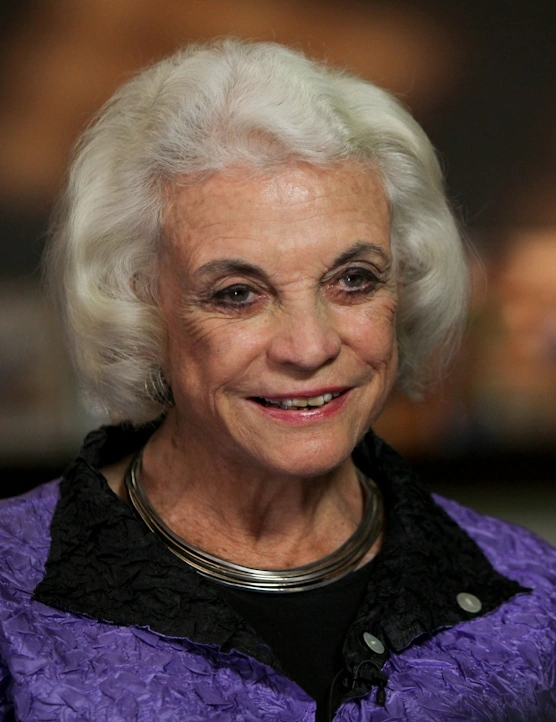
| 34 Quotes | |
| Occup. | Judge |
| From | USA |
| Born | March 26, 1930 El Paso, Texas |
| Age | 95 years |
| Cite | |
Citation Formats
APA Style (7th ed.)
Sandra day o'connor biography, facts and quotes. (2026, February 11). FixQuotes. https://fixquotes.com/authors/sandra-day-oconnor/
Chicago Style
"Sandra Day O'Connor biography, facts and quotes." FixQuotes. February 11, 2026. https://fixquotes.com/authors/sandra-day-oconnor/.
MLA Style (9th ed.)
"Sandra Day O'Connor biography, facts and quotes." FixQuotes, 11 Feb. 2026, https://fixquotes.com/authors/sandra-day-oconnor/. Accessed 6 Mar. 2026.
Early Life and Background
Sandra Day O'Connor was born on March 26, 1930, in El Paso, Texas, and raised largely on the Day family cattle ranch near Duncan, Arizona, in the high desert close to the New Mexico line. The ranch life was austere and practical - scarce water, long distances, and constant work - and it trained her early in self-reliance, clear judgment, and an unsentimental sense of consequence. In later years, she often returned in memory to the ranch as a classroom in responsibility: animals had to be tended, machinery fixed, and mistakes cost real money.Because the ranch was remote, she spent portions of childhood with her maternal grandmother in El Paso to attend school, moving between worlds that were culturally and economically distinct. That oscillation - between a frontier economy and a city shaped by border commerce - foreshadowed the balance she would later seek as a jurist: respect for tradition without romanticism, and an instinct to solve problems with workable rules rather than abstractions. The era of her youth, framed by Depression aftershocks and World War II mobilization, also reinforced a civic seriousness about institutions and duty.
Education and Formative Influences
After graduating from Austin High School in El Paso, O'Connor entered Stanford University at 16, earning a BA in economics in 1950 and graduating from Stanford Law School in 1952, where she ranked near the top of her class and served on the Stanford Law Review. Stanford placed her amid the postwar rise of administrative government and corporate power, while also exposing her to elite legal networks that did not yet know what to do with high-achieving women. She met John Jay O'Connor there; they married in 1952, and the partnership became central to how she navigated demanding public work alongside family life in an era that often treated those goals as mutually exclusive.Career, Major Works, and Turning Points
Despite her credentials, firms in California largely offered her secretarial work, so she began in public service as a deputy county attorney in San Mateo, then moved with her husband to Frankfurt, Germany, where she worked as a civilian attorney for the U.S. Army. Settling in Phoenix, she balanced family life with legal practice and Arizona public affairs, serving as assistant attorney general (1965-1969), then entering elective politics: appointed to the Arizona State Senate in 1969, she became the first woman to serve as Arizona Senate majority leader (1972). She then turned to judging, first on the Maricopa County Superior Court (1975), then the Arizona Court of Appeals (1979). In 1981, President Ronald Reagan nominated her to the U.S. Supreme Court, fulfilling a campaign pledge to appoint the first woman; she was confirmed unanimously. On the Court (1981-2006), she became the pivotal vote in many 5-4 cases, shaping abortion regulation (Planned Parenthood v. Casey, 1992), affirmative action (Grutter v. Bollinger, 2003), federalism (New York v. United States, 1992), religion in public life (Lee v. Weisman, 1992), and election law (Bush v. Gore, 2000). She retired in 2006 to care for her husband, who had Alzheimer's disease, and later spoke publicly about her own dementia diagnosis.Philosophy, Style, and Themes
O'Connor's jurisprudence was less a grand theory than a practiced temperament: cautious, institution-minded, and anchored in lived effects. She distrusted legal rules that pretended to be universally simple when social realities were not, and she preferred tests that required judges to look carefully at context, history, and consequences. Her opinions often carried the cadence of a former legislator - attentive to what government can realistically administer - and the discipline of a trial judge who knows that law touches people at their worst moments.Psychologically, she was driven by an ethic of competence and an aversion to drama, even as history made her a symbol. Her insistence on institutional balance came through explicitly: “It matters enormously to a successful democratic society like ours that we have three branches of government, each with some independence and some control over the other two. That's set out in the Constitution”. That sentence is not rhetorical flourish but a self-portrait of how she managed power - by refusing to let any branch, or any faction, claim total moral authority. The same practicality informed her recurring preference for settlement and moderation in legal conflict: “The courts of this country should not be the places where resolution of disputes begins. They should be the places where the disputes end after alternative methods of resolving disputes have been considered and tried”. Even her writing about church-state questions tended to resist panic and absolutism, leaning toward civic coexistence: “It is difficult to discern a serious threat to religious liberty from a room of silent, thoughtful schoolchildren”. Across these themes runs a consistent inner logic - protect the legitimacy of the Court by deciding narrowly, protect democratic processes by leaving room for elected institutions, and protect individuals by preventing government from flattening pluralism.
Legacy and Influence
O'Connor's legacy is both jurisprudential and cultural: she normalized the presence of women at the constitutional center of American life, while also modeling a style of judging that prized legitimacy, restraint, and incremental change. Critics argued her case-by-case approach lacked theory; admirers saw it as a democratic virtue suited to a polarized age. After leaving the Court, she became a prominent civic educator, founding iCivics to teach constitutional literacy, and she remained an emblem of how a justice can wield immense influence without cultivating celebrity. In an era when the Court is often described in partisan terms, her career endures as a study in how power can be exercised through patience, coalition-building, and a steady insistence that institutions - not personalities - must outlast the moment.Our collection contains 34 quotes written by Sandra, under the main topics: Justice - Freedom - Work Ethic - Equality - Faith.
Other people related to Sandra: Stephen Breyer (Judge), Evan Thomas (Writer), Anthony Kennedy (Judge), Strom Thurmond (Politician)
Source / external links