
Thurgood Marshall Biography Quotes 12 Report mistakes
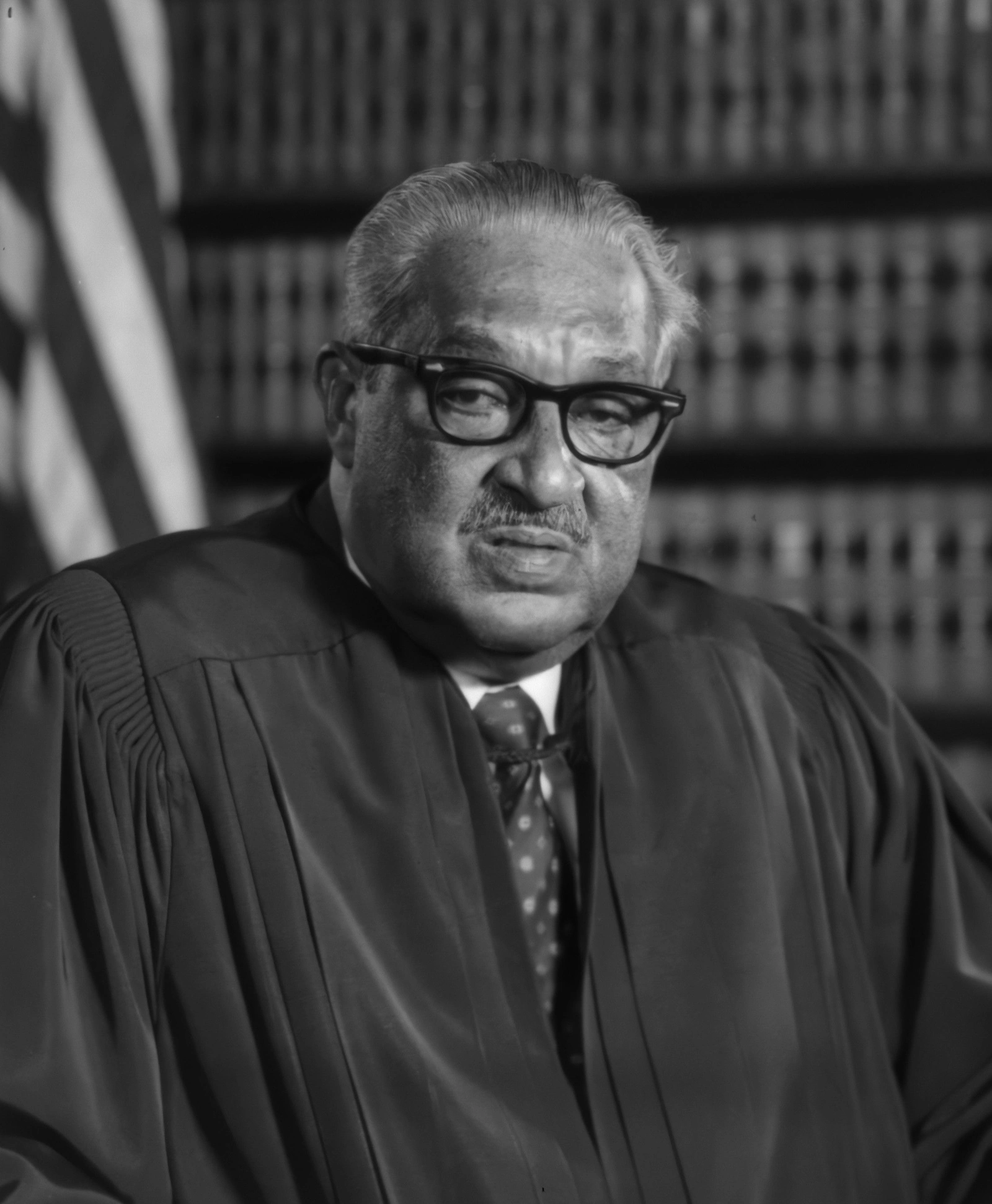
| 12 Quotes | |
| Occup. | Judge |
| From | USA |
| Born | July 2, 1908 |
| Died | January 24, 1993 |
| Aged | 84 years |
| Cite | |
Citation Formats
APA Style (7th ed.)
Thurgood marshall biography, facts and quotes. (2026, February 11). FixQuotes. https://fixquotes.com/authors/thurgood-marshall/
Chicago Style
"Thurgood Marshall biography, facts and quotes." FixQuotes. February 11, 2026. https://fixquotes.com/authors/thurgood-marshall/.
MLA Style (9th ed.)
"Thurgood Marshall biography, facts and quotes." FixQuotes, 11 Feb. 2026, https://fixquotes.com/authors/thurgood-marshall/. Accessed 6 Mar. 2026.
Early Life and Background
Thurgood Marshall was born on July 2, 1908, in Baltimore, Maryland, a border-city port where Jim Crow habits coexisted with Black institutions toughened by segregation. His father, William Canfield Marshall, worked as a railroad porter and later a steward; his mother, Norma Arica Williams, taught in Baltimore's segregated schools. The household prized argument, precision, and self-possession - skills a Black family needed when law and custom routinely collided.Marshall later traced his love of constitutional combat to everyday talk and to the courthouse itself. As a teenager he was occasionally sent to watch proceedings as a form of discipline, turning punishment into apprenticeship: he learned how narratives are built, how witnesses are cornered, and how judges signal what they will tolerate. In a city that offered Black talent both opportunity and ceilings, he absorbed an early lesson that dignity was not simply asserted - it was proved, repeatedly, in public.
Education and Formative Influences
After graduating from Frederick Douglass High School in 1925, Marshall attended Lincoln University in Pennsylvania, a historically Black college that linked him to a national Black intelligentsia and sharpened his appetite for debate; he married his first wife, Vivian "Buster" Burey, in 1929. Rejected by the University of Maryland Law School because of race, he entered Howard University School of Law in Washington, D.C., where Dean Charles Hamilton Houston ran a grueling, mission-driven program to produce "social engineers". Under Houston - and alongside future allies like Spottswood Robinson - Marshall learned to treat the Constitution as a working instrument, to master records and procedure, and to build test cases aimed at the weak joints of segregation.Career, Major Works, and Turning Points
Marshall joined the NAACP Legal Defense and Educational Fund, became its chief counsel in 1940, and over the next two decades turned litigation into a national lever: he won Murray v. Pearson (1936) forcing Maryland to admit a Black applicant or create an equal law school; Chambers v. Florida (1940) challenging coerced confessions; Smith v. Allwright (1944) ending the white primary; Shelley v. Kraemer (1948) limiting racially restrictive covenants; Sweatt v. Painter and McLaurin v. Oklahoma State Regents (1950) undermining "separate but equal" in higher education; and, as lead architect, Brown v. Board of Education (1954), which declared segregated public schools unconstitutional. Appointed by President John F. Kennedy to the Second Circuit in 1961, he was named U.S. Solicitor General in 1965 and won a striking share of his arguments before the Supreme Court. In 1967, President Lyndon B. Johnson elevated him as the first Black Justice, where he served until 1991, shaped by the civil rights era and increasingly in dissent as the Court moved right; he died on January 24, 1993.Philosophy, Style, and Themes
Marshall's inner life was forged in a paradox: faith in constitutional promise paired with an unsentimental memory of how that promise had been denied. He read rights as human instruments rather than museum pieces, and he distrusted abstractions that ignored power. That psychology appears in his insistence on moral recognition: “In recognizing the humanity of our fellow beings, we pay ourselves the highest tribute”. The sentence is not decorative; it reveals how he understood equal protection as a discipline of empathy enforced by law, especially for those whom the majority finds easy to forget.As a judge he wrote in plain, prosecutorial prose, favoring facts, institutional incentives, and the lived experience of defendants, jurors, prisoners, and schoolchildren. He challenged the mythology of solitary achievement because he had watched networks of exclusion operate just as efficiently as networks of help: “None of us got where we are solely by pulling ourselves up by our bootstraps. We got here because somebody - a parent, a teacher, an Ivy League crony or a few nuns - bent down and helped us pick up our boots”. That outlook made him skeptical of procedural minimalism; access without resources, competent counsel, and fair rules was a hollow ritual. His most enduring dissents - against weakening school desegregation orders, limiting voting protections, or narrowing criminal procedure - were driven by a single cross-examination he kept asking the law: “What is the quality of your intent?” For Marshall, intent mattered because harm often arrived wearing neutral language.
Legacy and Influence
Marshall helped move civil rights from aspiration to enforceable doctrine, then spent his Supreme Court years defending those gains against retrenchment, especially in education, policing, and access to justice. His methods professionalized impact litigation and trained generations of lawyers who treated the courtroom as a site of democratic repair, while his jurisprudence modeled a Constitution attentive to history's injuries and to the state's capacity for abuse. In public memory he remains both the strategist of Brown and the Justice who refused to romanticize the past, insisting instead that American freedom was made more real only when law confronted what society preferred to deny.Our collection contains 12 quotes written by Thurgood, under the main topics: Witty One-Liners - Ethics & Morality - Justice - Freedom - Equality.
Other people related to Thurgood: Juan Williams (Journalist), John Paul Stevens (Judge), Mordecai Wyatt Johnson (Educator), Floyd Abrams (Lawyer), Tom C. Clark (Politician), Cass Sunstein (Lawyer), Abe Fortas (Judge), James H. Meredith (American), Anthony Kennedy (Judge), Doug Wilder (Politician)