
William Blackstone Biography Quotes 27 Report mistakes
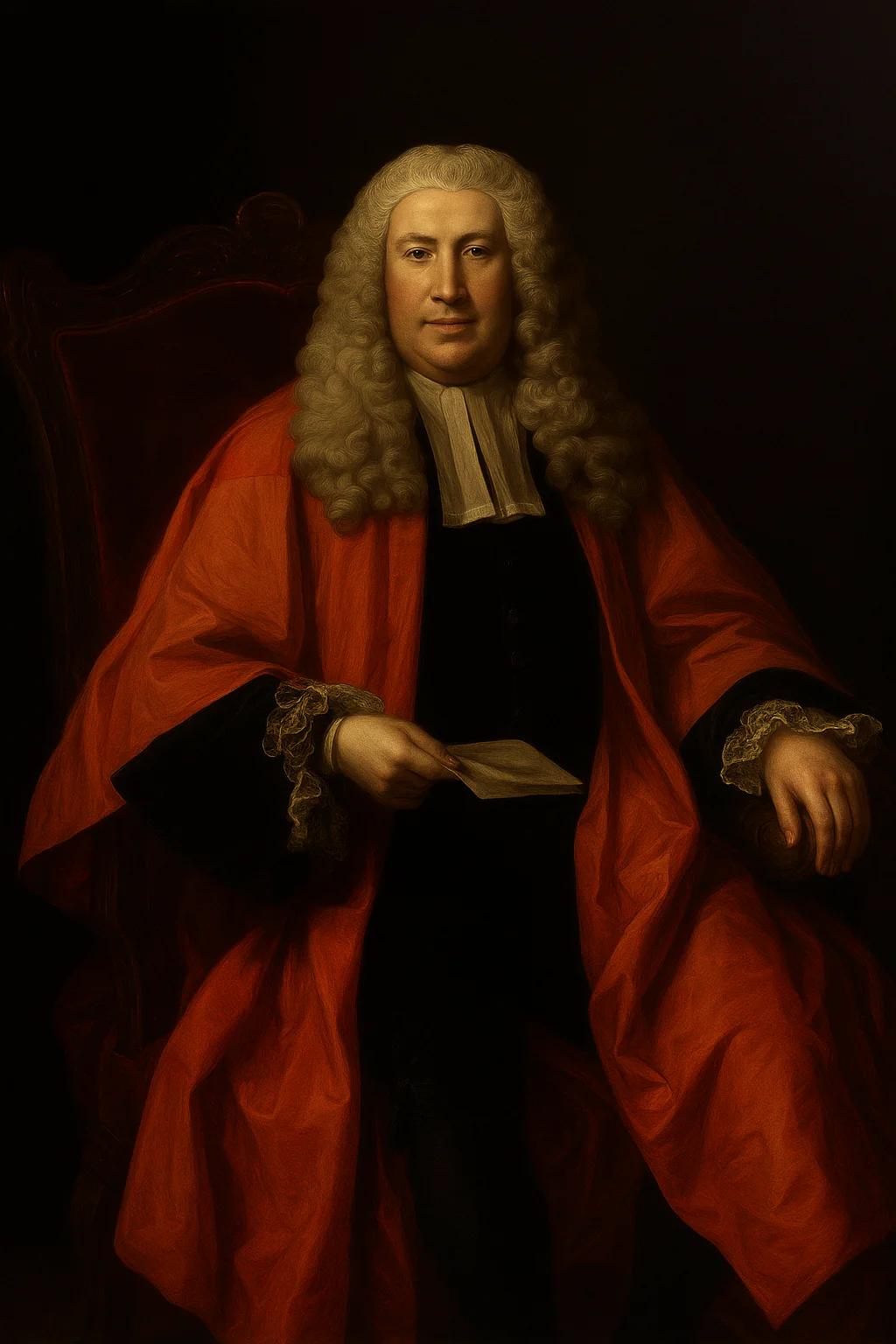
| 27 Quotes | |
| Known as | Sir William Blackstone |
| Occup. | Judge |
| From | England |
| Spouse | Sarah Clitherow (1761) |
| Born | July 10, 1723 London, England |
| Died | February 14, 1780 Wallingford, Berkshire, England |
| Aged | 56 years |
| Cite | |
Citation Formats
APA Style (7th ed.)
William blackstone biography, facts and quotes. (2026, February 11). FixQuotes. https://fixquotes.com/authors/william-blackstone/
Chicago Style
"William Blackstone biography, facts and quotes." FixQuotes. February 11, 2026. https://fixquotes.com/authors/william-blackstone/.
MLA Style (9th ed.)
"William Blackstone biography, facts and quotes." FixQuotes, 11 Feb. 2026, https://fixquotes.com/authors/william-blackstone/. Accessed 25 Mar. 2026.
Early Life and Background
William Blackstone was born on July 10, 1723, in Cheapside, London, into a mercantile family whose stability was shadowed by early loss. His father, a silk merchant, died when William was young, and the boy grew up under the care of relatives who valued order, reputation, and the sober virtues of the City. The London he inherited was commercial, litigious, and increasingly governed by paper - deeds, bonds, leases, and the expanding machinery of Parliament - a world in which law was not an abstraction but a daily language of power and protection.Eighteenth-century England offered both opportunity and anxiety: the Hanoverian settlement was still being defended, Jacobite memory still haunted politics, and empire and trade were remaking society faster than institutions could comfortably absorb. Blackstone developed a temperament suited to such an age: cautious rather than flamboyant, drawn to clarity, precedent, and the reassurance that the constitution could be explained as a coherent inheritance. That impulse - to make the common law intelligible and therefore defensible - became the quiet engine of his life.
Education and Formative Influences
Educated at Charterhouse and then Pembroke College, Oxford, Blackstone immersed himself in classical learning, architecture, and poetry before turning decisively to law at the Middle Temple. Oxford in the 1740s prized Anglican stability and feared enthusiasm and faction; its intellectual atmosphere favored system and moderation. Blackstone absorbed that ethos and, dissatisfied with the haphazard way English law was taught, began to imagine legal instruction as a public, rational discipline. The idea of order - that rules could be arranged, explained, and thereby legitimated - became his method and, in a deeper sense, his consolation.Career, Major Works, and Turning Points
Called to the bar in 1746, Blackstone struggled for practice, then found his real vocation at Oxford: his celebrated lectures on English law, begun in the early 1750s, were a turning point for legal education and for his own confidence. They became the foundation of his masterwork, Commentaries on the Laws of England (1765-1769), four volumes that presented the common law as a structured whole, balancing royal prerogative, Parliament, courts, and the rights of persons and property. He entered Parliament as member for Hindon (1761-1768), but his temperament favored the bench over the hustings. In 1770 he became a Justice of the Court of Common Pleas, serving until his death on February 14, 1780, at Wallingford; his later years were marked by ill health, yet he remained identified with the judicial ideal of restrained authority and reasoned continuity.Philosophy, Style, and Themes
Blackstone wrote as an architect of reassurance. His Commentaries are not merely a digest of rules but a narrative in which English law appears as inherited wisdom, disciplined by procedure and animated by moral purpose. He treated law as a civilizing restraint, insisting that ordered constraint enlarges social freedom: “The law, which restrains a man from doing mischief to his fellow citizens, though it diminishes the natural, increases the civil liberty of mankind”. This is not the libertarian romance of unfettered will; it is the conservative psychology of a man who mistrusted passion, feared arbitrary violence, and believed liberty survives by accepting forms.His moral confidence rested on natural-law premises that placed legality under higher judgment. He argued that human enactment loses legitimacy when it contradicts ultimate moral order: “No enactment of man can be considered law unless it conforms to the law of God”. Yet he was also a careful constitutionalist, willing to describe - and thereby normalize - doctrines that insulated state authority: “That the king can do no wrong is a necessary and fundamental principle of the English constitution”. The tension is revealing. Blackstone sought a world where sovereignty is stable enough to prevent chaos, but constrained enough to avoid tyranny; where conscience sits above statute, yet the constitution remains the practical instrument for everyday justice. His style - lucid, balanced, often gently rhetorical - made those tensions feel harmonized, which is precisely why his work proved so potent.
Legacy and Influence
Blackstone became the great translator of English common law for the modern world. In Britain he helped professionalize legal education and shaped how lawyers and judges imagined the coherence of the constitution; in North America his Commentaries were read as a civic scripture, influencing colonial lawyers, early American jurists, and the framing generation's vocabulary of rights, property, and due process. Later reformers criticized his deference to hierarchy and his comfort with inherited inequities, but even criticism testified to his reach: to argue with Blackstone became, for two centuries, a way of thinking about law itself. His enduring influence lies in the confidence he gave to legal reasoning - the belief that a nation can understand its freedoms by understanding its forms, and that clarity is not merely style but a kind of constitutional faith.Our collection contains 27 quotes written by William, under the main topics: Ethics & Morality - Wisdom - Justice - Freedom - Military & Soldier.
Other people related to William: Jeremy Bentham (Philosopher)
Frequently Asked Questions
- William Blackstone philosophy: Blackstone’s legal philosophy blended common law tradition with natural law, arguing that human laws must align with a higher moral law and emphasizing the protection of individual rights under a stable, orderly legal system.
- Sir William Blackstone age of marriage: In his Commentaries, Blackstone described the common law rule that a boy could marry at 14 and a girl at 12, reflecting the legal standards of his time rather than a personal rule he created.
- William Blackstone books: His key books are the four volumes of Commentaries on the Laws of England: Of the Rights of Persons, Of the Rights of Things, Of Private Wrongs, and Of Public Wrongs.
- William Blackstone famous Works: William Blackstone’s most famous work is Commentaries on the Laws of England, a four‑volume treatise published between 1765 and 1769 that systematized English common law.
- William Blackstone contributions to democracy: William Blackstone’s Commentaries on the Laws of England clarified English common law and influenced democratic legal systems, especially in the United States, by promoting ideas like the rule of law, rights of individuals, and limits on government power.
- How old was William Blackstone? He became 56 years old
Source / external links