
Chuck Berry Biography Quotes 3 Report mistakes
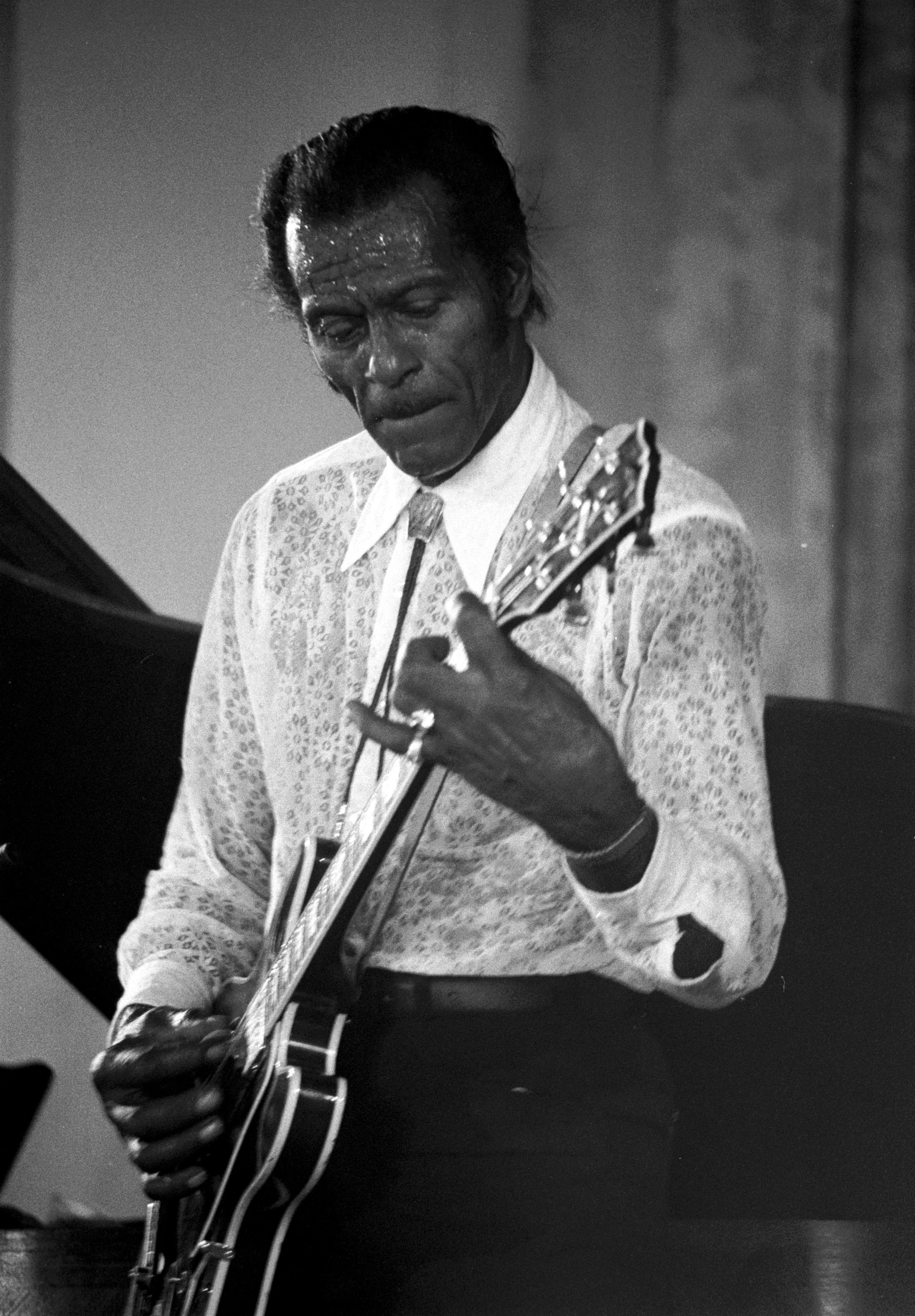
| 3 Quotes | |
| Born as | Charles Edward Anderson Berry |
| Occup. | Musician |
| From | USA |
| Born | October 18, 1926 St. Louis, Missouri, U.S. |
| Age | 99 years |
| Cite | |
Citation Formats
APA Style (7th ed.)
Chuck berry biography, facts and quotes. (2026, February 13). FixQuotes. https://fixquotes.com/artists/chuck-berry/
Chicago Style
"Chuck Berry biography, facts and quotes." FixQuotes. February 13, 2026. https://fixquotes.com/artists/chuck-berry/.
MLA Style (9th ed.)
"Chuck Berry biography, facts and quotes." FixQuotes, 13 Feb. 2026, https://fixquotes.com/artists/chuck-berry/. Accessed 1 Apr. 2026.
Early Life and Background
Charles Edward Anderson Berry was born on October 18, 1926, in St. Louis, Missouri, and grew up in the Ville, a dense, self-reliant Black neighborhood shaped by segregation and by a fierce local pride in education, church life, and upward mobility. He was one of six children in a family anchored by faith and discipline - his father, Henry Berry, was a deacon and contractor; his mother, Martha, was a school principal. That mixture of working-class craft, respectability, and the daily pressures of Jim Crow left Berry with a lifelong sensitivity to status: how people dress, talk, spend, and move through public space.As a teenager he was pulled between the neighborhood's expectations and the thrill of risk. In 1944 he and two friends committed armed robbery while traveling, and Berry was sent to a reformatory, where he stayed until 1947. The episode became a private scar and a public fact that shadowed him in later decades, but it also clarified his instincts: self-protection, control of his own business, and a wary, unsentimental reading of human motives. After his release he married Themetta "Toddy" Suggs (1948) and worked factory and service jobs while playing guitar at night, already treating music as both escape and enterprise.
Education and Formative Influences
Berry attended Sumner High School in St. Louis, where he performed in talent shows and absorbed the showmanship of urban blues and the formal polish expected of a prominent Black school. Musically, he studied the guitar language of T-Bone Walker and Charlie Christian, the jump rhythm of Louis Jordan, and the storytelling clarity of country artists he heard on the radio; he learned that a song could be a small movie, and that a guitar could talk with the punch of a horn section. Equally formative was St. Louis itself: river commerce, car culture, and nightlife, a city where blues met western swing and where a sharp-dressed player could earn money if he could hold a crowd.Career, Major Works, and Turning Points
By the early 1950s Berry was a working musician in St. Louis clubs, and in 1955 a trip to Chicago introduced him to Muddy Waters, who sent him to Chess Records; Berry's audition became "Maybellene", a rewritten country tune powered by a new kind of electric drive, and it made him a national star. Over the next few years he built a blueprint for rock and roll with "Roll Over Beethoven" (1956), "School Day" (1957), "Sweet Little Sixteen" (1958), "Johnny B. Goode" (1958), "Carol" (1958), and "Memphis, Tennessee" (1959) - songs that fused blues changes, country narrative, teen slang, and guitar riffs that sounded like engines and laughter. Legal trouble repeatedly interrupted that ascent: a Mann Act conviction in 1959 led to prison time (1962-1963), and later tax problems and a 1979 prison sentence punctuated his touring life. Yet even as the British Invasion revived his catalog in the 1960s, Berry kept performing on his own terms - traveling with minimal rehearsals, often using local backing bands, and treating the road as a system he could manage rather than a community he had to join.Philosophy, Style, and Themes
Berry's art was built on shrewd observation and a businessman's sense of what would travel across racial and regional lines. His lyrics turned ordinary American scenes into myth: the high school, the soda shop, the jukebox, the highway, the bandstand, the prom. He wrote in a fast, witty vernacular that sounded spontaneous but was carefully engineered, with internal rhymes and comic timing that mirrored his guitar phrasing. The guitar style - double-stops, ringing open strings, crisp bends, and a percussive backbeat - created a feel of motion, as if the song itself were a car pulling onto the interstate. He performed with a grin that could read as invitation or challenge, and his famous duckwalk was both circus and swagger: a bodily riff to match the musical one.Underneath the fun was a guarded psychology shaped by early consequences and later scrutiny. He valued learning that was practical and self-directed - “It's amazing how much you can learn if your intentions are truly earnest”. - and he applied that earnestness to writing, contracts, and the mechanics of show business. He also spoke like someone who believed experience is a hard tutor: “Don't let the same dog bite you twice”. In his best songs, teenage joy is real but never naive; pleasure is earned, purchased, negotiated. Even his tenderness often arrives through distance - a phone call, a letter, a one-way trip - as if intimacy required a buffer. When Berry described rock and roll as lineage and inheritance - “Rock's so good to me. Rock is my child and my grandfather”. - he was admitting both pride and dependency: he made a form that remade him, and he carried it like family, with affection and obligation intertwined.
Legacy and Influence
Chuck Berry's influence is structural, not just stylistic: he standardized the rock guitar intro as a signature, the riff as narrative engine, and the three-minute single as a complete world with characters, jokes, and a plot. The Beatles, the Rolling Stones, the Beach Boys, and generations of bar bands learned his songs as a common language, while later guitarists borrowed his double-stops and his bright, forward tone as if they were part of the instrument itself. Berry died in 2017 in Wentzville, Missouri, having lived long enough to see his teenage America become a global imaginary; his work remains a primary source for how postwar desire sounded - fast, clever, and hungry for the open road.Our collection contains 3 quotes written by Chuck, under the main topics: Music - Learning - Learning from Mistakes.
Other people related to Chuck: George Harrison (Musician), Keith Richards (Musician), Tom Petty (Musician), Johnny Thunders (Musician), Mick Ralphs (Musician), Bill Haley (Musician), George Thorogood (Musician), Rick Derringer (Musician), Bon Scott (Musician)
Source / external links