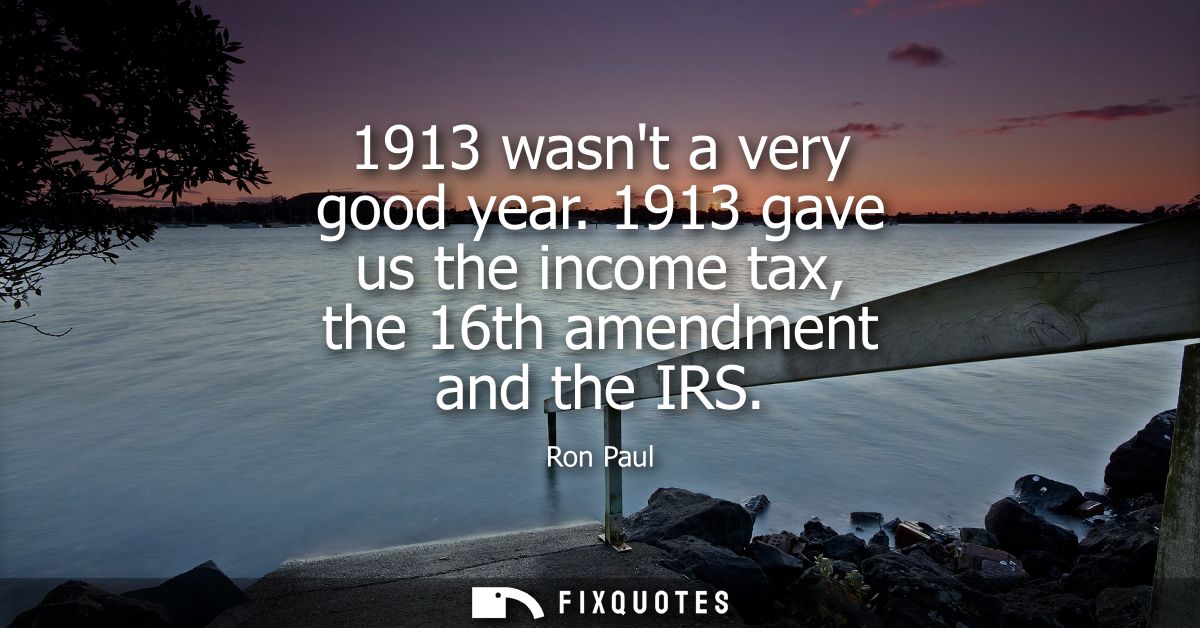
"1913 wasn't a very good year. 1913 gave us the income tax, the 16th amendment and the IRS"
About this Quote
Ron Paul's quote, "1913 wasn't an excellent year. 1913 offered us the earnings tax, the 16th change and the IRS", reflects his crucial position on the foundational modifications in U.S. financial policy that happened that year. To comprehend the implications of his statement, it's essential to unload the historic and political context behind each element he mentions.
Initially, the 16th Amendment, ratified in 1913, approved Congress the power to levy an earnings tax without assigning it among the states or basing it on the U.S. Census. Before this modification, the federal government's profits mostly depended upon tariffs and excise taxes. The intro of a federal income tax represented a substantial shift towards a more direct type of tax that allowed the federal government to gather revenue straight from people' incomes based upon their revenues.
The establishment of the Internal Revenue Service (IRS) in the exact same year was the next logical step to implement this brand-new tax system. The IRS ended up being the firm accountable for collecting taxes and carrying out the tax code, thus becoming an important part of federal financial operations.
Ron Paul, known for his libertarian views and focus on minimal federal government, viewed these advancements as a departure from the concepts of very little federal government intervention and individual freedom. From his point of view, the income tax and the IRS represent an expanded government power that intrudes upon individual liberties and imposes troublesome responsibilities on people. The establishment of income tax marked a shift towards what he views as an overreaching government with increased control over the economic lives of people.
In essence, Ron Paul is vocalizing his belief that the tradition of 1913 represents a negative pivotal moment in American history. By critiquing these modifications, Paul highlights continuous arguments about the balance between necessary government function and specific flexibilities-- a balance that has actually been a core problem in American political discourse throughout history.
More details
About the Author