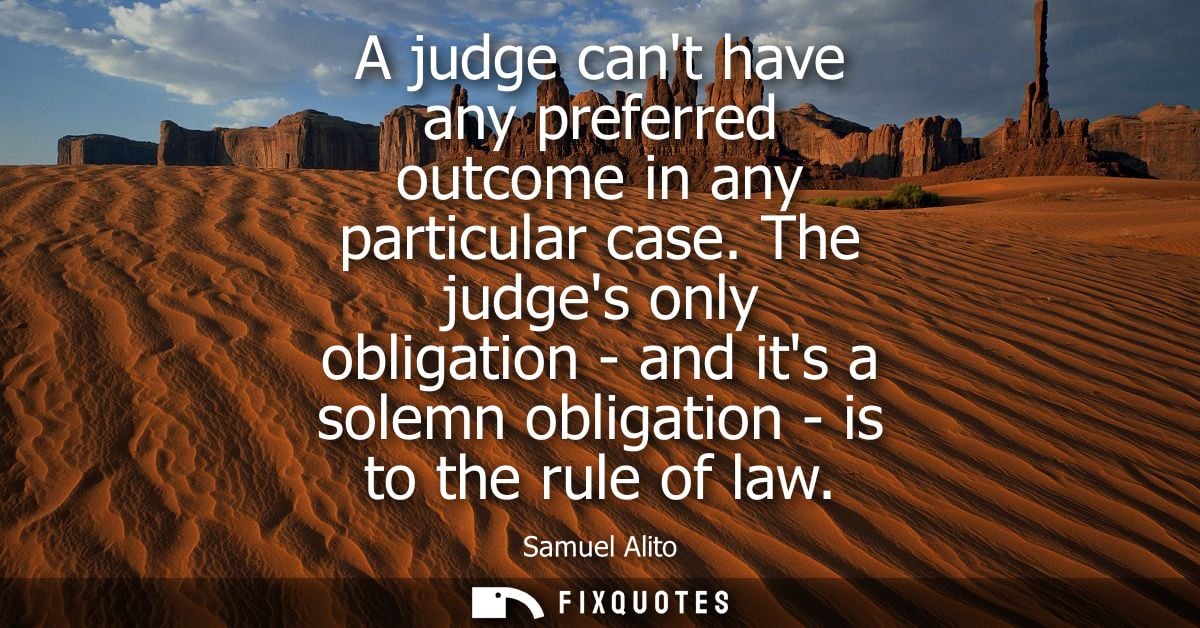
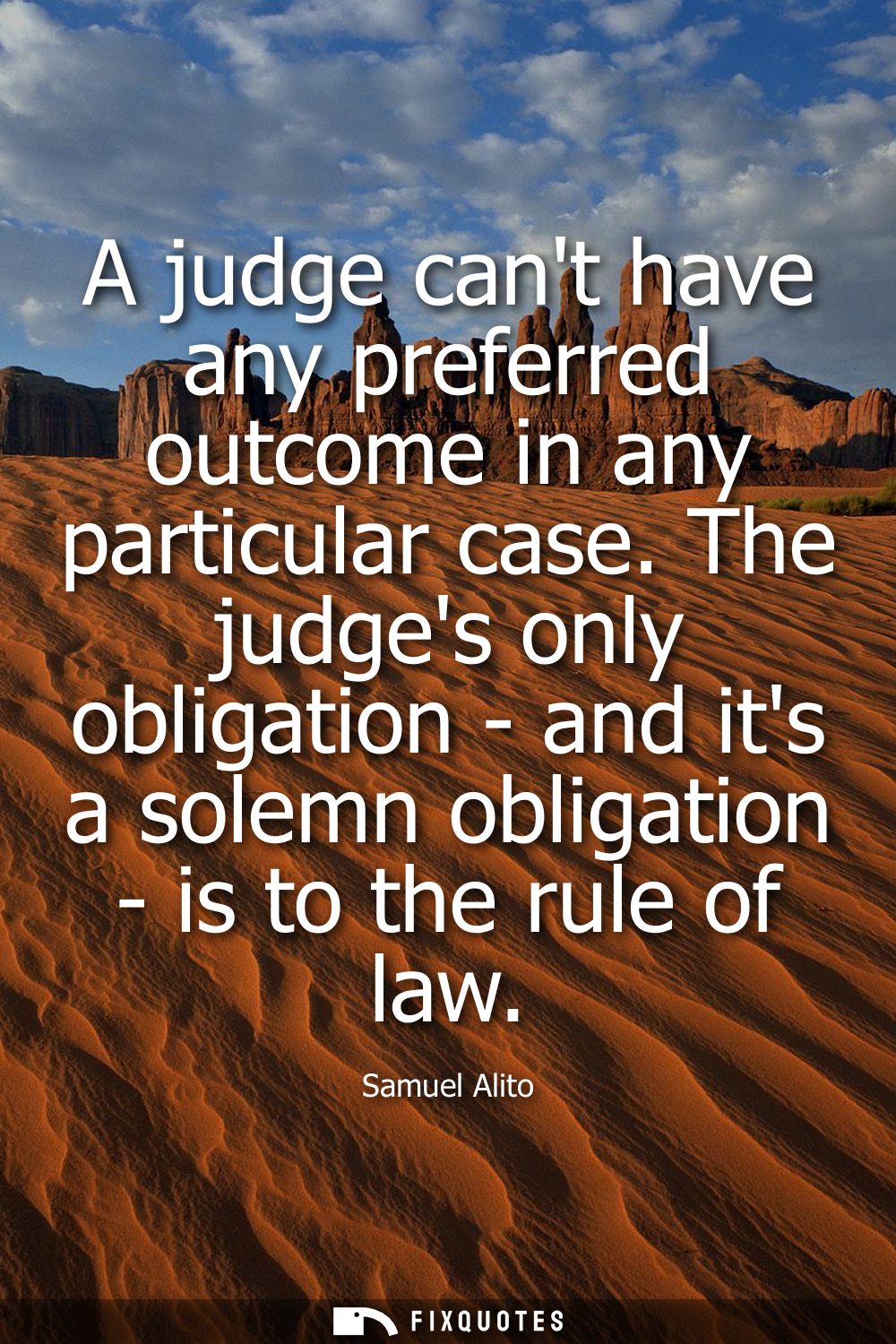
"A judge can't have any preferred outcome in any particular case. The judge's only obligation - and it's a solemn obligation - is to the rule of law"
About this Quote
The pivot to “only obligation” and “solemn obligation” does rhetorical double duty. It elevates the judge’s role into a quasi-priestly vocation while narrowing the universe of accountability. If the only duty is “to the rule of law,” then criticism based on outcomes, impacts, or lived consequences can be dismissed as category error: you’re judging the judge by politics, not by law. It’s a shield built from civics-class idealism.
The subtext is defensive because the context is combustible. Modern confirmation politics, ideological sorting, and high-stakes decisions on voting, guns, abortion, and executive power have made “preferred outcome” the accusation that never leaves the room. Alito’s formulation attempts to reframe the fight: disagreement is permitted, but only if it stays inside the boundaries of legal method.
The catch is that “the rule of law” sounds fixed while often being contested terrain. Choosing which precedent to emphasize, how to read text, when to defer, and what counts as “history and tradition” can tilt outcomes without ever admitting preference. The quote works because it’s aspirational; it persuades because it implies that aspiration is already reality.
Quote Details
| Topic | Justice |
|---|---|
| Source | Help us find the source |
| Cite |
Citation Formats
APA Style (7th ed.)
Alito, Samuel. (2026, January 15). A judge can't have any preferred outcome in any particular case. The judge's only obligation - and it's a solemn obligation - is to the rule of law. FixQuotes. https://fixquotes.com/quotes/a-judge-cant-have-any-preferred-outcome-in-any-88076/
Chicago Style
Alito, Samuel. "A judge can't have any preferred outcome in any particular case. The judge's only obligation - and it's a solemn obligation - is to the rule of law." FixQuotes. January 15, 2026. https://fixquotes.com/quotes/a-judge-cant-have-any-preferred-outcome-in-any-88076/.
MLA Style (9th ed.)
"A judge can't have any preferred outcome in any particular case. The judge's only obligation - and it's a solemn obligation - is to the rule of law." FixQuotes, 15 Jan. 2026, https://fixquotes.com/quotes/a-judge-cant-have-any-preferred-outcome-in-any-88076/. Accessed 11 Mar. 2026.