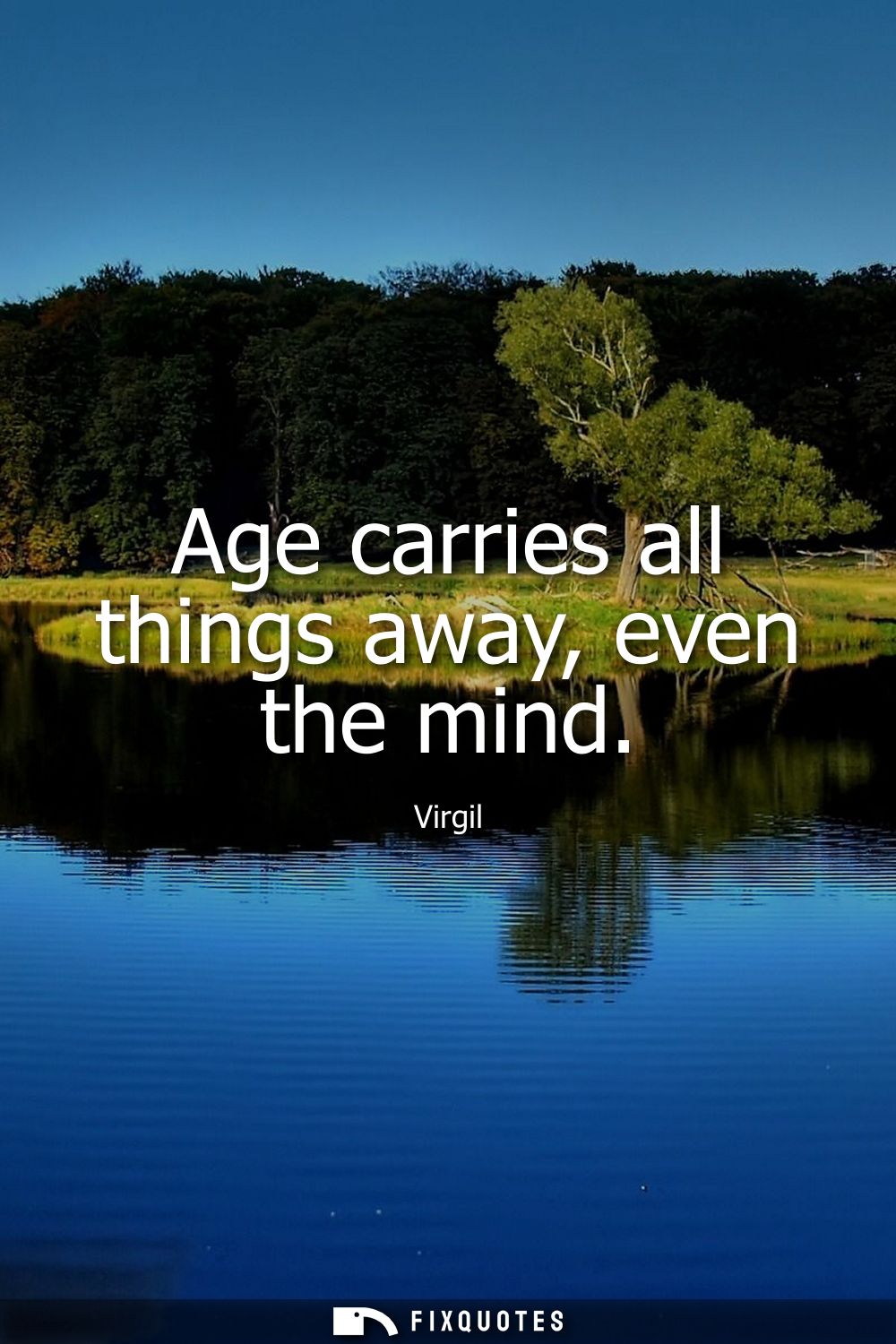
"Age carries all things away, even the mind"
About this Quote
Virgil lands the blow with a quiet inevitability: time is not a thief with taste, it is a solvent. "Age carries all things away" reads like a maxim you might inscribe on stone, but the sting is in the appositive clause that follows, narrowing the target from the usual props of youth to the one faculty we flatter ourselves is timeless. Beauty fades, strength goes, fortunes turn - fine. Even the mind? That is the line that punctures Roman self-mythology about discipline, virtue, and rational command.
The verb choice matters. "Carries away" suggests a steady current rather than a sudden catastrophe: erosion, not explosion. It refuses the heroic narrative in which losses arrive only by battle or fate's dramatic intervention. Age is the unglamorous antagonist that wins by merely continuing.
Virgil writes from a culture obsessed with legacy: the Aeneid is practically a national origin story engineered to make Rome feel inevitable. Against that background, this sentence is an anticlimax with teeth. The empire can build monuments and genealogies, but the individual still confronts the humiliating truth that memory itself is mortal. There's a political undertone, too: if the mind degrades, so does judgment, and with it the capacity to rule oneself - the Roman ideal of self-mastery quietly recast as temporary.
The subtext is not despair so much as a hard corrective to pride. Virgil isn't asking you to fear death; he's asking you to distrust the consolation that intellect exempts you from the body's countdown.
The verb choice matters. "Carries away" suggests a steady current rather than a sudden catastrophe: erosion, not explosion. It refuses the heroic narrative in which losses arrive only by battle or fate's dramatic intervention. Age is the unglamorous antagonist that wins by merely continuing.
Virgil writes from a culture obsessed with legacy: the Aeneid is practically a national origin story engineered to make Rome feel inevitable. Against that background, this sentence is an anticlimax with teeth. The empire can build monuments and genealogies, but the individual still confronts the humiliating truth that memory itself is mortal. There's a political undertone, too: if the mind degrades, so does judgment, and with it the capacity to rule oneself - the Roman ideal of self-mastery quietly recast as temporary.
The subtext is not despair so much as a hard corrective to pride. Virgil isn't asking you to fear death; he's asking you to distrust the consolation that intellect exempts you from the body's countdown.
Quote Details
| Topic | Aging |
|---|
More Quotes by Virgil
Add to List