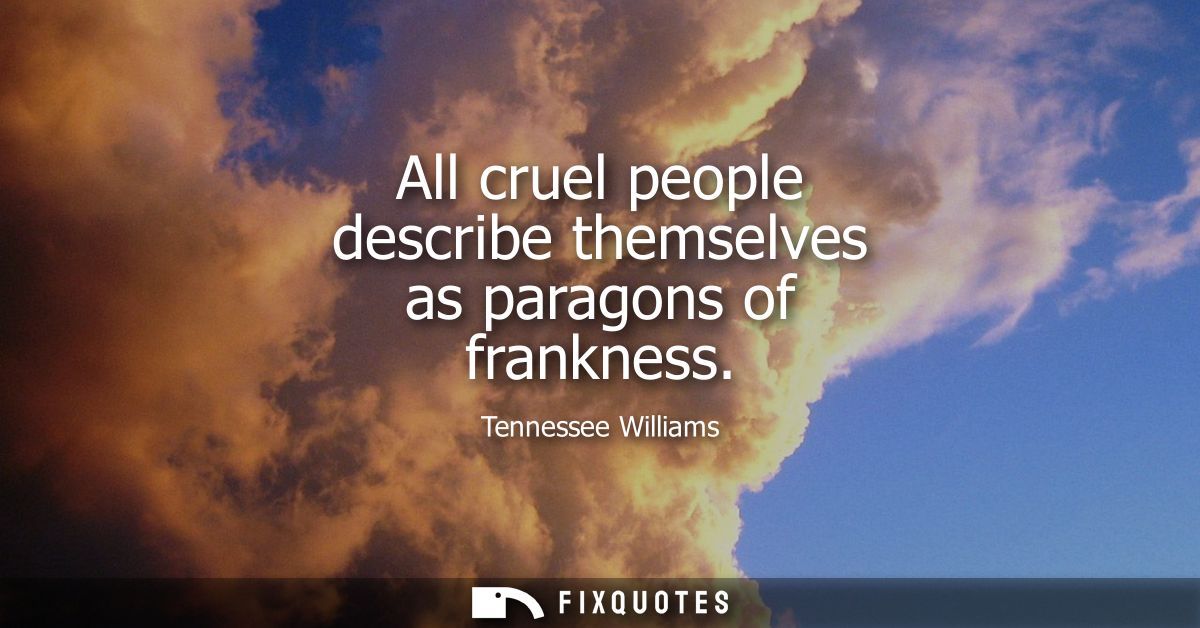
"All cruel people describe themselves as paragons of frankness"
About this Quote
People who inflict cruelty on others often see themselves not as wrongdoers, but as champions of honesty. They cloak their harshness in the guise of candor, claiming a commitment to truth as justification for their hurtful actions. By doing so, they avoid self-examination, sidestepping the uncomfortable reality that their words or behaviors might be rooted in malice, aggression, or insecurity rather than sincerity. The self-identification as paragons of frankness allows them to feel morally superior, as if they are courageously tearing away comforting illusions for the benefit of others.
This is not genuine bravery or integrity, but a subtle form of self-deception. Frankness describes openness and sincerity, but it does not require brutality. Authentic honesty can coexist with compassion; the manner in which truth is delivered matters just as much as the truth itself. For those hiding behind a mask of honesty, cruelty becomes excusable, even noble. Their victims are framed as unable to handle hard truths, shifting blame away from the speaker and onto the recipient. In such dynamics, the cruel person accrues self-esteem from their supposed forthrightness, casting themselves as bold and uncompromising in a world of polite liars.
Yet, this self-aggrandizement overlooks the emotional cost inflicted on others. True honesty springs from empathy and courage, not from a desire to wound or dominate. The use of “frankness” as a shield highlights a deep discomfort with vulnerability; it is far easier to be harsh than gentle. The act of labeling oneself as forthright is often a blindfold, preventing awareness of one’s own motivations. Ultimately, the statement suggests that cruelty is frequently rationalized by those who perpetrate it, hidden behind a narrative of principled honesty that serves as both armor and escape from confronting their true selves.
More details
About the Author