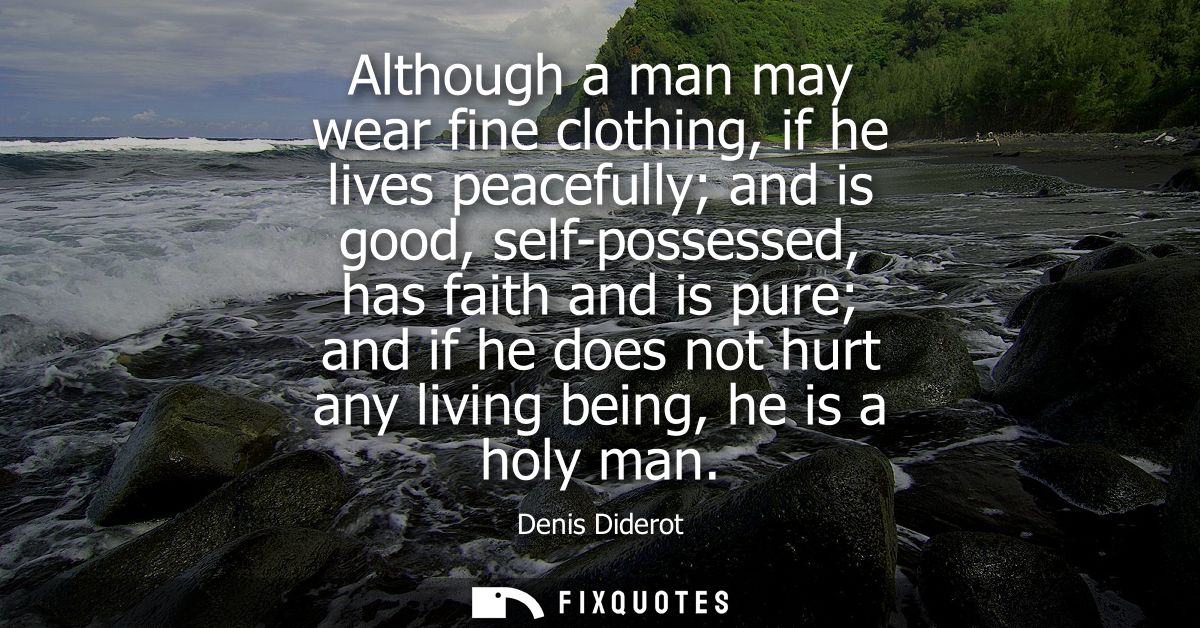
"Although a man may wear fine clothing, if he lives peacefully; and is good, self-possessed, has faith and is pure; and if he does not hurt any living being, he is a holy man"
About this Quote
That “although” matters. It’s a preemptive strike against a culture that treated virtue as visible branding - the saint in rags, the courtier in lace, each legible at a glance. Diderot, the great editor of the Encyclopedie, is editing the very idea of sanctity: away from ecclesiastical markers and toward a portable ethics anyone can practice. “Holy man” becomes a secular job title, earned through conduct rather than consecration.
The list of virtues is tellingly practical. “Peacefully” and “self-possessed” read like civic temperament, not mystical ecstasy. “Faith” sits beside “pure” without doctrinal specifics, a shrewd broadening that keeps religion from monopolizing morality while still speaking in a vocabulary 18th-century readers recognized. The ethical core arrives with the final clause: “does not hurt any living being.” It’s radical in its quiet way, pushing compassion beyond tribe and church toward a proto-humanitarian, even proto-animal-rights sensibility.
Subtext: stop mistaking aesthetics for ethics. In a France of salons, clerical power, and sharp class signals, Diderot argues that virtue is not a uniform - it’s a practice, and it can survive prosperity.
Quote Details
| Topic | Ethics & Morality |
|---|---|
| Source | Help us find the source |
| Cite |
Citation Formats
APA Style (7th ed.)
Diderot, Denis. (2026, January 17). Although a man may wear fine clothing, if he lives peacefully; and is good, self-possessed, has faith and is pure; and if he does not hurt any living being, he is a holy man. FixQuotes. https://fixquotes.com/quotes/although-a-man-may-wear-fine-clothing-if-he-lives-81578/
Chicago Style
Diderot, Denis. "Although a man may wear fine clothing, if he lives peacefully; and is good, self-possessed, has faith and is pure; and if he does not hurt any living being, he is a holy man." FixQuotes. January 17, 2026. https://fixquotes.com/quotes/although-a-man-may-wear-fine-clothing-if-he-lives-81578/.
MLA Style (9th ed.)
"Although a man may wear fine clothing, if he lives peacefully; and is good, self-possessed, has faith and is pure; and if he does not hurt any living being, he is a holy man." FixQuotes, 17 Jan. 2026, https://fixquotes.com/quotes/although-a-man-may-wear-fine-clothing-if-he-lives-81578/. Accessed 3 Apr. 2026.