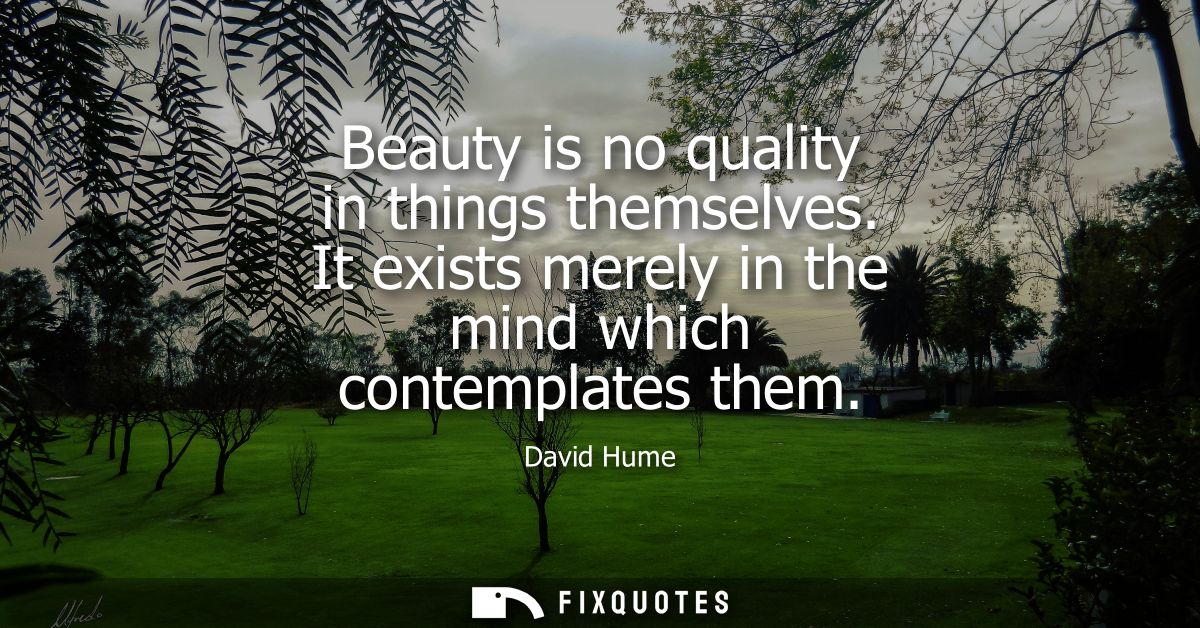
"Beauty is no quality in things themselves. It Exists merely in the mind which contemplates them"
About this Quote
The line lands with the cool audacity of Enlightenment skepticism. Hume is writing against the comforting idea that taste can be settled the way geometry can. If beauty “exists” only in contemplation, then aesthetic disputes aren’t scientific disagreements; they’re collisions of temperament, culture, and history. The subtext is quietly destabilizing: the museum, the canon, the critic, even the lover’s gaze become less like neutral arbiters and more like participants in a psychological transaction.
Yet Hume isn’t just licensing “anything goes.” His larger project in “Of the Standard of Taste” tries to explain why we still talk as if some judgments are better than others. If beauty is mind-dependent, you can still compare minds: whose perception is more practiced, less distracted by prejudice, more attentive to form? That’s the tightrope he walks: dismantling the myth of objective beauty without surrendering to pure relativism.
Read today, the quote feels eerily contemporary. It anticipates algorithmic aesthetics and culture-war taste battles by insisting that the battlefield was always inside the observer.
Quote Details
| Topic | Wisdom |
|---|---|
| Source | Later attribution: Life as We Know It (Joseph Seckbach, 2006) modern compilationISBN: 9781402044038 · ID: kZnCw6jAO98C
Evidence:
... David Hume : " Beauty is no quality in things themselves . It exists merely in the mind which contemplates them . " My mind contemplated my personal view on beauty . It is now up to you to contemplate whether this view can be shared ... |
| Cite |
Citation Formats
APA Style (7th ed.)
Hume, David. (2026, April 1). Beauty is no quality in things themselves. It Exists merely in the mind which contemplates them. FixQuotes. https://fixquotes.com/quotes/beauty-is-no-quality-in-things-themselves-it-72818/
Chicago Style
Hume, David. "Beauty is no quality in things themselves. It Exists merely in the mind which contemplates them." FixQuotes. April 1, 2026. https://fixquotes.com/quotes/beauty-is-no-quality-in-things-themselves-it-72818/.
MLA Style (9th ed.)
"Beauty is no quality in things themselves. It Exists merely in the mind which contemplates them." FixQuotes, 1 Apr. 2026, https://fixquotes.com/quotes/beauty-is-no-quality-in-things-themselves-it-72818/. Accessed 2 Apr. 2026.