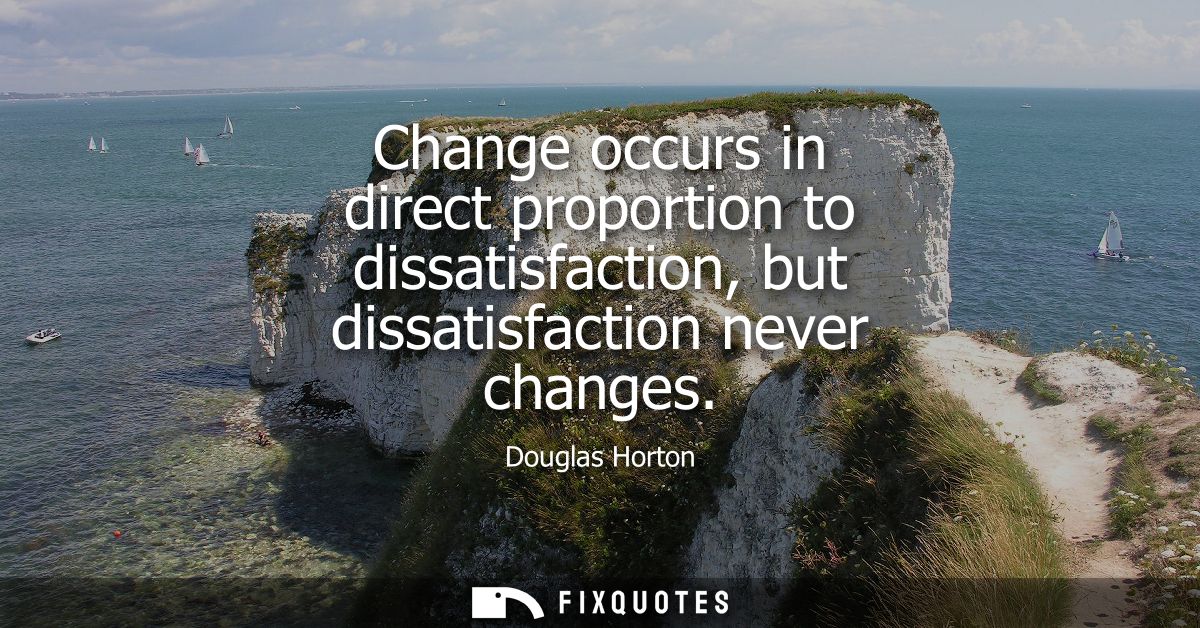
"Change occurs in direct proportion to dissatisfaction, but dissatisfaction never changes"
About this Quote
Horton’s line reads like a neat equation, then slips the knife: dissatisfaction is the engine of reform, yet it’s also the one constant we never reform out of ourselves. The first clause flatters the modern faith in progress - suffer enough and you’ll finally do something about it. The second clause is the cleric’s corrective, a theological eye-roll at the self-help fantasy that fixing the world will fix the heart.
As a clergyman writing in the churn of the early-to-mid 20th century, Horton is speaking to congregations living through depression, war, social upheaval, and the expanding promises of modern life. In that atmosphere, “change” was both a moral imperative and a social slogan. He acknowledges the practical truth: dissatisfaction can catalyze conversion, activism, institutional reform. People move when comfort fails.
But the subtext is more sobering: dissatisfaction isn’t just a response to bad conditions; it’s a durable human posture. Solve one problem and the mind drafts the next complaint. The appetite for “better” regenerates faster than any program can satisfy it. Horton’s intent isn’t to shame discontent so much as to locate it: if dissatisfaction is bottomless, then progress can’t be the same thing as peace.
Rhetorically, the sentence works because it mimics a scientific law while smuggling in a spiritual diagnosis. The symmetry (“change…dissatisfaction…dissatisfaction…changes”) creates a trapdoor: you think you’re reading management advice, then realize you’re being warned about the limits of reform without inner transformation.
As a clergyman writing in the churn of the early-to-mid 20th century, Horton is speaking to congregations living through depression, war, social upheaval, and the expanding promises of modern life. In that atmosphere, “change” was both a moral imperative and a social slogan. He acknowledges the practical truth: dissatisfaction can catalyze conversion, activism, institutional reform. People move when comfort fails.
But the subtext is more sobering: dissatisfaction isn’t just a response to bad conditions; it’s a durable human posture. Solve one problem and the mind drafts the next complaint. The appetite for “better” regenerates faster than any program can satisfy it. Horton’s intent isn’t to shame discontent so much as to locate it: if dissatisfaction is bottomless, then progress can’t be the same thing as peace.
Rhetorically, the sentence works because it mimics a scientific law while smuggling in a spiritual diagnosis. The symmetry (“change…dissatisfaction…dissatisfaction…changes”) creates a trapdoor: you think you’re reading management advice, then realize you’re being warned about the limits of reform without inner transformation.
Quote Details
| Topic | Change |
|---|
More Quotes by Douglas
Add to List