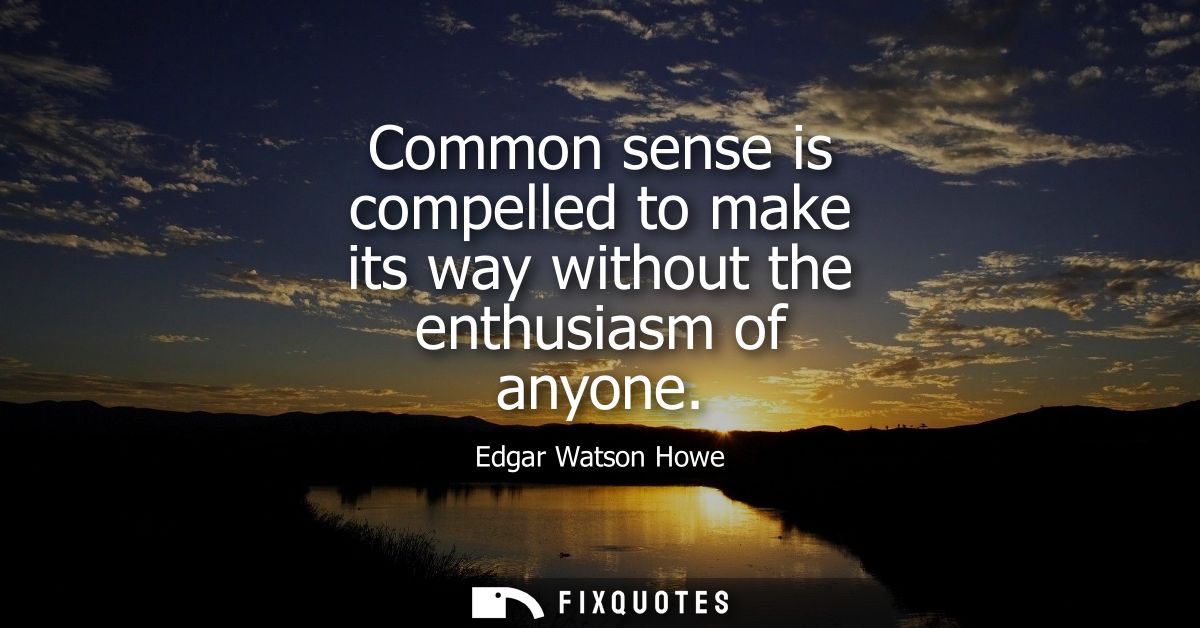
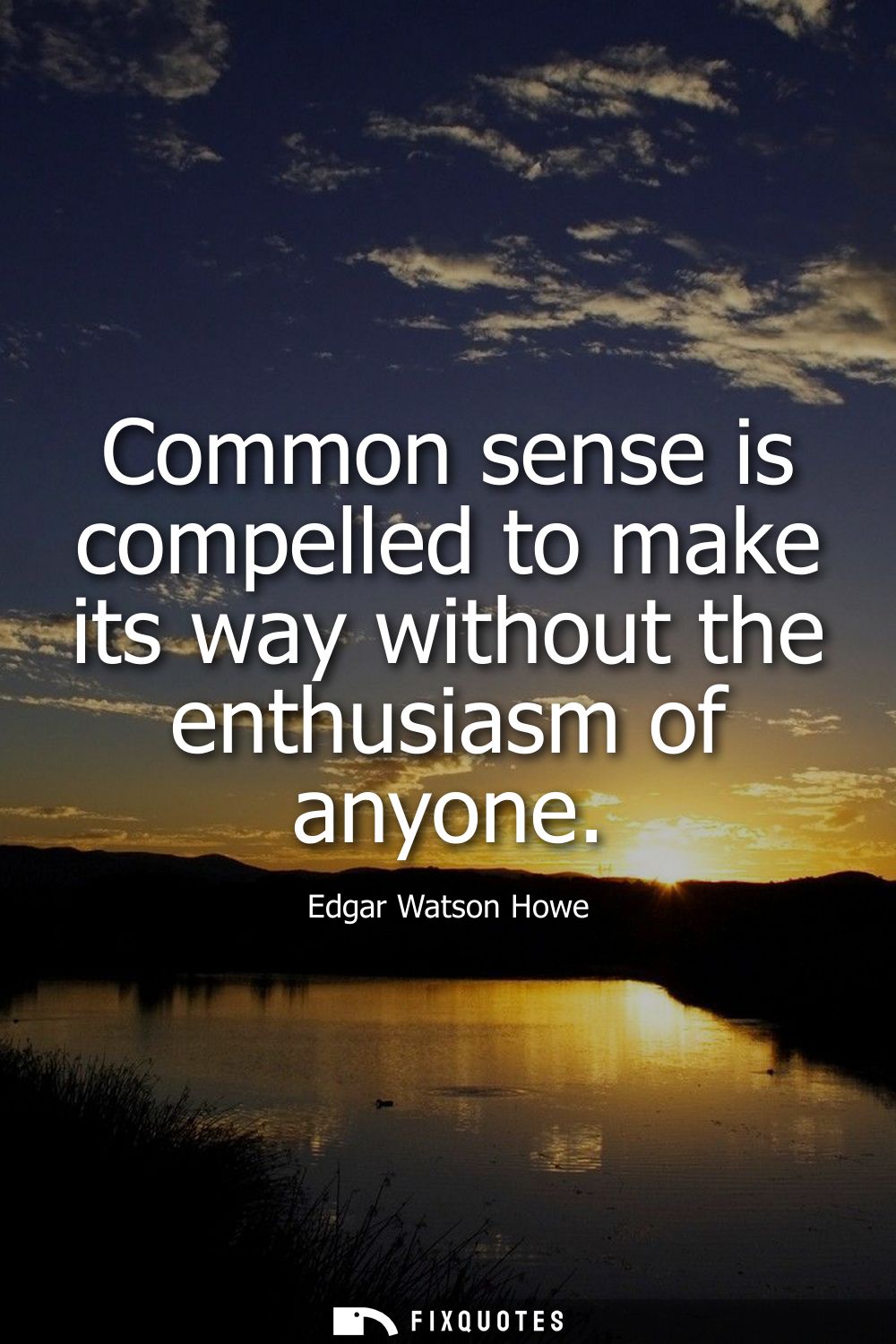
"Common sense is compelled to make its way without the enthusiasm of anyone"
About this Quote
The verb choice is the tell. "Compelled" suggests necessity without romance: common sense doesn't stride in triumph; it trudges because reality eventually enforces it. And "make its way" frames wisdom as incremental and obstructed, as if it must push through a crowd that would rather be entertained than persuaded. The subtext is a critique of public discourse as performance, where intensity is mistaken for truth. If no one is enthusiastic, it's not because the idea lacks merit; it's because it lacks dopamine.
Howe's context matters. As a late-19th- and early-20th-century American editor, he worked in an era when newspapers were becoming mass entertainment and opinion factories, with sensationalism selling better than sober judgment. The aphorism reads like newsroom scar tissue: the editor watches cycles of mania crest and crash, while the sensible position only becomes acceptable after consequences do the convincing.
There's also a quiet warning for reformers: if you're waiting for applause before acting sanely, you're already lost. Common sense often wins, Howe suggests, but it wins the way gravity does - silently, and after everyone has had their fun.
Quote Details
| Topic | Wisdom |
|---|---|
| Source | Help us find the source |
| Cite |
Citation Formats
APA Style (7th ed.)
Howe, Edgar Watson. (2026, January 15). Common sense is compelled to make its way without the enthusiasm of anyone. FixQuotes. https://fixquotes.com/quotes/common-sense-is-compelled-to-make-its-way-without-144774/
Chicago Style
Howe, Edgar Watson. "Common sense is compelled to make its way without the enthusiasm of anyone." FixQuotes. January 15, 2026. https://fixquotes.com/quotes/common-sense-is-compelled-to-make-its-way-without-144774/.
MLA Style (9th ed.)
"Common sense is compelled to make its way without the enthusiasm of anyone." FixQuotes, 15 Jan. 2026, https://fixquotes.com/quotes/common-sense-is-compelled-to-make-its-way-without-144774/. Accessed 25 Mar. 2026.