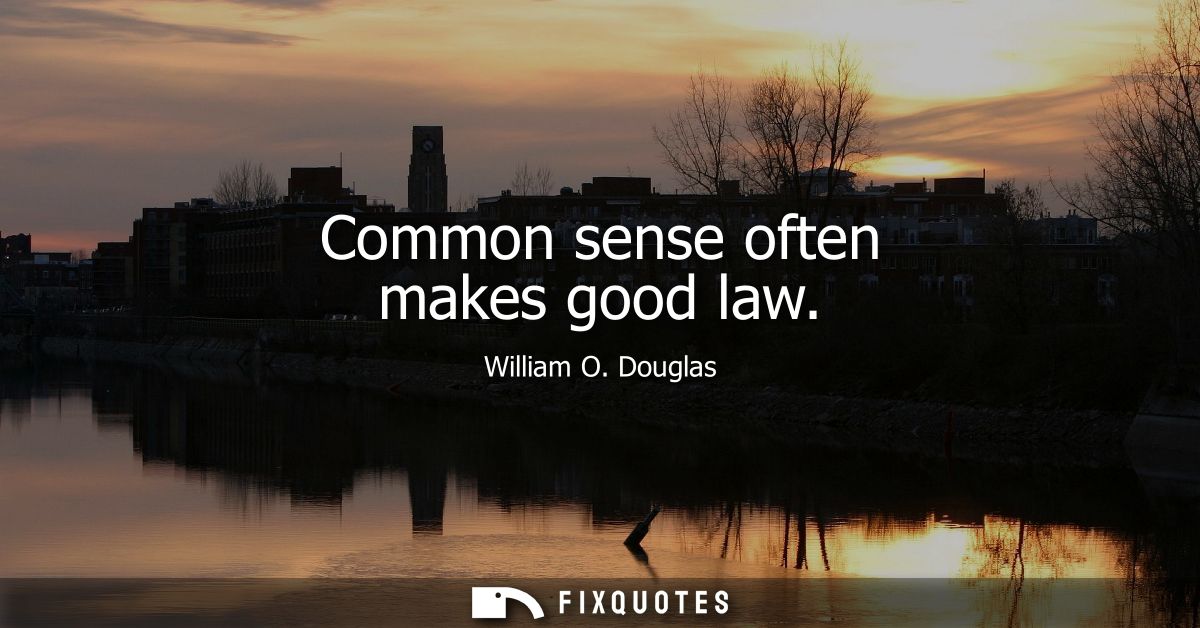
"Common sense often makes good law"
About this Quote
“Common sense often makes good law” is a deceptively homespun line from a justice who spent his career fighting over what, exactly, counts as “sense” in a plural, unequal country. William O. Douglas wasn’t praising gut instinct so much as taking aim at legal formalism: the tendency to treat doctrine as a self-contained machine that can grind out results indifferent to lived reality. The word “often” does real work here. It’s a hedge and a warning. Common sense can correct legal absurdities, but it can also smuggle in prejudice dressed up as practicality.
Douglas’s intent reads as both populist and strategic. Populist because it flatters the public’s intuition that law should track everyday moral reasoning; strategic because it gives judges permission to resist technicalities when they produce outcomes that feel wrong. This is the subtext of much of Douglas’s jurisprudence, especially in civil liberties: he routinely pushed courts to see constitutional protections not as museum pieces but as usable tools. “Common sense” becomes a bridge between abstract rights and concrete harms - an argument that legitimacy depends on law’s ability to map onto recognizable human experience.
The context matters. Douglas served through the New Deal state’s expansion, World War II, the Red Scare, and the civil rights era - decades when “reasonable” was contested terrain. In such moments, law is tempted either by bureaucratic overreach or by panic-driven crackdowns. Douglas’s line tries to tether legal authority to something sturdier than fear or ritual. It’s also a quiet reminder: when law loses contact with ordinary judgment, it risks becoming a profession’s private language - and a public’s private grievance.
Douglas’s intent reads as both populist and strategic. Populist because it flatters the public’s intuition that law should track everyday moral reasoning; strategic because it gives judges permission to resist technicalities when they produce outcomes that feel wrong. This is the subtext of much of Douglas’s jurisprudence, especially in civil liberties: he routinely pushed courts to see constitutional protections not as museum pieces but as usable tools. “Common sense” becomes a bridge between abstract rights and concrete harms - an argument that legitimacy depends on law’s ability to map onto recognizable human experience.
The context matters. Douglas served through the New Deal state’s expansion, World War II, the Red Scare, and the civil rights era - decades when “reasonable” was contested terrain. In such moments, law is tempted either by bureaucratic overreach or by panic-driven crackdowns. Douglas’s line tries to tether legal authority to something sturdier than fear or ritual. It’s also a quiet reminder: when law loses contact with ordinary judgment, it risks becoming a profession’s private language - and a public’s private grievance.
Quote Details
| Topic | Justice |
|---|---|
| Source | Help us find the source |
| Cite |
Citation Formats
APA Style (7th ed.)
Douglas, William O. (2026, January 17). Common sense often makes good law. FixQuotes. https://fixquotes.com/quotes/common-sense-often-makes-good-law-66435/
Chicago Style
Douglas, William O. "Common sense often makes good law." FixQuotes. January 17, 2026. https://fixquotes.com/quotes/common-sense-often-makes-good-law-66435/.
MLA Style (9th ed.)
"Common sense often makes good law." FixQuotes, 17 Jan. 2026, https://fixquotes.com/quotes/common-sense-often-makes-good-law-66435/. Accessed 27 Mar. 2026.
More Quotes by William
Add to List