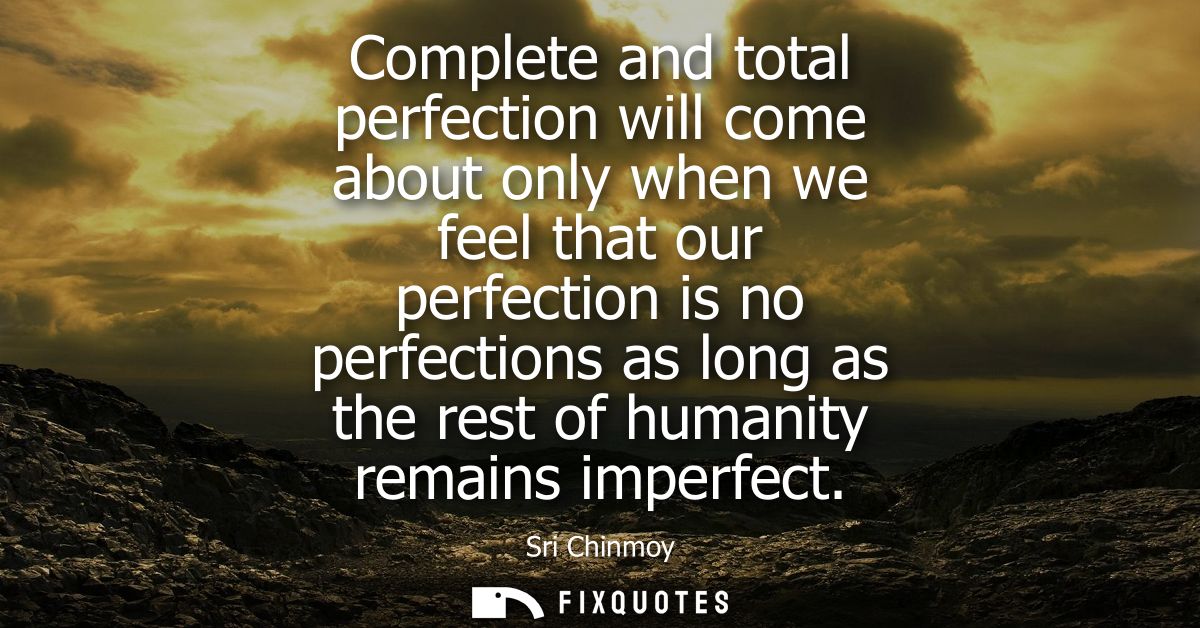
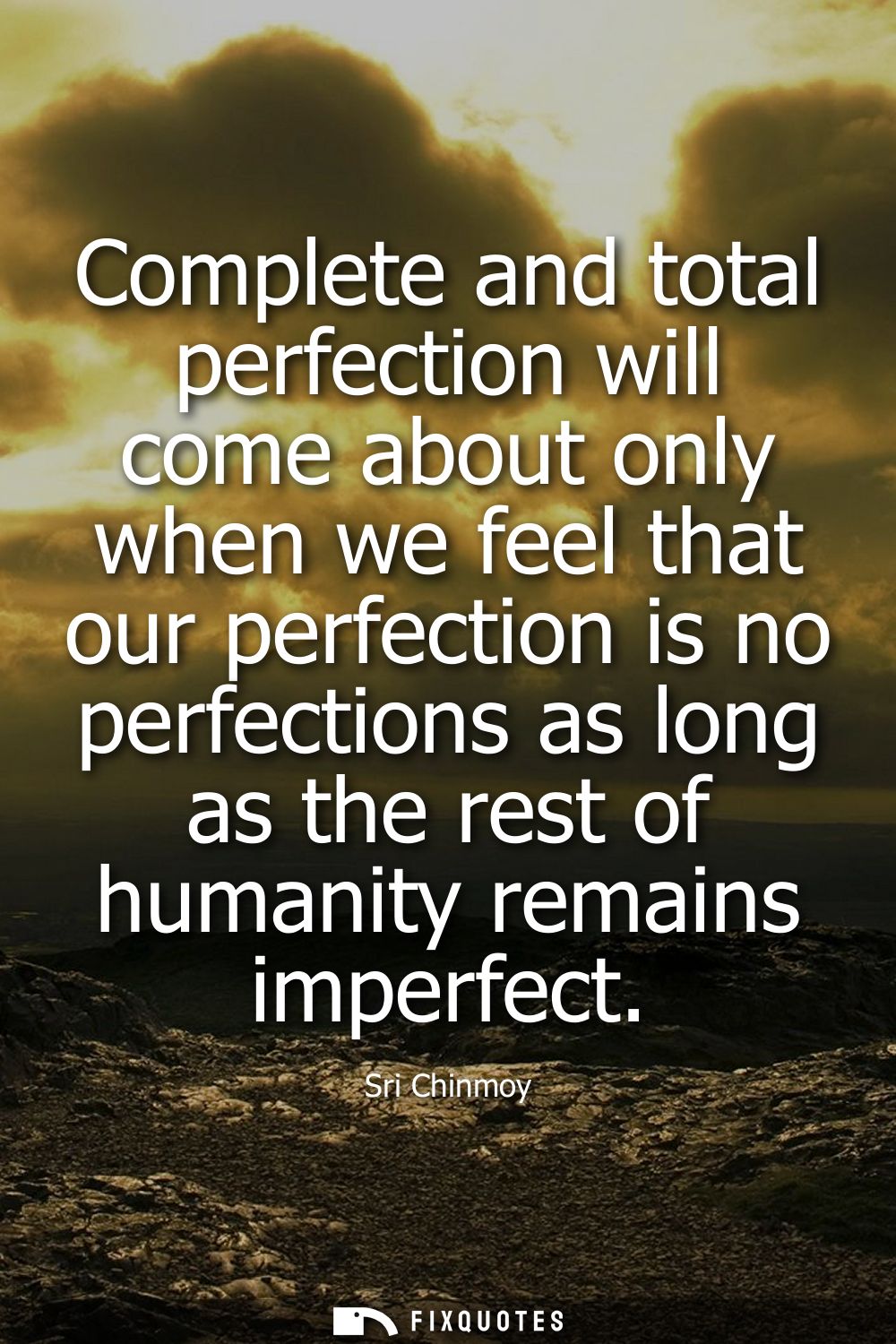
"Complete and total perfection will come about only when we feel that our perfection is no perfections as long as the rest of humanity remains imperfect"
About this Quote
The line reframes perfection as a shared destiny rather than a private trophy. By declaring that our perfection is no perfection while others remain imperfect, it denies the fantasy of solitary enlightenment and replaces it with a vision of radical interdependence. Fulfillment is not an isolated peak but a horizon that expands as our sense of oneness expands. The test of personal attainment becomes the tenderness, responsibility, and solidarity we feel toward the rest of humanity.
Sri Chinmoy often spoke of the oneness-heart and self-transcendence. Perfection, in his view, is not a static endpoint but a continual widening of sympathy, action, and awareness. The word feel is crucial: the statement does not impose a moral rule from outside but invites an inner recognition that the boundary between self and other is porous. When that recognition flowers, what once looked like personal perfection feels incomplete, because love cannot be satisfied when others suffer or lag behind.
There is also a paradox designed to dethrone spiritual pride. If we take our progress as final, we detach from the living web that made it possible. Humility restores perspective: the more refined the consciousness, the more vivid the perception of our shared unfinishedness. The ideal echoes currents found in Vedanta and the bodhisattva vow, where awakening is measured by the drive to uplift all beings.
Practically, this vision redirects ambition. Excellence is encouraged, yet the goal shifts from private achievement to service that invites others into growth. Art, meditation, athletics, or leadership become vehicles for collective elevation. Perfection turns relational: a field we co-create through empathy, encouragement, and concrete help. In that light, progress is not downgraded; it is dignified by purpose. The summit is not conquered alone. It is reached when the joy of one becomes the progress of all, and the progress of all confirms the truth of the one.
Sri Chinmoy often spoke of the oneness-heart and self-transcendence. Perfection, in his view, is not a static endpoint but a continual widening of sympathy, action, and awareness. The word feel is crucial: the statement does not impose a moral rule from outside but invites an inner recognition that the boundary between self and other is porous. When that recognition flowers, what once looked like personal perfection feels incomplete, because love cannot be satisfied when others suffer or lag behind.
There is also a paradox designed to dethrone spiritual pride. If we take our progress as final, we detach from the living web that made it possible. Humility restores perspective: the more refined the consciousness, the more vivid the perception of our shared unfinishedness. The ideal echoes currents found in Vedanta and the bodhisattva vow, where awakening is measured by the drive to uplift all beings.
Practically, this vision redirects ambition. Excellence is encouraged, yet the goal shifts from private achievement to service that invites others into growth. Art, meditation, athletics, or leadership become vehicles for collective elevation. Perfection turns relational: a field we co-create through empathy, encouragement, and concrete help. In that light, progress is not downgraded; it is dignified by purpose. The summit is not conquered alone. It is reached when the joy of one becomes the progress of all, and the progress of all confirms the truth of the one.
Quote Details
| Topic | Wisdom |
|---|
More Quotes by Sri
Add to List