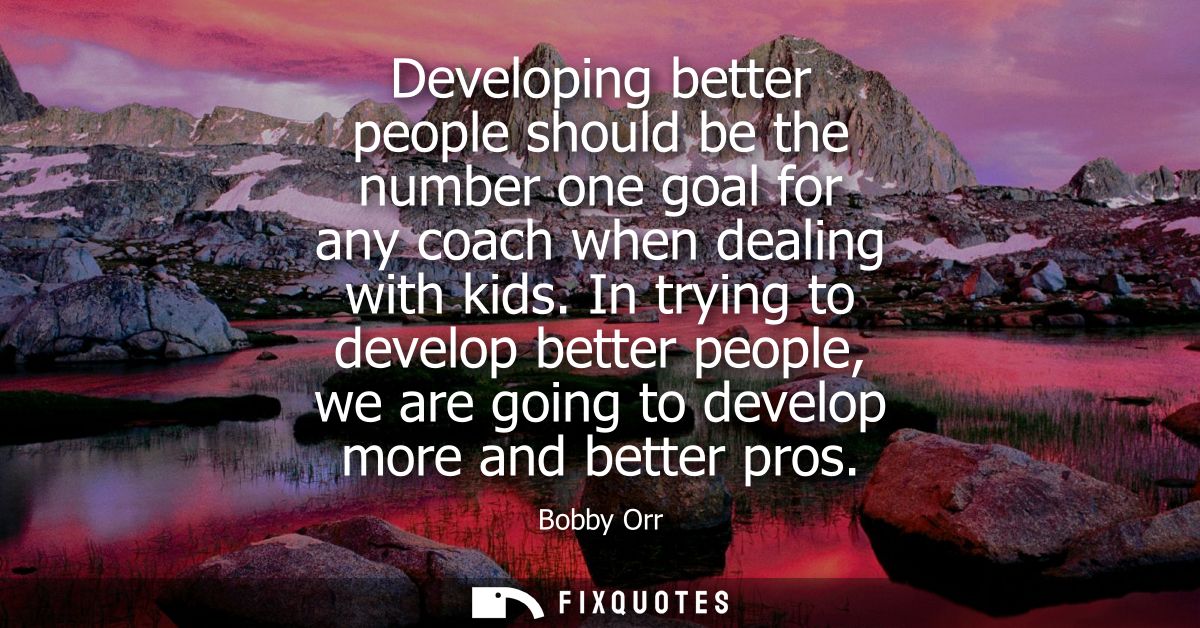
"Developing better people should be the number one goal for any coach when dealing with kids. In trying to develop better people, we are going to develop more and better pros"
About this Quote
Bobby Orr shifts the center of gravity in youth coaching from scoreboards to character. He argues that the primary mission with kids is forming better people, and that excellence in sport emerges as a byproduct of that deeper work. The message pushes back against a win-at-all-costs culture and the narrow focus on early specialization, rankings, and highlight reels. Coaching becomes a moral craft: shaping habits, values, and identities that endure long after a season ends.
Developing better people means teaching discipline, resilience, humility, teamwork, and respect. These traits are not soft add-ons; they drive performance. An athlete who can handle failure, listen to feedback, sacrifice for the group, and stay steady under pressure is more likely to improve steadily and perform when it matters. By investing in character, coaches build the foundation for coachability, consistency, and competitive poise. The paradox Orr identifies is that the less we obsess over producing prodigies, the more likely true professionals emerge.
Context matters coming from Orr. As a transformational NHL defenseman and later an advocate for young players, he has seen how early hype and adult agendas can warp kids’ experiences. His perspective recasts success: not every child will become a professional athlete, but every child can carry professional habits into whatever they do. For the few who reach elite levels, the difference between talent that flashes and talent that endures is often character.
Practically, this ethos looks like praising effort over outcome, modeling grace in winning and losing, creating space for safe failure, and putting relationships before tactics. It means protecting kids from burnout and burnout’s cousin, cynicism. When coaches measure their impact by the kind of people their players become, they dignify the game and the child. The irony, as Orr notes, is that doing the right thing for kids is also the best way to develop champions.
Developing better people means teaching discipline, resilience, humility, teamwork, and respect. These traits are not soft add-ons; they drive performance. An athlete who can handle failure, listen to feedback, sacrifice for the group, and stay steady under pressure is more likely to improve steadily and perform when it matters. By investing in character, coaches build the foundation for coachability, consistency, and competitive poise. The paradox Orr identifies is that the less we obsess over producing prodigies, the more likely true professionals emerge.
Context matters coming from Orr. As a transformational NHL defenseman and later an advocate for young players, he has seen how early hype and adult agendas can warp kids’ experiences. His perspective recasts success: not every child will become a professional athlete, but every child can carry professional habits into whatever they do. For the few who reach elite levels, the difference between talent that flashes and talent that endures is often character.
Practically, this ethos looks like praising effort over outcome, modeling grace in winning and losing, creating space for safe failure, and putting relationships before tactics. It means protecting kids from burnout and burnout’s cousin, cynicism. When coaches measure their impact by the kind of people their players become, they dignify the game and the child. The irony, as Orr notes, is that doing the right thing for kids is also the best way to develop champions.
Quote Details
| Topic | Coaching |
|---|
More Quotes by Bobby
Add to List