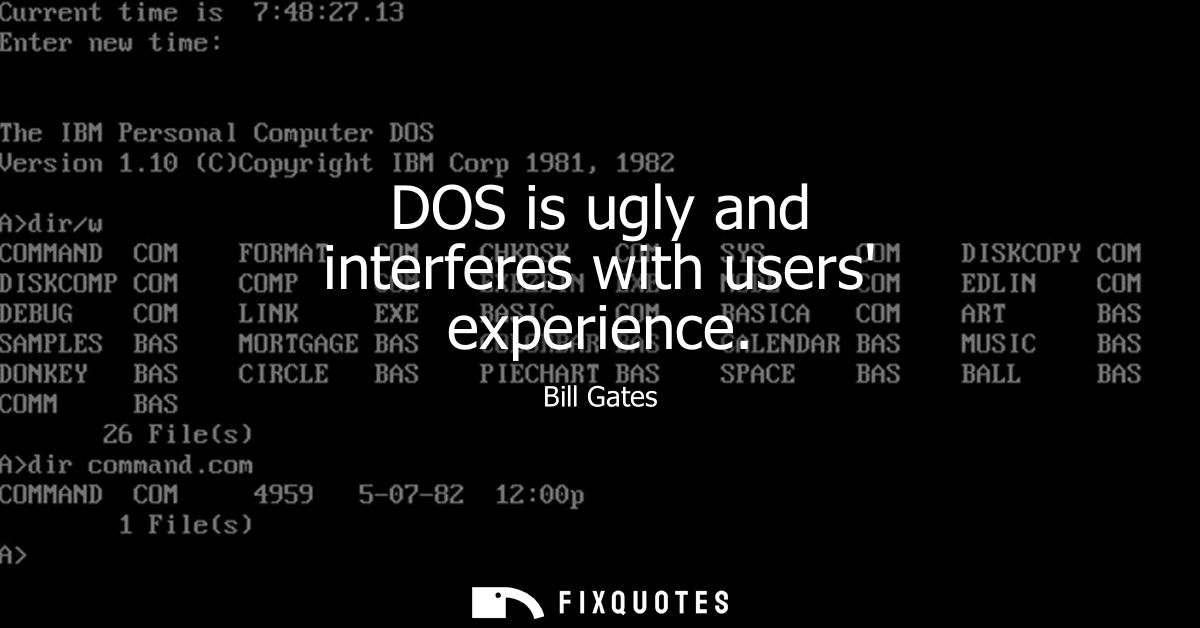
"DOS is ugly and interferes with users' experience"
About this Quote
“DOS is ugly and interferes with users' experience” reads less like an aesthetic complaint and more like a strategy memo disguised as empathy. In the early personal-computing era, “ugly” wasn’t about taste; it was about friction. Command lines demanded literacy in a machine’s language, punishing novices with cryptic errors and reward structures built for hobbyists and professionals. Gates is naming the bottleneck: not processor speed, not storage, but adoption. If the interface is hostile, the market stays small.
The key subtext is power. Calling DOS “ugly” quietly reframes technical competence as a design failure. It shifts authority away from the priesthood of programmers and toward whoever can make computers feel inevitable to ordinary people. That’s not just user-friendly rhetoric; it’s how you justify a platform shift. If DOS “interferes,” then the next layer up (a graphical shell, a unified interface, eventually Windows as the default experience) becomes not a luxury but a correction to a harm.
The line also plays defense. DOS was Microsoft’s foundation; publicly criticizing it creates distance from its limitations while keeping ownership of the transition. It positions Microsoft as the advocate for the user, even as it steers the industry into tighter platform control. Gates’ genius here is managerial, not poetic: he turns “ugly” into a market diagnosis, then sells the cure as progress.
The key subtext is power. Calling DOS “ugly” quietly reframes technical competence as a design failure. It shifts authority away from the priesthood of programmers and toward whoever can make computers feel inevitable to ordinary people. That’s not just user-friendly rhetoric; it’s how you justify a platform shift. If DOS “interferes,” then the next layer up (a graphical shell, a unified interface, eventually Windows as the default experience) becomes not a luxury but a correction to a harm.
The line also plays defense. DOS was Microsoft’s foundation; publicly criticizing it creates distance from its limitations while keeping ownership of the transition. It positions Microsoft as the advocate for the user, even as it steers the industry into tighter platform control. Gates’ genius here is managerial, not poetic: he turns “ugly” into a market diagnosis, then sells the cure as progress.
Quote Details
| Topic | Technology |
|---|
More Quotes by Bill
Add to List