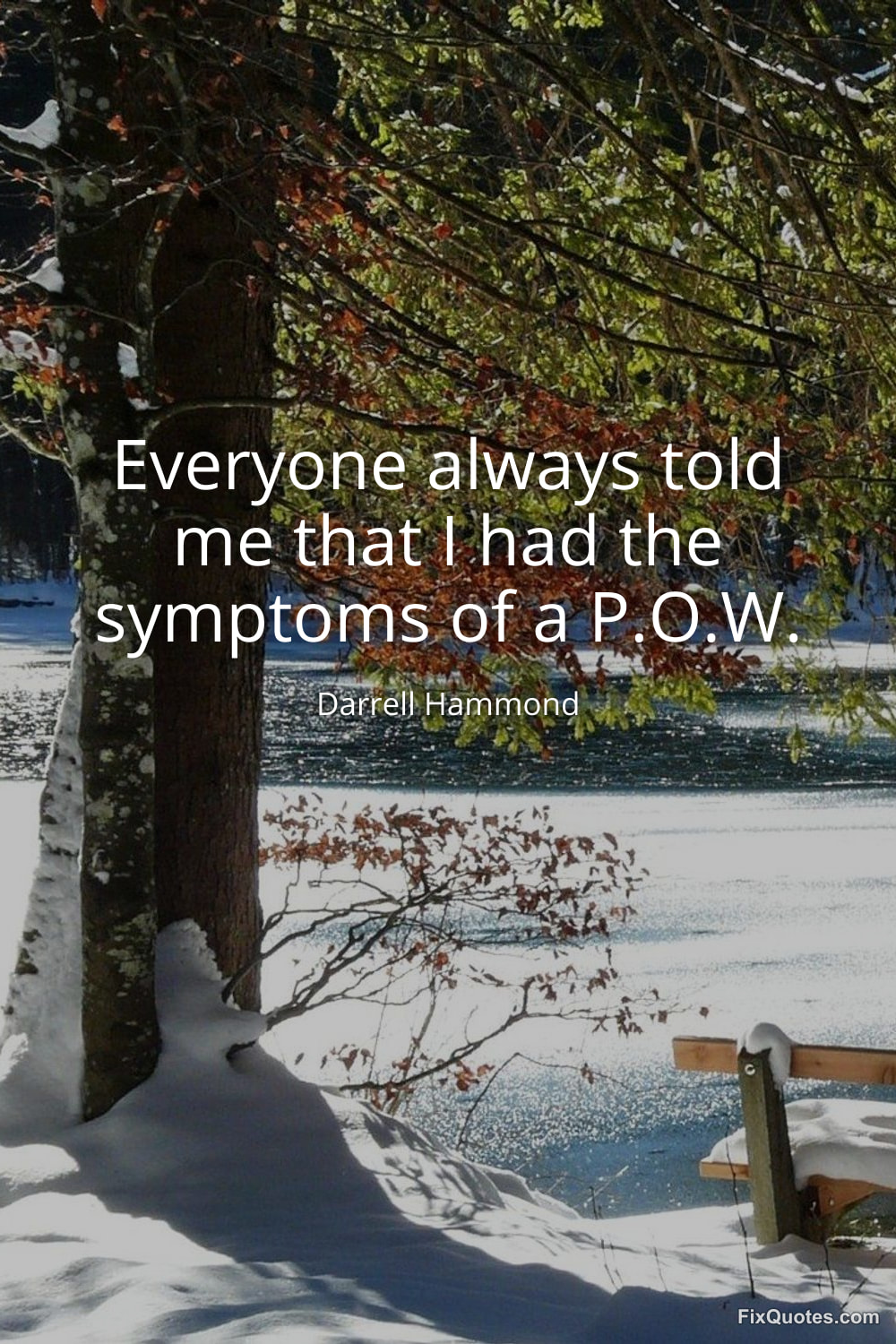
"Everyone always told me that I had the symptoms of a P.O.W"
About this Quote
It lands like a joke with the air let out of it: the setup points toward a punchline, but the punchline is damage. Darrell Hammond’s line uses the blunt acronym “P.O.W.” as a cultural shortcut for a particular kind of psychic wreckage, then swivels the camera back onto the comedian as the supposed “prisoner” of his own life. The humor is in the mismatch between the mundane “everyone always told me” and the catastrophic diagnosis. The sting is that he’s not really exaggerating.
Hammond’s public story makes the intent sharper: a performer famous for immaculate impressions and the professionally useful ability to disappear into other people, paired with long-reported trauma and mental health struggles. In that light, “symptoms” becomes a darkly clinical word for what showbiz often treats as quirks. The line exposes how pain gets translated into something legible to outsiders only when it resembles an approved narrative of suffering. A P.O.W. is someone we’re culturally trained to sympathize with; a traumatized kid, or an adult spiraling behind a grin, is easier to misread as “moody,” “difficult,” “intense.”
There’s also a sly indictment of the audience’s appetite. Comedy has always smuggled confession through laughter, but Hammond’s phrasing suggests the crowd’s complicity: people around him could name the symptoms, but not the captivity. The joke isn’t asking for pity; it’s forcing recognition that survival can look like performance, and performance can be a kind of continued imprisonment.
Hammond’s public story makes the intent sharper: a performer famous for immaculate impressions and the professionally useful ability to disappear into other people, paired with long-reported trauma and mental health struggles. In that light, “symptoms” becomes a darkly clinical word for what showbiz often treats as quirks. The line exposes how pain gets translated into something legible to outsiders only when it resembles an approved narrative of suffering. A P.O.W. is someone we’re culturally trained to sympathize with; a traumatized kid, or an adult spiraling behind a grin, is easier to misread as “moody,” “difficult,” “intense.”
There’s also a sly indictment of the audience’s appetite. Comedy has always smuggled confession through laughter, but Hammond’s phrasing suggests the crowd’s complicity: people around him could name the symptoms, but not the captivity. The joke isn’t asking for pity; it’s forcing recognition that survival can look like performance, and performance can be a kind of continued imprisonment.
Quote Details
| Topic | Witty One-Liners |
|---|---|
| Source | Help us find the source |
| Cite |
Citation Formats
APA Style (7th ed.)
Hammond, Darrell. (2026, January 15). Everyone always told me that I had the symptoms of a P.O.W. FixQuotes. https://fixquotes.com/quotes/everyone-always-told-me-that-i-had-the-symptoms-173626/
Chicago Style
Hammond, Darrell. "Everyone always told me that I had the symptoms of a P.O.W." FixQuotes. January 15, 2026. https://fixquotes.com/quotes/everyone-always-told-me-that-i-had-the-symptoms-173626/.
MLA Style (9th ed.)
"Everyone always told me that I had the symptoms of a P.O.W." FixQuotes, 15 Jan. 2026, https://fixquotes.com/quotes/everyone-always-told-me-that-i-had-the-symptoms-173626/. Accessed 28 Mar. 2026.
More Quotes by Darrell
Add to List