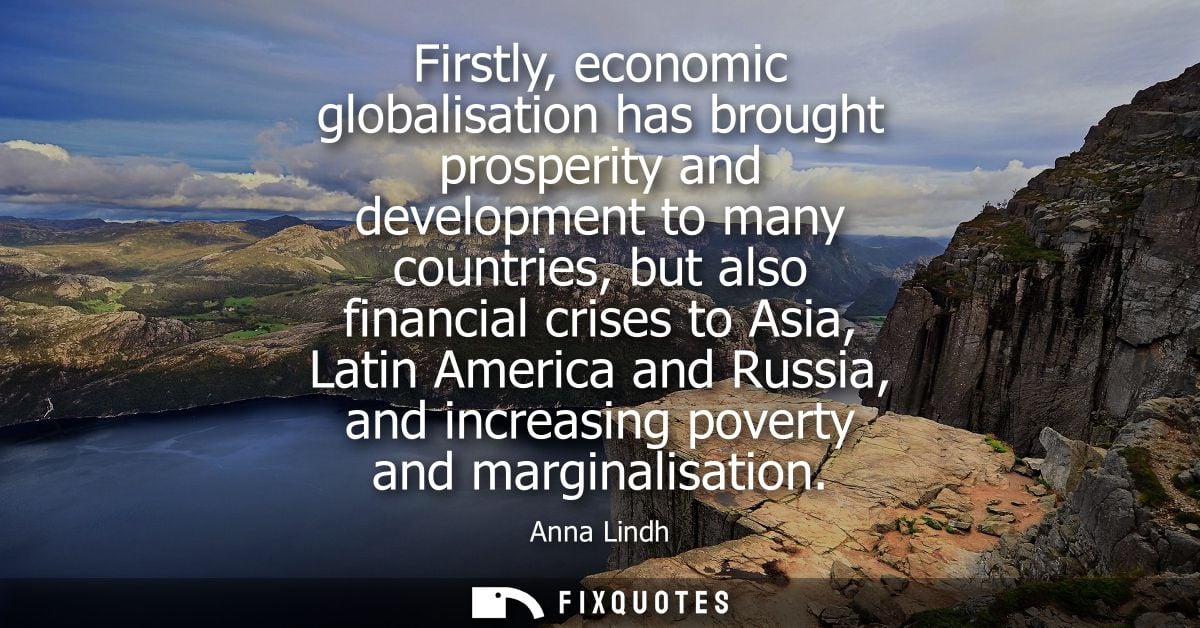
"Firstly, economic globalisation has brought prosperity and development to many countries, but also financial crises to Asia, Latin America and Russia, and increasing poverty and marginalisation"
About this Quote
Anna Lindh distills the double edge of economic globalization: an engine of growth and modernity that also magnifies volatility and exclusion. Trade and investment flows have sped up development in export-led economies, diffused technology, and opened markets to new producers. At the same time, the same channels transmit shocks with brutal speed. The Asian financial crisis of 1997, the Russian default of 1998, the Mexican peso crisis in the mid-1990s, and Argentinas collapse in 2001 revealed how sudden stops in capital, currency mismatches, and herd behavior can unravel years of progress in a few months. When crises hit, the burdens often fall on workers and the poor through job losses, austerity, and evaporating social services.
Lindhs phrasing about poverty and marginalisation points to a distributional fault line. Globalization can lift national averages while leaving regions, sectors, or classes behind. Gains accrue to firms plugged into global value chains, to skilled labor, and to consumers who benefit from cheaper imports. Those without access to education, credit, or formal employment may see precariousness increase. Rural communities, indigenous groups, and urban informal workers often face intensified competition and weakened protections, and inequality within countries can widen even as aggregate growth improves.
As Swedens foreign minister and a leading European social democrat, Lindh championed a model that matched openness with rules and solidarity. Her agenda stressed financial regulation to tame volatile capital flows, fair trade that recognized labor and environmental standards, debt relief for heavily indebted countries, and strong social safety nets to cushion dislocation. She did not reject integration; she argued that markets need democratic governance to be legitimate and sustainable.
The observation remains prescient. The benefits of interconnectedness are real, but so are the systemic risks and social fractures it can produce. The task is to shape the global economy so that prosperity is broadly shared, shocks are buffered, and those at the margins are brought into the circle of opportunity rather than pushed further out.
Lindhs phrasing about poverty and marginalisation points to a distributional fault line. Globalization can lift national averages while leaving regions, sectors, or classes behind. Gains accrue to firms plugged into global value chains, to skilled labor, and to consumers who benefit from cheaper imports. Those without access to education, credit, or formal employment may see precariousness increase. Rural communities, indigenous groups, and urban informal workers often face intensified competition and weakened protections, and inequality within countries can widen even as aggregate growth improves.
As Swedens foreign minister and a leading European social democrat, Lindh championed a model that matched openness with rules and solidarity. Her agenda stressed financial regulation to tame volatile capital flows, fair trade that recognized labor and environmental standards, debt relief for heavily indebted countries, and strong social safety nets to cushion dislocation. She did not reject integration; she argued that markets need democratic governance to be legitimate and sustainable.
The observation remains prescient. The benefits of interconnectedness are real, but so are the systemic risks and social fractures it can produce. The task is to shape the global economy so that prosperity is broadly shared, shocks are buffered, and those at the margins are brought into the circle of opportunity rather than pushed further out.
Quote Details
| Topic | Equality |
|---|
More Quotes by Anna
Add to List