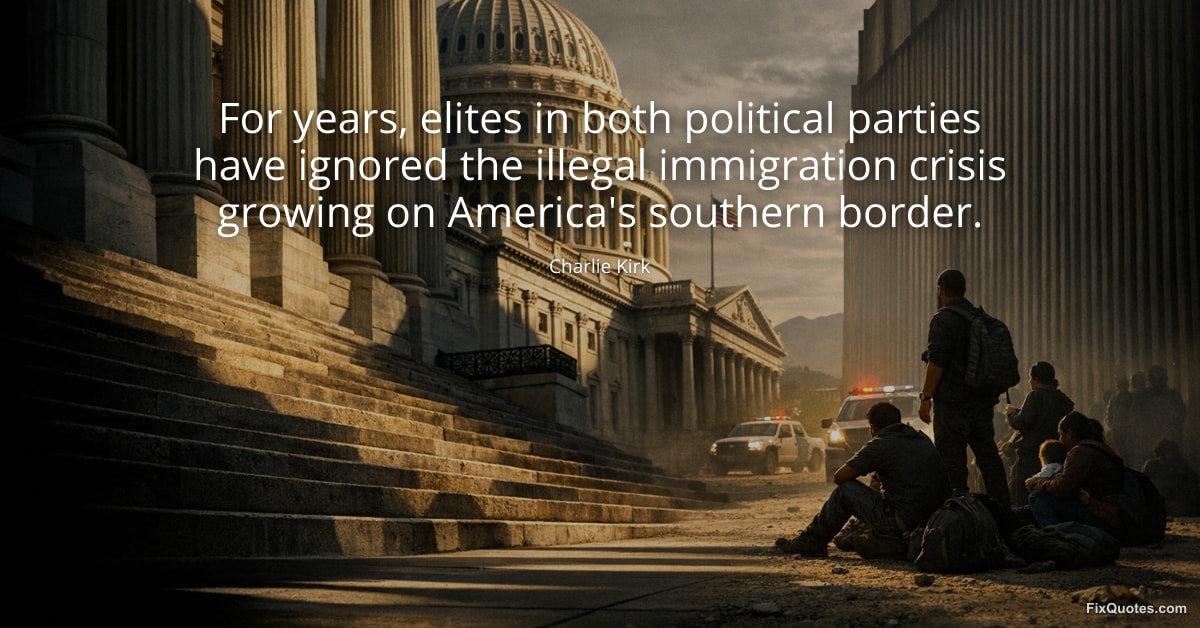
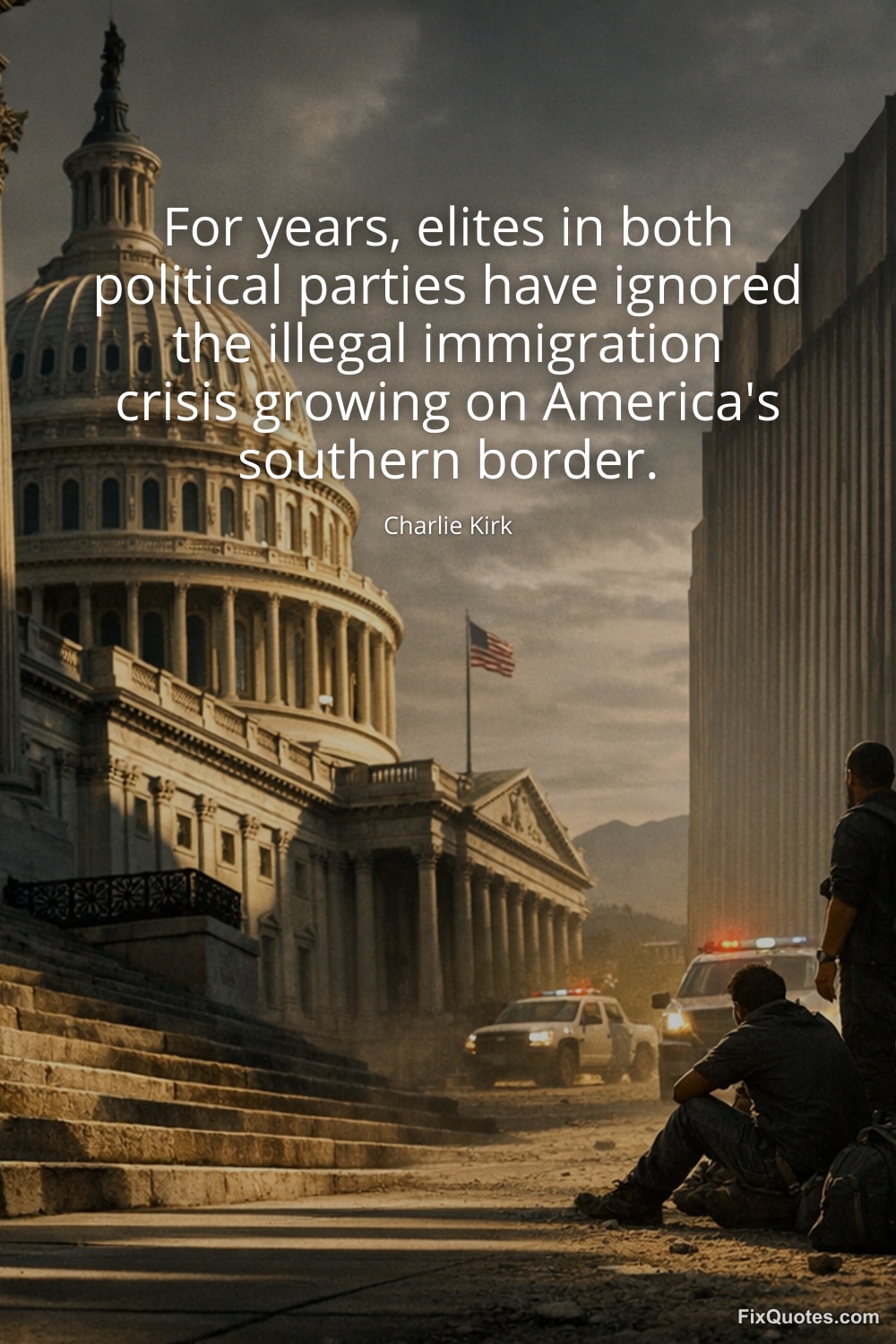
"For years, elites in both political parties have ignored the illegal immigration crisis growing on America's southern border"
About this Quote
The line is built to do two jobs at once: assign blame broadly enough to sound nonpartisan, and narrow the solution space so the only “serious” response feels like Kirk’s side of the argument. “Elites in both political parties” is a populist pressure point, less a demographic description than a moral category. It tells the listener who the villains are before any facts arrive: not just Democrats, but the supposedly complicit Republican leadership class, too. That framing launders partisanship through a pose of independence.
“For years” adds a slow-burn indictment, implying sustained negligence rather than episodic policy failure. It’s an invitation to anger that doesn’t require the audience to track specific administrations, laws, or conditions. The vagueness is functional: it keeps the charge immune to counterexamples.
Calling it an “illegal immigration crisis” is the emotional payload. “Illegal” foregrounds lawbreaking, not labor markets, asylum rules, or U.S. foreign policy; “crisis” signals urgency and exceptional measures. Together they shift the debate from governance to emergency management, where hardline enforcement can be sold as common sense rather than ideology.
“Growing on America’s southern border” supplies a visual map and a physical locus of threat. The border becomes a stage for national decline: porousness equals weakness, and weakness equals betrayal by “elites.” In the contemporary media ecosystem, especially post-2016, this phrasing is designed to travel as a clip: simple villains, a ticking clock, a singular problem. The subtext is less about immigration policy specifics than about legitimacy: if the establishment failed, it forfeited the right to rule.
“For years” adds a slow-burn indictment, implying sustained negligence rather than episodic policy failure. It’s an invitation to anger that doesn’t require the audience to track specific administrations, laws, or conditions. The vagueness is functional: it keeps the charge immune to counterexamples.
Calling it an “illegal immigration crisis” is the emotional payload. “Illegal” foregrounds lawbreaking, not labor markets, asylum rules, or U.S. foreign policy; “crisis” signals urgency and exceptional measures. Together they shift the debate from governance to emergency management, where hardline enforcement can be sold as common sense rather than ideology.
“Growing on America’s southern border” supplies a visual map and a physical locus of threat. The border becomes a stage for national decline: porousness equals weakness, and weakness equals betrayal by “elites.” In the contemporary media ecosystem, especially post-2016, this phrasing is designed to travel as a clip: simple villains, a ticking clock, a singular problem. The subtext is less about immigration policy specifics than about legitimacy: if the establishment failed, it forfeited the right to rule.
Quote Details
| Topic | Justice |
|---|
More Quotes by Charlie
Add to List