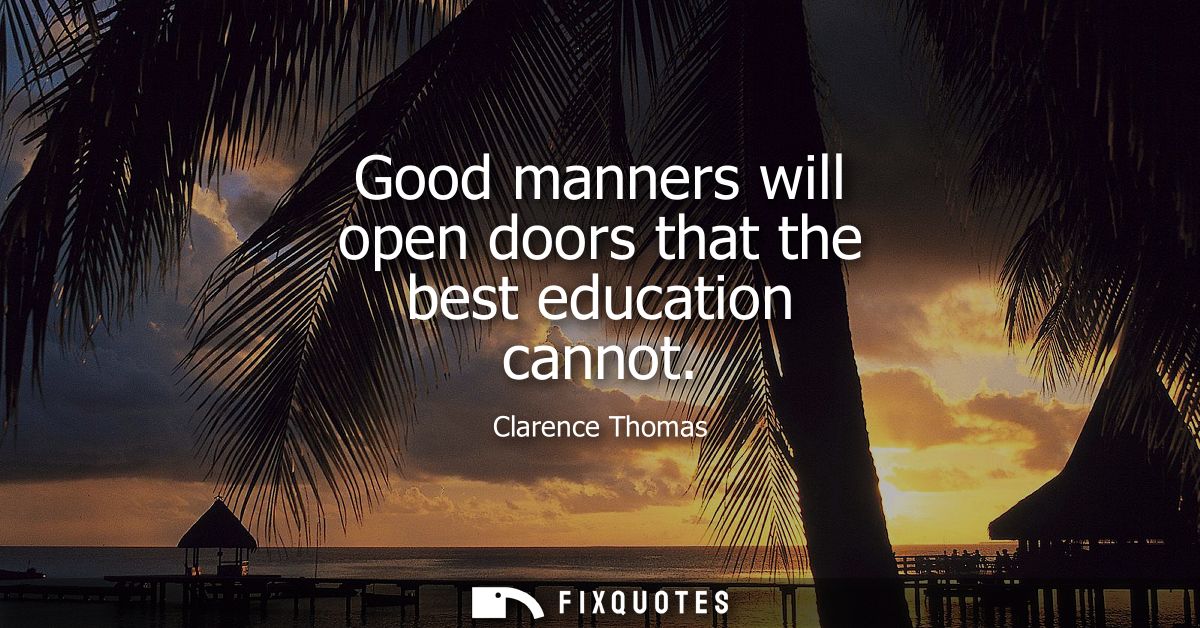
"Good manners will open doors that the best education cannot"
About this Quote
"Good manners" is doing heavy lifting here: not etiquette as lace doilies, but as social access. Clarence Thomas frames politeness as a kind of master key, the portable credential that works even when institutional credentials don’t. It’s a seductive idea in a country that loves to pretend status is earned through character rather than inherited through networks. By elevating manners over education, the line flatters the listener with a democratic promise: you can be uncredentialed and still move through elite spaces if you learn the codes.
The subtext is less cozy. Manners are never neutral; they’re a gatekeeping technology, a way powerful people decide who feels "safe", "respectable", and worth hearing out. Thomas’s phrasing concedes that doors exist, that they’re controlled, and that formal education alone doesn’t guarantee entry. That’s a pointed critique of credentialism, but it also carries an adaptationist message: if the system is stacked, refine your performance within it.
Context matters because Thomas’s public persona is inseparable from debates about legitimacy and elite institutions: Yale Law, the Supreme Court, the politics of respectability, and the long American tension between merit and belonging. Read as advice, it’s practical: don’t underestimate how far courtesy and self-command can carry you. Read as cultural commentary, it’s sharper: the "best education" can be trumped by the small rituals that signal deference and familiarity to the people holding the keys. In other words, the quote isn’t just about being nice; it’s about navigating power.
The subtext is less cozy. Manners are never neutral; they’re a gatekeeping technology, a way powerful people decide who feels "safe", "respectable", and worth hearing out. Thomas’s phrasing concedes that doors exist, that they’re controlled, and that formal education alone doesn’t guarantee entry. That’s a pointed critique of credentialism, but it also carries an adaptationist message: if the system is stacked, refine your performance within it.
Context matters because Thomas’s public persona is inseparable from debates about legitimacy and elite institutions: Yale Law, the Supreme Court, the politics of respectability, and the long American tension between merit and belonging. Read as advice, it’s practical: don’t underestimate how far courtesy and self-command can carry you. Read as cultural commentary, it’s sharper: the "best education" can be trumped by the small rituals that signal deference and familiarity to the people holding the keys. In other words, the quote isn’t just about being nice; it’s about navigating power.
Quote Details
| Topic | Respect |
|---|---|
| Source | Verified source: The Washington Post: Praise, Protest Greet Justice Thomas (Clarence Thomas, 1996)
Evidence: "Remember that good manners will open doors that the best education will not and cannot," he said. "Even though you may have strong feelings about matters, that does not give you license to have bad manners.". This is a contemporaneous news report describing Clarence Thomas speaking at an eighth-grade awards ceremony for the Thomas G. Pullen Creative and Performing Arts School (in Landover, Maryland), held at Central High School in Capitol Heights. The article is dated June 10, 1996 (published June 11, 1996 on the Post site). The widely-circulated version (“Good manners will open doors that the best education cannot”) appears to be a shortened paraphrase of the wording recorded here (“will not and cannot”). This provides a primary, time-stamped instance of the quote being spoken publicly by Thomas, but it is still mediated through journalistic transcription (not an official speech transcript). Other candidates (1) Driving the Career Highway (Janice Reals Ellig, 2009) compilation95.0% ... Good manners will open doors that the best education cannot . —Clarence Thomas , JUSTICE OF THE U.S. SUPREME COUR... |
| Cite |
Citation Formats
APA Style (7th ed.)
Thomas, Clarence. (2026, February 13). Good manners will open doors that the best education cannot. FixQuotes. https://fixquotes.com/quotes/good-manners-will-open-doors-that-the-best-45367/
Chicago Style
Thomas, Clarence. "Good manners will open doors that the best education cannot." FixQuotes. February 13, 2026. https://fixquotes.com/quotes/good-manners-will-open-doors-that-the-best-45367/.
MLA Style (9th ed.)
"Good manners will open doors that the best education cannot." FixQuotes, 13 Feb. 2026, https://fixquotes.com/quotes/good-manners-will-open-doors-that-the-best-45367/. Accessed 13 Feb. 2026.
More Quotes by Clarence
Add to List