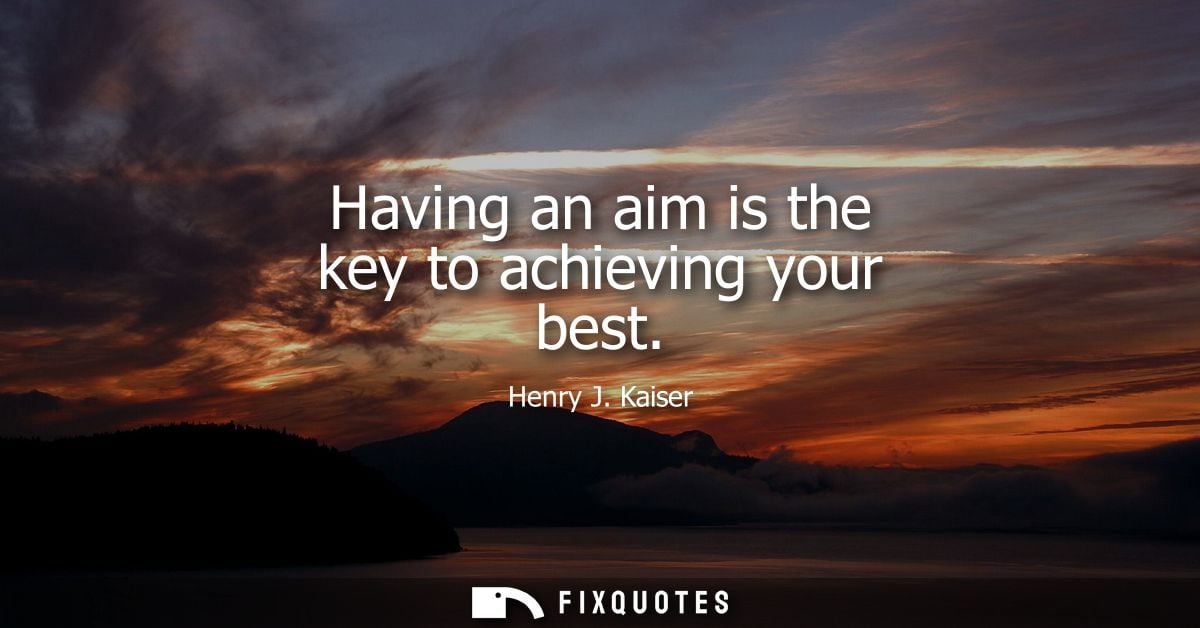
"Having an aim is the key to achieving your best"
About this Quote
Kaiser’s line reads like clean motivational wallpaper, but it’s really an industrialist’s operating manual disguised as self-help. “Having an aim” isn’t about vague aspiration; it’s a managerial premise: define a target, align resources, measure output, repeat. Coming from the man who helped pioneer mass-production shipbuilding and postwar housing at scale, the sentence carries the quiet confidence of someone who watched “best” become something you can engineer, not merely discover.
The phrasing is revealing. Not “talent” or “virtue” or “luck” as the key, but aim: directionality. In a business context, aim is strategy, and strategy converts effort into leverage. The subtext is almost blunt: without a clear objective, your energy leaks into noise. With one, you can standardize your decisions, discipline your time, and make performance legible to yourself and to others. That last part matters. “Achieving your best” sounds personal, but it’s also evaluative; it implies benchmarks, quotas, deadlines - the modern grammar of productivity.
Context sharpens the edge. Kaiser thrived in an America that increasingly treated ambition as infrastructure: projects, schedules, and scale as moral virtues. In that world, “aim” is a kind of civic technology, the thing that turns individual drive into collective output. The appeal of the quote is its promise that excellence is not mystical. It’s navigational. Set the coordinates, and even “best” starts to look like something you can build.
The phrasing is revealing. Not “talent” or “virtue” or “luck” as the key, but aim: directionality. In a business context, aim is strategy, and strategy converts effort into leverage. The subtext is almost blunt: without a clear objective, your energy leaks into noise. With one, you can standardize your decisions, discipline your time, and make performance legible to yourself and to others. That last part matters. “Achieving your best” sounds personal, but it’s also evaluative; it implies benchmarks, quotas, deadlines - the modern grammar of productivity.
Context sharpens the edge. Kaiser thrived in an America that increasingly treated ambition as infrastructure: projects, schedules, and scale as moral virtues. In that world, “aim” is a kind of civic technology, the thing that turns individual drive into collective output. The appeal of the quote is its promise that excellence is not mystical. It’s navigational. Set the coordinates, and even “best” starts to look like something you can build.
Quote Details
| Topic | Goal Setting |
|---|---|
| Source | Help us find the source |
More Quotes by Henry
Add to List