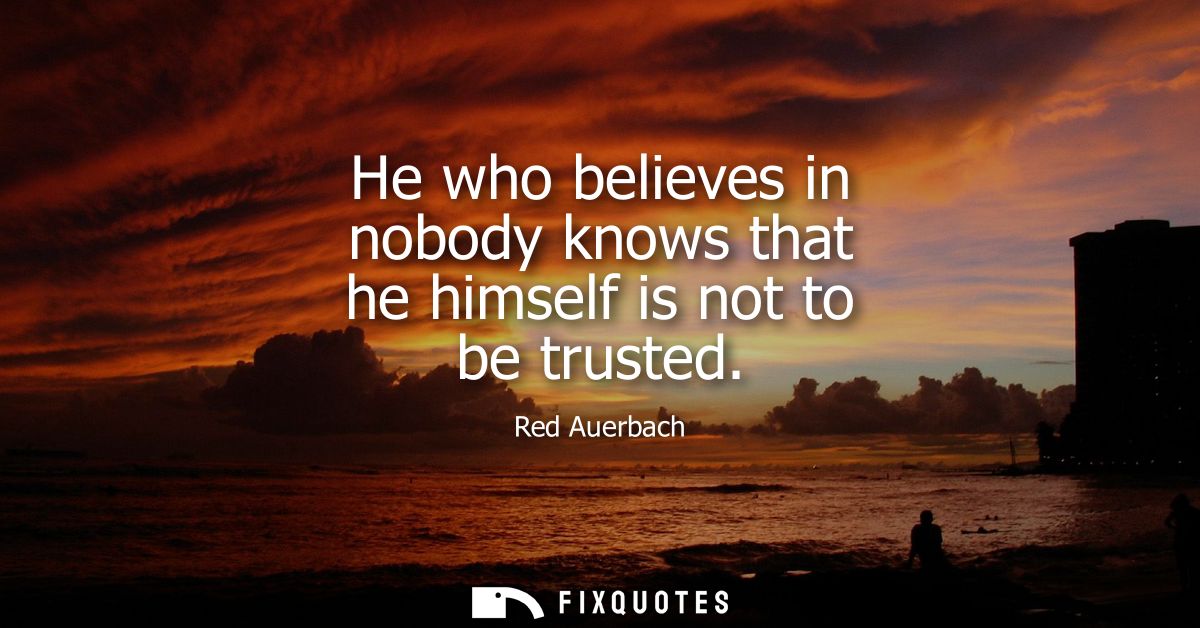
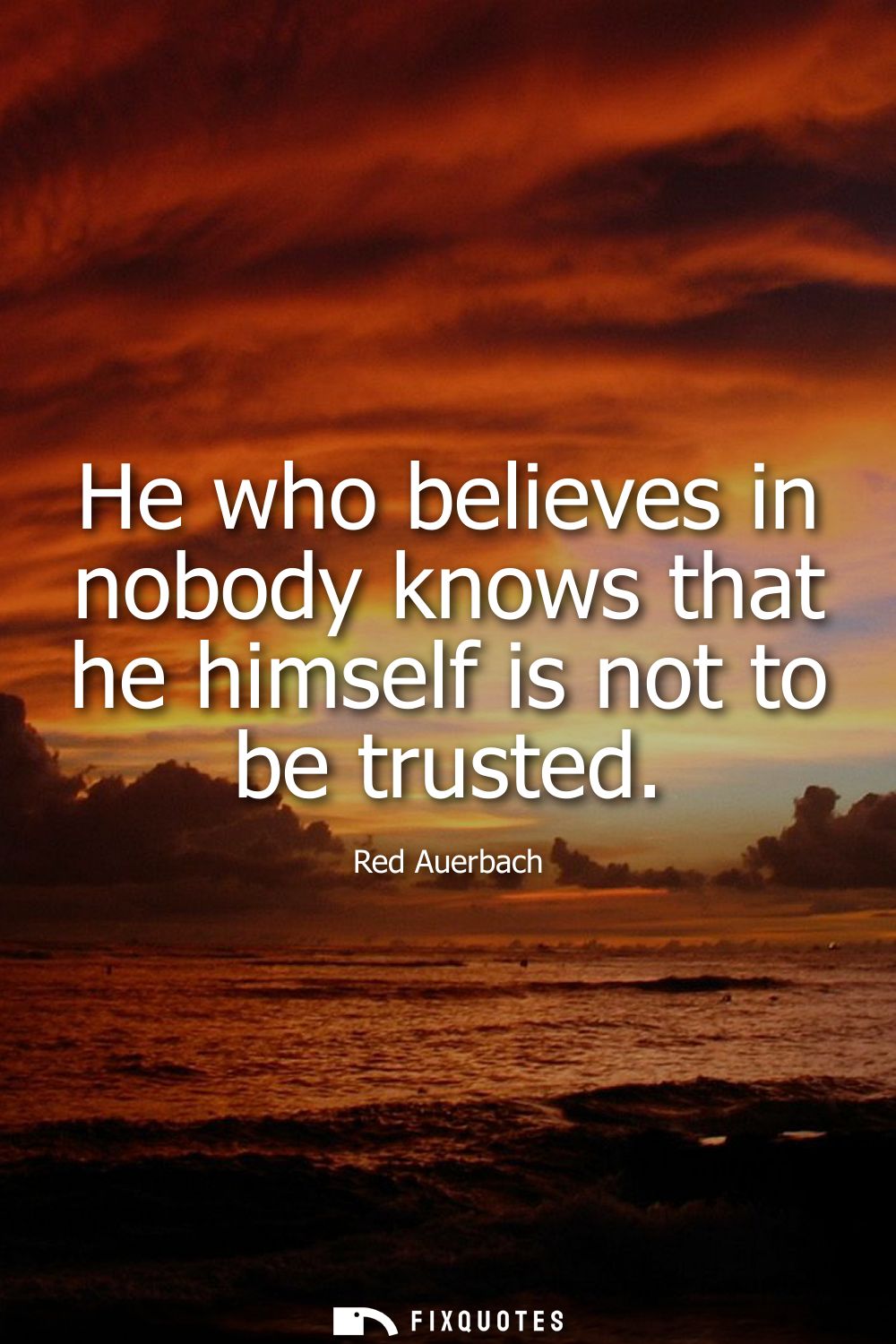
"He who believes in nobody knows that he himself is not to be trusted"
About this Quote
Auerbach doesn’t dress this up as wisdom; he delivers it like a locker-room diagnostic. “He who believes in nobody” isn’t just a cynic. In Auerbach’s world, that posture is a tell: the person broadcasting distrust is usually confessing something about their own reliability. It’s a neat reversal that works because it treats suspicion not as sophistication, but as self-portrait.
The intent is practical, not philosophical. A coach is constantly evaluating character under stress: who will rotate the ball, who will take the shortcut, who will blame teammates when the play breaks. Absolute distrust poisons the basic transaction of team sports, where you’re always making bets on other people’s decisions at full speed. Auerbach’s line says that if someone can’t extend even minimal faith outward, they probably can’t sustain it inward. Distrust becomes a permission structure: if no one is dependable, then my own lapses are just “realism.”
There’s subtext here about leadership, too. Coaches need players to buy into a system, to accept roles, to risk looking foolish for the collective. The chronic unbeliever undermines that architecture. Auerbach isn’t asking for naive positivity; he’s warning against the corrosive posture of preemptive betrayal. In that sense, the quote reads like a personnel filter: if you make a brand out of not trusting anyone, don’t be surprised when people stop trusting you back.
The intent is practical, not philosophical. A coach is constantly evaluating character under stress: who will rotate the ball, who will take the shortcut, who will blame teammates when the play breaks. Absolute distrust poisons the basic transaction of team sports, where you’re always making bets on other people’s decisions at full speed. Auerbach’s line says that if someone can’t extend even minimal faith outward, they probably can’t sustain it inward. Distrust becomes a permission structure: if no one is dependable, then my own lapses are just “realism.”
There’s subtext here about leadership, too. Coaches need players to buy into a system, to accept roles, to risk looking foolish for the collective. The chronic unbeliever undermines that architecture. Auerbach isn’t asking for naive positivity; he’s warning against the corrosive posture of preemptive betrayal. In that sense, the quote reads like a personnel filter: if you make a brand out of not trusting anyone, don’t be surprised when people stop trusting you back.
Quote Details
| Topic | Honesty & Integrity |
|---|---|
| Source | Help us find the source |
| Cite |
Citation Formats
APA Style (7th ed.)
Auerbach, Red. (2026, January 16). He who believes in nobody knows that he himself is not to be trusted. FixQuotes. https://fixquotes.com/quotes/he-who-believes-in-nobody-knows-that-he-himself-126641/
Chicago Style
Auerbach, Red. "He who believes in nobody knows that he himself is not to be trusted." FixQuotes. January 16, 2026. https://fixquotes.com/quotes/he-who-believes-in-nobody-knows-that-he-himself-126641/.
MLA Style (9th ed.)
"He who believes in nobody knows that he himself is not to be trusted." FixQuotes, 16 Jan. 2026, https://fixquotes.com/quotes/he-who-believes-in-nobody-knows-that-he-himself-126641/. Accessed 13 Mar. 2026.
More Quotes by Red
Add to List