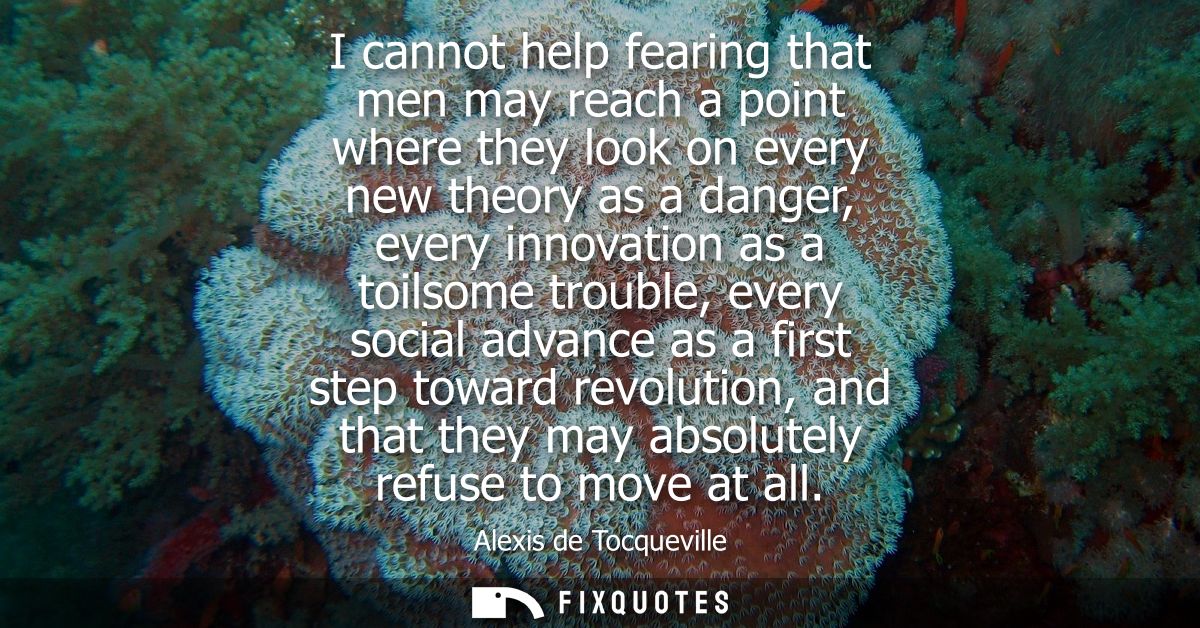
"I cannot help fearing that men may reach a point where they look on every new theory as a danger, every innovation as a toilsome trouble, every social advance as a first step toward revolution, and that they may absolutely refuse to move at all"
About this Quote
Tocqueville is diagnosing a quiet pathology of democracy: not the fever of revolution, but the chill of immobilized fear. The sentence builds like an anxiety spiral. “Every new theory,” “every innovation,” “every social advance” gets filed into the same mental drawer labeled danger, trouble, revolution. By the time he lands on “absolutely refuse to move at all,” the reader has watched a society talk itself out of its own future.
The intent isn’t to cheerlead novelty for novelty’s sake. It’s a warning about a particular kind of conservatism that emerges when public life becomes allergic to risk. Tocqueville saw how modern equality can produce a craving for stability: when people feel newly empowered yet perpetually vulnerable, they start treating change as an existential threat, not a negotiable cost. That’s the subtext behind “toilsome trouble” - innovation isn’t just scary, it’s exhausting. The fear is as much about fatigue as ideology.
Context matters: Tocqueville wrote in the long shadow of the French Revolution and the whiplash of regime changes that followed. He understood why “social advance” could sound like a match near dry straw. But he also recognizes the trap: when the memory of upheaval becomes the governing emotion, incremental reform starts to look like the first domino of catastrophe. The rhetorical brilliance is that he frames paralysis as a choice - “refuse to move” - making stagnation not safety, but a self-imposed defeat.
The intent isn’t to cheerlead novelty for novelty’s sake. It’s a warning about a particular kind of conservatism that emerges when public life becomes allergic to risk. Tocqueville saw how modern equality can produce a craving for stability: when people feel newly empowered yet perpetually vulnerable, they start treating change as an existential threat, not a negotiable cost. That’s the subtext behind “toilsome trouble” - innovation isn’t just scary, it’s exhausting. The fear is as much about fatigue as ideology.
Context matters: Tocqueville wrote in the long shadow of the French Revolution and the whiplash of regime changes that followed. He understood why “social advance” could sound like a match near dry straw. But he also recognizes the trap: when the memory of upheaval becomes the governing emotion, incremental reform starts to look like the first domino of catastrophe. The rhetorical brilliance is that he frames paralysis as a choice - “refuse to move” - making stagnation not safety, but a self-imposed defeat.
Quote Details
| Topic | Change |
|---|---|
| Source | Alexis de Tocqueville, Democracy in America (De la démocratie en Amérique), c.1835–1840; passage commonly cited from Volume II on attitudes toward innovation and social change. |
More Quotes by Alexis
Add to List