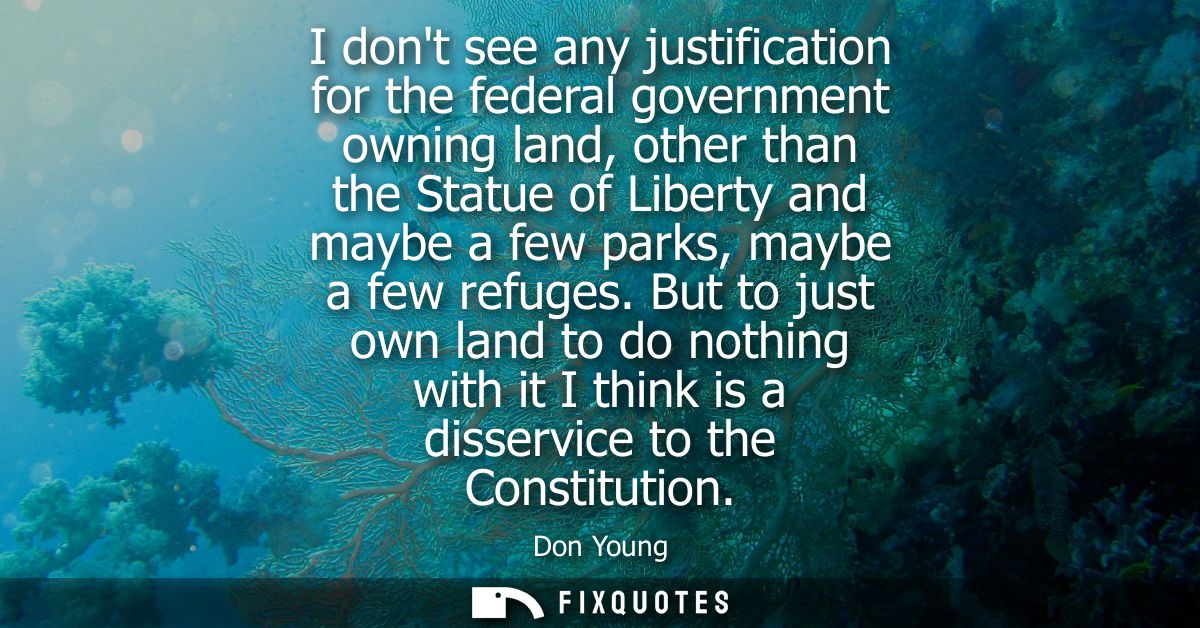
"I don't see any justification for the federal government owning land, other than the Statue of Liberty and maybe a few parks, maybe a few refuges. But to just own land to do nothing with it I think is a disservice to the Constitution"
About this Quote
Don Young’s line reads like small-government principle, but it’s really a frontier power move dressed up as constitutional piety. By conceding the Statue of Liberty and “maybe a few parks,” he signals he’s not anti-America, just anti-Washington. That opening carve-out is rhetorical jiu-jitsu: it frames everything beyond a few iconic exceptions as wasteful, illegitimate hoarding.
The operative phrase is “own land to do nothing with it.” In the West and especially Alaska, federal land is rarely “nothing.” It’s habitat, subsistence terrain, mineral reserve, strategic buffer, and a regulatory lever. Calling it idle turns conservation and Indigenous use into absence, and turns federal restraint into neglect. The subtext is development: if the government isn’t actively extracting, leasing, logging, or building, then it’s failing. That’s an economic argument smuggled in as a moral one.
Then comes the clincher: “a disservice to the Constitution.” Young isn’t making a careful legal claim so much as invoking the Constitution as a cultural weapon against distant authority. It’s a classic Western grievance narrative: locals live with the consequences; bureaucrats hold the keys. In context, this sits squarely in late-20th-century “Sagebrush Rebellion” politics and Alaska’s perpetual fight over who gets to decide what happens on vast federal tracts.
The intent isn’t just to shrink government; it’s to relocate power, turning public land from a national trust into a negotiable asset controlled closer to extractive interests and state politics.
The operative phrase is “own land to do nothing with it.” In the West and especially Alaska, federal land is rarely “nothing.” It’s habitat, subsistence terrain, mineral reserve, strategic buffer, and a regulatory lever. Calling it idle turns conservation and Indigenous use into absence, and turns federal restraint into neglect. The subtext is development: if the government isn’t actively extracting, leasing, logging, or building, then it’s failing. That’s an economic argument smuggled in as a moral one.
Then comes the clincher: “a disservice to the Constitution.” Young isn’t making a careful legal claim so much as invoking the Constitution as a cultural weapon against distant authority. It’s a classic Western grievance narrative: locals live with the consequences; bureaucrats hold the keys. In context, this sits squarely in late-20th-century “Sagebrush Rebellion” politics and Alaska’s perpetual fight over who gets to decide what happens on vast federal tracts.
The intent isn’t just to shrink government; it’s to relocate power, turning public land from a national trust into a negotiable asset controlled closer to extractive interests and state politics.
Quote Details
| Topic | Freedom |
|---|
More Quotes by Don
Add to List