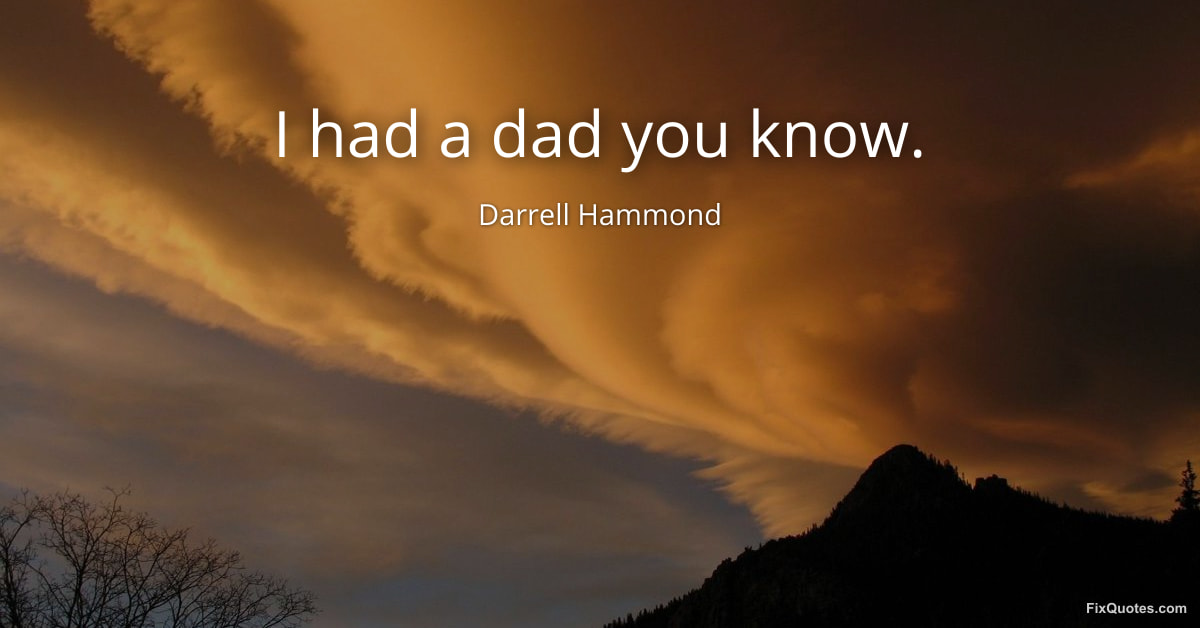
"I had a dad, you know"
About this Quote
"I had a dad you know" is a four-word sentence that lands like a thrown paperweight: casual on the surface, bruised underneath. Coming from Darrell Hammond, a comedian whose public persona is built on vocal control and impersonation, the line reads as a deliberate break in performance. It’s not a punchline; it’s the raw material comedy usually hides behind timing.
The phrasing matters. "I had" puts the father in the past tense, but not necessarily dead - more like absent, lost, or emotionally unavailable. It signals distance without spelling out the story, which is exactly how trauma often leaks into conversation: sideways, prematurely, almost as if the speaker is surprised to hear himself say it. Then there’s "you know", that classic social softener that pretends the audience is already on your side. Subtext: don’t make me explain; please just accept the claim.
As intent, it functions like a quiet correction. In a culture that treats "dad issues" as a cheap tag for jokes (or a lazy diagnosis), Hammond’s line asserts a basic fact of personhood: I wasn’t hatched from pure dysfunction; I came from a family structure that existed, at least technically. The ache is that having a dad isn’t the same as being fathered.
Contextually, it also echoes the way comedians talk around pain in interviews: one blunt fragment, then back to the bits. Hammond’s career depends on inhabiting other voices; this sentence is him insisting, briefly, on his own.
The phrasing matters. "I had" puts the father in the past tense, but not necessarily dead - more like absent, lost, or emotionally unavailable. It signals distance without spelling out the story, which is exactly how trauma often leaks into conversation: sideways, prematurely, almost as if the speaker is surprised to hear himself say it. Then there’s "you know", that classic social softener that pretends the audience is already on your side. Subtext: don’t make me explain; please just accept the claim.
As intent, it functions like a quiet correction. In a culture that treats "dad issues" as a cheap tag for jokes (or a lazy diagnosis), Hammond’s line asserts a basic fact of personhood: I wasn’t hatched from pure dysfunction; I came from a family structure that existed, at least technically. The ache is that having a dad isn’t the same as being fathered.
Contextually, it also echoes the way comedians talk around pain in interviews: one blunt fragment, then back to the bits. Hammond’s career depends on inhabiting other voices; this sentence is him insisting, briefly, on his own.
Quote Details
| Topic | Father |
|---|---|
| Source | Help us find the source |
| Cite |
Citation Formats
APA Style (7th ed.)
Hammond, Darrell. (2026, February 16). I had a dad, you know. FixQuotes. https://fixquotes.com/quotes/i-had-a-dad-you-know-173633/
Chicago Style
Hammond, Darrell. "I had a dad, you know." FixQuotes. February 16, 2026. https://fixquotes.com/quotes/i-had-a-dad-you-know-173633/.
MLA Style (9th ed.)
"I had a dad, you know." FixQuotes, 16 Feb. 2026, https://fixquotes.com/quotes/i-had-a-dad-you-know-173633/. Accessed 7 Mar. 2026.
More Quotes by Darrell
Add to List