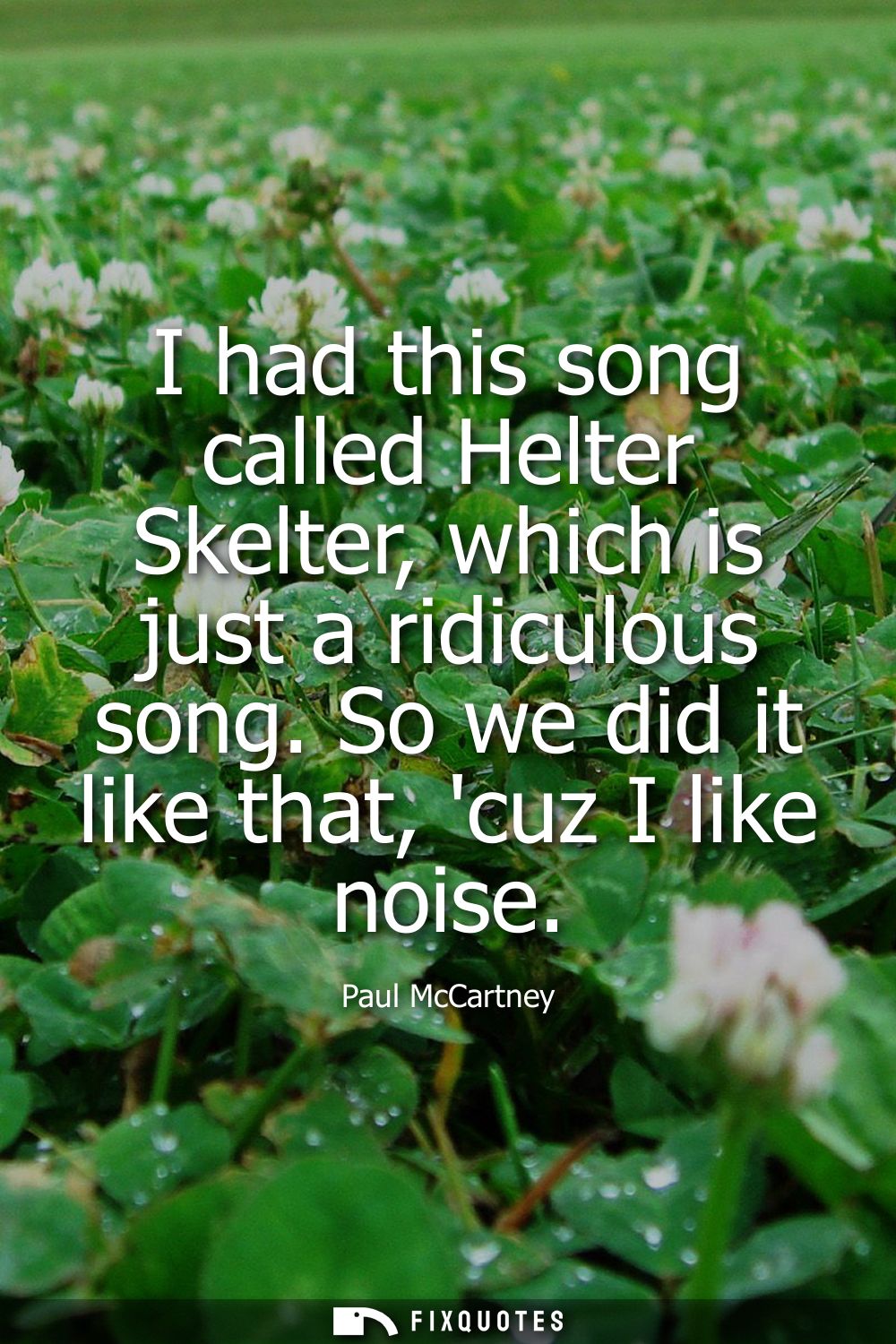
"I had this song called Helter Skelter, which is just a ridiculous song. So we did it like that, 'cuz I like noise"
About this Quote
McCartney’s toss-off phrasing - “just a ridiculous song” - is doing a lot of work. It’s a preemptive shrug that disarms seriousness, the classic pop-star move: don’t overthink it, mate, we were having fun. But the subtext is competitive and tactical. “Helter Skelter” wasn’t noise for noise’s sake; it was The Beatles deliberately roughing up their own immaculate image, leaning into distortion, strain, and mess at a moment when rock was getting heavier and authenticity was starting to mean abrasion.
The genius is how he frames intent as appetite: “’cuz I like noise.” That line recasts experimentation as instinct, not theory. No manifesto, no art-school justification - just desire. It also flips the usual narrative where “noise” is what happens when craft fails. Here, noise is the craft. It’s performance pushed to the edge: vocals that scrape, guitars that blur, drums that sound like they’re trying to outrun the tape machine. Calling it “ridiculous” signals pleasure in excess, a willingness to risk sounding ugly in pursuit of something alive.
Context haunts the quote, too. “Helter Skelter” later got grotesquely misread through the Manson lens, turned into evidence for an imagined apocalypse rather than a band playing with volume and chaos. McCartney’s casualness reads, in that shadow, as a reclamation: it was never prophecy, it was punk energy before punk had a name - a mainstream idol admitting he wanted the racket.
The genius is how he frames intent as appetite: “’cuz I like noise.” That line recasts experimentation as instinct, not theory. No manifesto, no art-school justification - just desire. It also flips the usual narrative where “noise” is what happens when craft fails. Here, noise is the craft. It’s performance pushed to the edge: vocals that scrape, guitars that blur, drums that sound like they’re trying to outrun the tape machine. Calling it “ridiculous” signals pleasure in excess, a willingness to risk sounding ugly in pursuit of something alive.
Context haunts the quote, too. “Helter Skelter” later got grotesquely misread through the Manson lens, turned into evidence for an imagined apocalypse rather than a band playing with volume and chaos. McCartney’s casualness reads, in that shadow, as a reclamation: it was never prophecy, it was punk energy before punk had a name - a mainstream idol admitting he wanted the racket.
Quote Details
| Topic | Music |
|---|
More Quotes by Paul
Add to List