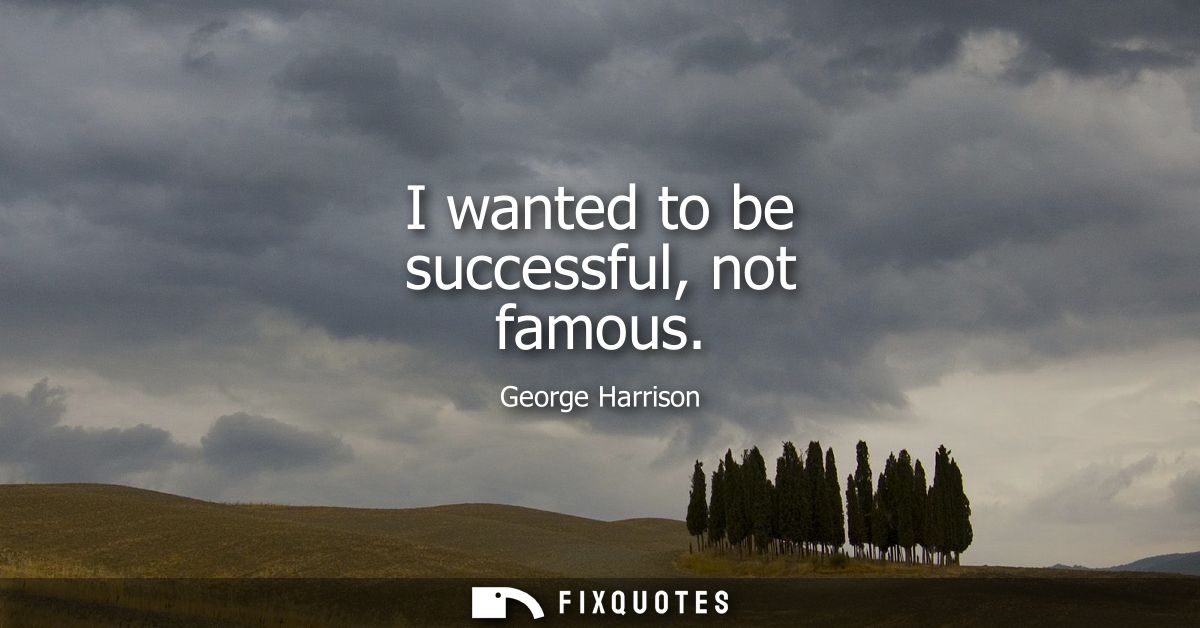
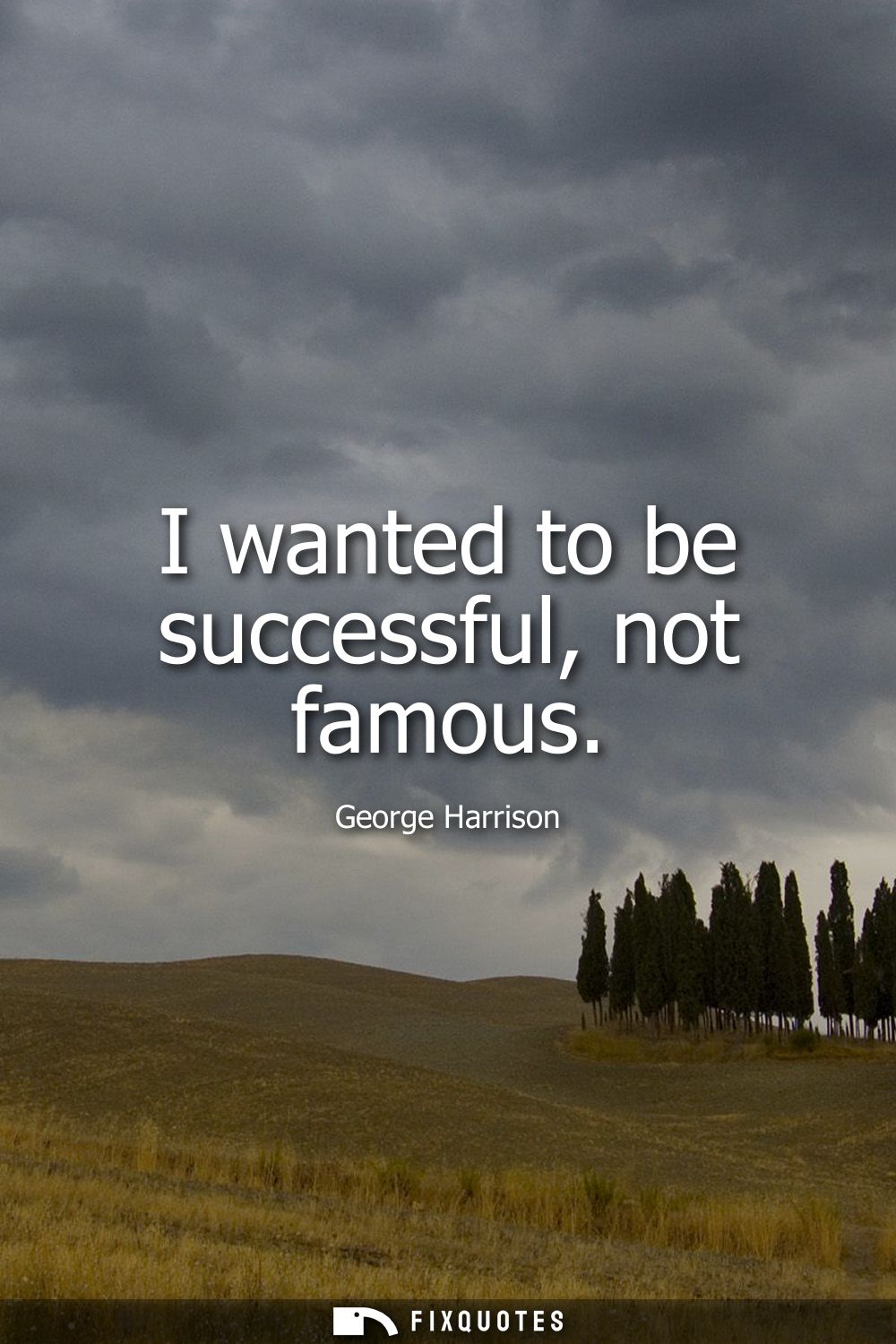
"I wanted to be successful, not famous"
About this Quote
Harrison’s line lands like a quiet rebuke delivered in a whisper loud enough to rattle stadium speakers. Coming from a Beatle, “not famous” isn’t humblebrag minimalism; it’s a claim that the most coveted currency of pop culture is also the most corrosive. Success suggests craft, autonomy, and the ability to keep making work. Fame suggests exposure without consent: the public gets a vote in your face, your time, your interior life.
The intent is practical, almost managerial. Harrison is separating outcome from attention, a distinction celebrities are supposed to deny so the spotlight can feel like “just part of the job.” He’s telling you it wasn’t the screaming that mattered, it was the building: songs written, records made, musicianship sharpened, a life with some private rooms still intact. That’s the subtext of a man who spent years in the loudest band on earth while often being treated as the “quiet one,” the junior partner in a Lennon-McCartney economy. Wanting success without fame is also a way of clawing back authorship when your identity has been flattened into a group brand.
Context does the heavy lifting. Harrison watched the 60s turn celebrity into a permanent surveillance state, then spent the 70s and beyond trying to route meaning through spirituality, philanthropy, and selective withdrawal. The line works because it flips the usual aspiration: instead of fame as proof of success, success becomes a defense against fame. It’s less a complaint than a boundary, stated with the calm of someone who’s already seen what happens when the world won’t let you be offstage.
The intent is practical, almost managerial. Harrison is separating outcome from attention, a distinction celebrities are supposed to deny so the spotlight can feel like “just part of the job.” He’s telling you it wasn’t the screaming that mattered, it was the building: songs written, records made, musicianship sharpened, a life with some private rooms still intact. That’s the subtext of a man who spent years in the loudest band on earth while often being treated as the “quiet one,” the junior partner in a Lennon-McCartney economy. Wanting success without fame is also a way of clawing back authorship when your identity has been flattened into a group brand.
Context does the heavy lifting. Harrison watched the 60s turn celebrity into a permanent surveillance state, then spent the 70s and beyond trying to route meaning through spirituality, philanthropy, and selective withdrawal. The line works because it flips the usual aspiration: instead of fame as proof of success, success becomes a defense against fame. It’s less a complaint than a boundary, stated with the calm of someone who’s already seen what happens when the world won’t let you be offstage.
Quote Details
| Topic | Success |
|---|---|
| Source | Help us find the source |
| Cite | Cite this Quote |
Citation Formats
APA Style (7th ed.)
Harrison, George. (n.d.). I wanted to be successful, not famous. FixQuotes. https://fixquotes.com/quotes/i-wanted-to-be-successful-not-famous-31354/
Chicago Style
Harrison, George. "I wanted to be successful, not famous." FixQuotes. Accessed February 1, 2026. https://fixquotes.com/quotes/i-wanted-to-be-successful-not-famous-31354/.
MLA Style (9th ed.)
"I wanted to be successful, not famous." FixQuotes, https://fixquotes.com/quotes/i-wanted-to-be-successful-not-famous-31354/. Accessed 1 Feb. 2026.
More Quotes by George
Add to List