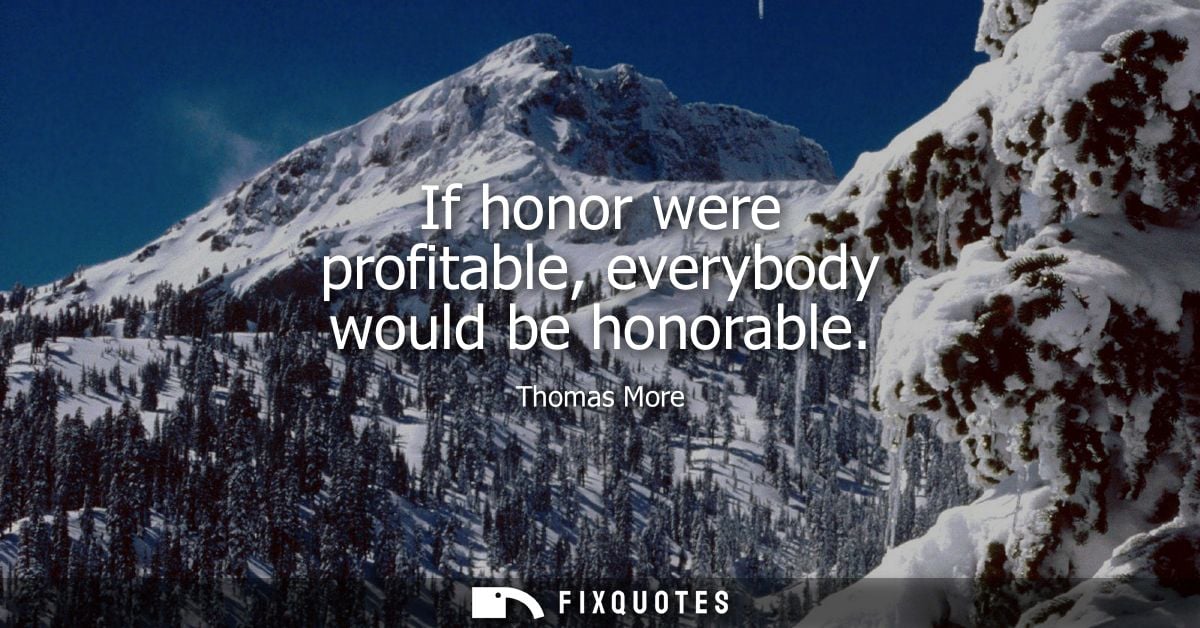
"If honor were profitable, everybody would be honorable"
About this Quote
Honor, More suggests, is easiest to praise when it costs nothing. The line snaps like a courtroom aside: if virtue reliably paid dividends, we would see a sudden, suspicious boom in moral behavior. Its wit is transactional, almost accounting-style, and that’s the point. By reducing “honor” to a balance sheet item, More exposes how often ethical language is just a luxury brand people wear when it flatters them.
The intent is not to sneer at honor itself, but to diagnose why it’s rare. More is writing in a world where reputation, patronage, and survival are tangled up with political obedience. In Tudor England, integrity could mean losing your position, your security, even your head. So his cynicism has teeth: honor is not scarce because humans don’t understand it, but because they do understand the price.
The subtext is a challenge to readers who like to imagine themselves as naturally upright. If you’re honorable only when it’s “profitable,” you’re not honorable; you’re strategic. More’s line also quietly indicts institutions that make dishonor lucrative: courts that reward flattery, markets that reward exploitation, regimes that reward silence. It anticipates a modern insight we still dodge: moral behavior isn’t just a matter of character, it’s a matter of incentives.
Coming from More, the remark reads less like detached irony and more like grim foreknowledge. He would eventually choose principle over profit, and pay accordingly.
The intent is not to sneer at honor itself, but to diagnose why it’s rare. More is writing in a world where reputation, patronage, and survival are tangled up with political obedience. In Tudor England, integrity could mean losing your position, your security, even your head. So his cynicism has teeth: honor is not scarce because humans don’t understand it, but because they do understand the price.
The subtext is a challenge to readers who like to imagine themselves as naturally upright. If you’re honorable only when it’s “profitable,” you’re not honorable; you’re strategic. More’s line also quietly indicts institutions that make dishonor lucrative: courts that reward flattery, markets that reward exploitation, regimes that reward silence. It anticipates a modern insight we still dodge: moral behavior isn’t just a matter of character, it’s a matter of incentives.
Coming from More, the remark reads less like detached irony and more like grim foreknowledge. He would eventually choose principle over profit, and pay accordingly.
Quote Details
| Topic | Honesty & Integrity |
|---|
More Quotes by Thomas
Add to List