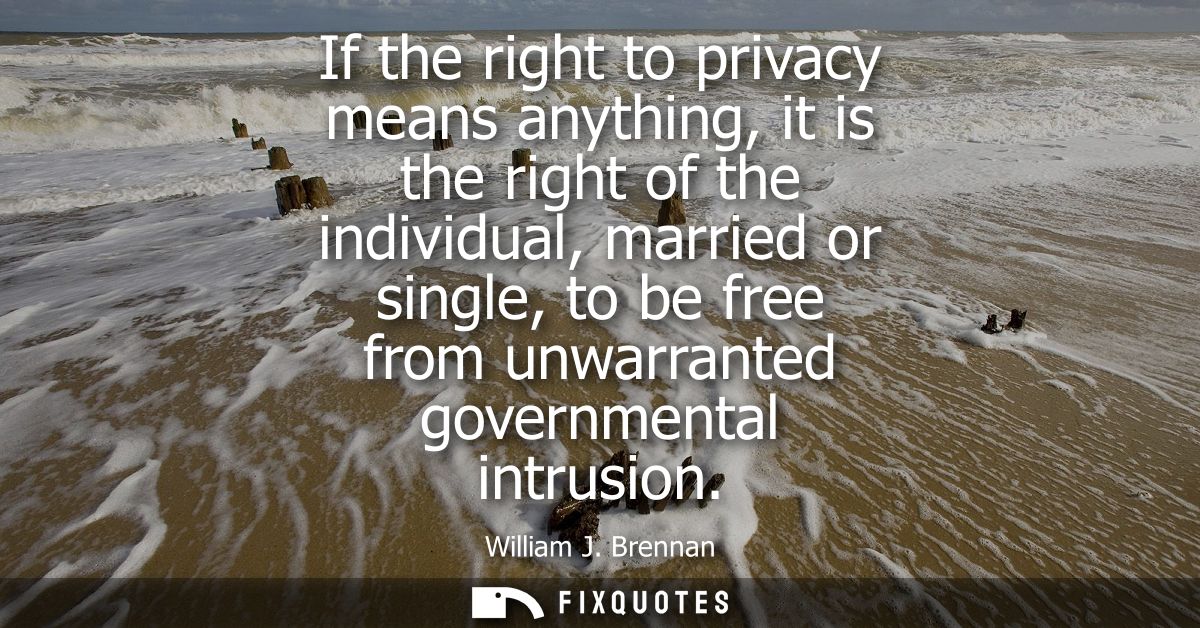
"If the right to privacy means anything, it is the right of the individual, married or single, to be free from unwarranted governmental intrusion"
About this Quote
Brennan’s line is doing what the best constitutional rhetoric does: it sounds plainspoken while quietly rearranging the furniture of American law. The key move is in the phrase “means anything.” It’s a lawyer’s dare, implying that privacy can’t be treated as a polite abstraction or a luxury interest; either it has enforceable force against the state, or it’s a hollow slogan. Brennan frames privacy not as secrecy, but as liberty: “to be free” from “unwarranted” intrusion. That adjective matters. He’s not arguing government can never regulate intimate life; he’s insisting the burden is on the state to justify crossing the threshold.
The subtext is a rebuke to moral majoritarianism dressed up as legislation. By specifying “married or single,” Brennan punctures the idea that dignity and sexual autonomy are earned through socially approved institutions. It’s an equalizing clause that widens the circle of constitutional concern from respectable households to individuals as such, anticipating the fight over whether rights attach to persons or to sanctioned lifestyles.
Context sharpens the stakes. Brennan wrote in an era when the Court was building a doctrine of privacy from constitutional “penumbras” and substantive due process, a method critics derided as airy and invented. He answers that critique with moral clarity: the intrusion is the fact on the ground; the constitutional question is whether it’s “unwarranted.” The sentence is less about hiding and more about limiting power, drawing a hard line around the state’s temptation to police intimacy.
The subtext is a rebuke to moral majoritarianism dressed up as legislation. By specifying “married or single,” Brennan punctures the idea that dignity and sexual autonomy are earned through socially approved institutions. It’s an equalizing clause that widens the circle of constitutional concern from respectable households to individuals as such, anticipating the fight over whether rights attach to persons or to sanctioned lifestyles.
Context sharpens the stakes. Brennan wrote in an era when the Court was building a doctrine of privacy from constitutional “penumbras” and substantive due process, a method critics derided as airy and invented. He answers that critique with moral clarity: the intrusion is the fact on the ground; the constitutional question is whether it’s “unwarranted.” The sentence is less about hiding and more about limiting power, drawing a hard line around the state’s temptation to police intimacy.
Quote Details
| Topic | Freedom |
|---|---|
| Source | Eisenstadt v. Baird, 405 U.S. 438 (1972), majority opinion by Justice William J. Brennan — contains the line extending the right of privacy to 'the individual, married or single' regarding contraception. |
More Quotes by William
Add to List