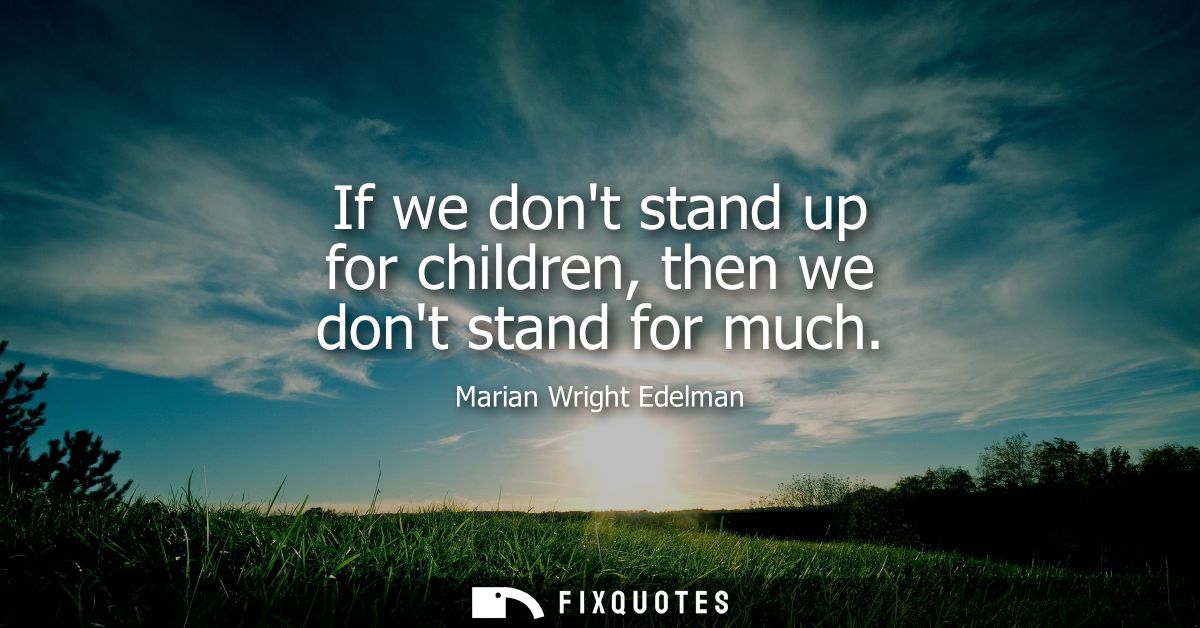
"If we don't stand up for children, then we don't stand for much"
About this Quote
A moral dare disguised as a plainspoken sentence, Marian Wright Edelman’s line works because it collapses politics into character. “Stand up” signals action, not sentiment: not liking kids, not posting slogans, but taking risk on their behalf. Then the kicker: “we don’t stand for much.” She turns the usual debate about budgets, personal responsibility, or “family values” into a referendum on adult seriousness. If you can’t protect the people with the least power, your principles are decorative.
The subtext is pointedly accusatory, but it’s also strategic. Children are society’s easiest claim to innocence; invoking them short-circuits the comfortable dodge that harm is always deserved. Edelman, a civil rights lawyer and founder of the Children’s Defense Fund, has spent decades watching policymakers treat children as rhetorical props - praised in speeches, sacrificed in appropriations. Her phrasing exposes that hypocrisy: you can’t wrap yourself in virtue while letting schools crumble, health care lapse, or hunger become a “complex issue.”
The “we” matters, too. It drafts the listener into complicity and responsibility, refusing the idea that child welfare is a niche concern for parents or charities. And the sentence is deliberately nonpartisan in surface form, which is part of its bite: it invites everyone to agree, then forces the question of what your agreement costs you. In Edelman’s world, standing up for children isn’t a soft cause; it’s the hard test of whether a society’s proclaimed ideals have any spine.
The subtext is pointedly accusatory, but it’s also strategic. Children are society’s easiest claim to innocence; invoking them short-circuits the comfortable dodge that harm is always deserved. Edelman, a civil rights lawyer and founder of the Children’s Defense Fund, has spent decades watching policymakers treat children as rhetorical props - praised in speeches, sacrificed in appropriations. Her phrasing exposes that hypocrisy: you can’t wrap yourself in virtue while letting schools crumble, health care lapse, or hunger become a “complex issue.”
The “we” matters, too. It drafts the listener into complicity and responsibility, refusing the idea that child welfare is a niche concern for parents or charities. And the sentence is deliberately nonpartisan in surface form, which is part of its bite: it invites everyone to agree, then forces the question of what your agreement costs you. In Edelman’s world, standing up for children isn’t a soft cause; it’s the hard test of whether a society’s proclaimed ideals have any spine.
Quote Details
| Topic | Human Rights |
|---|---|
| Source | Quote attributed to Marian Wright Edelman. Source: Wikiquote entry “Marian Wright Edelman” (contains the line “If we don't stand up for children, then we don't stand for much”). |
More Quotes by Marian
Add to List