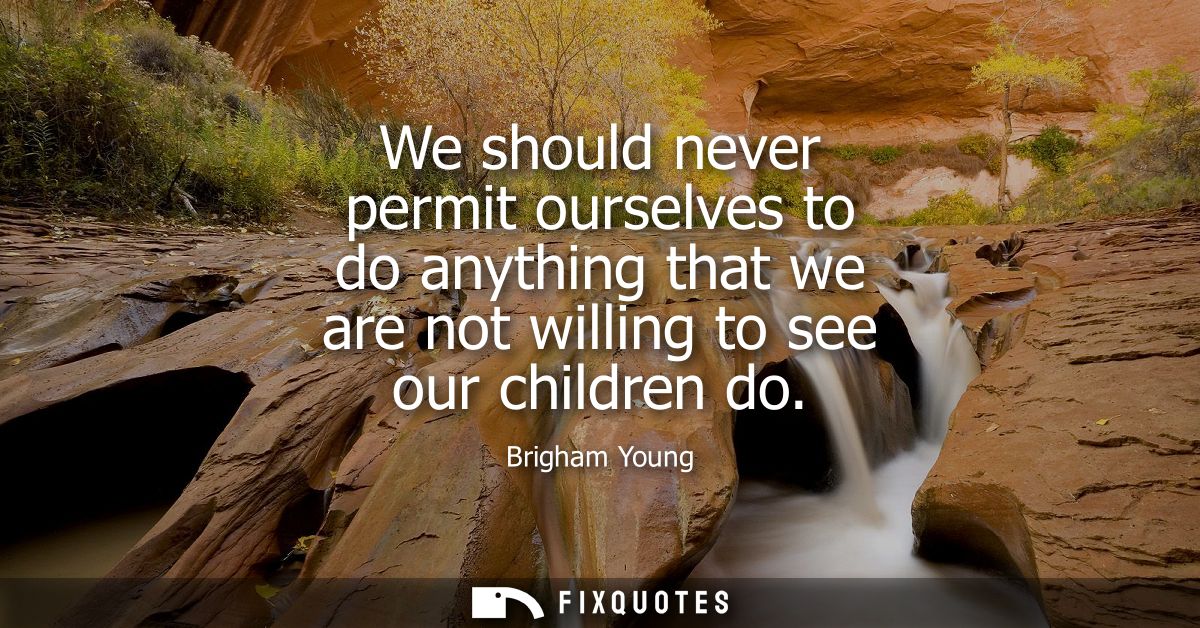
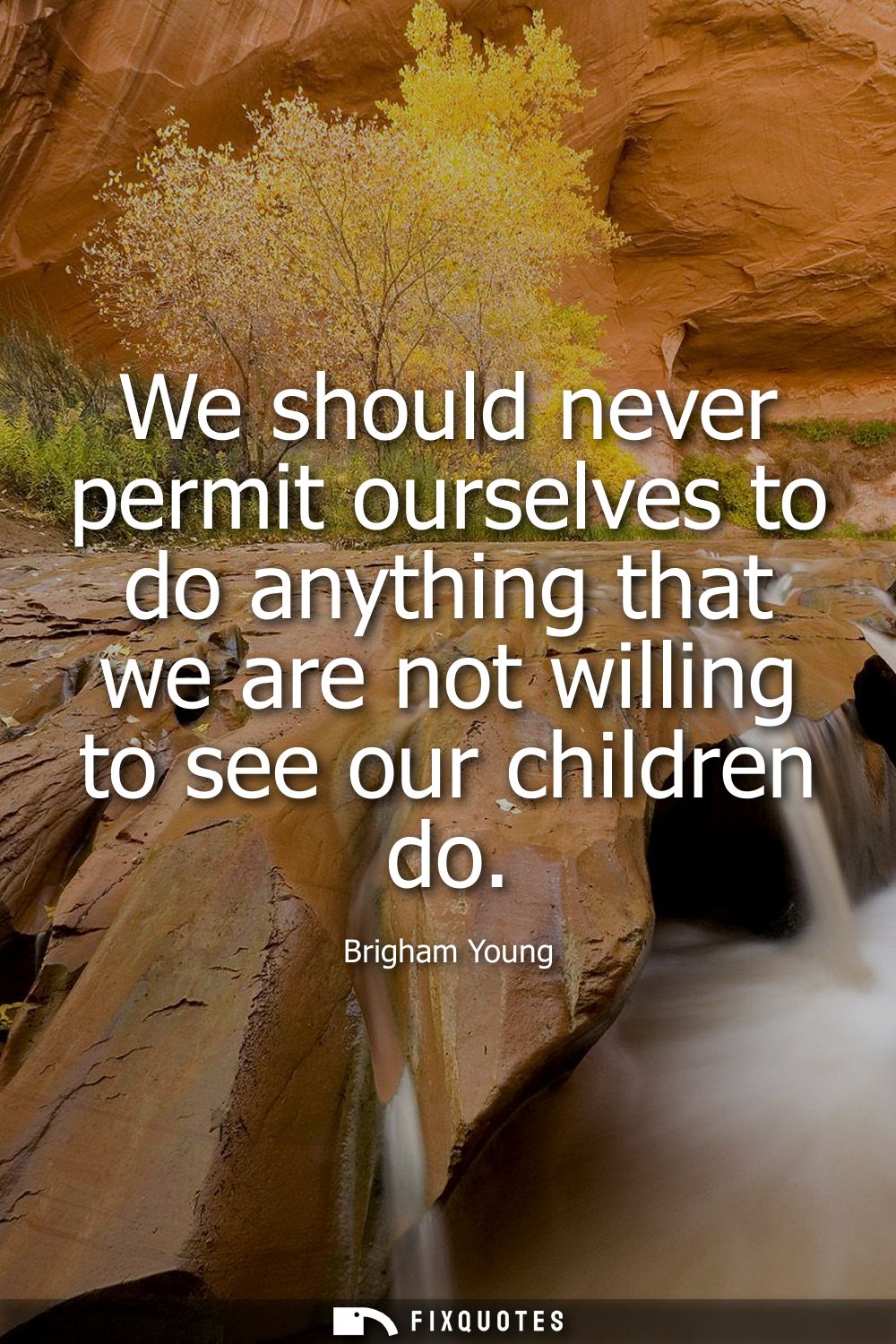
"We should never permit ourselves to do anything that we are not willing to see our children do"
About this Quote
The line holds adults to a demanding standard: live in such a way that your actions could be safely copied by the next generation. It shifts morality from abstract rules to visible example. Children learn less from lectures than from the daily theater of adult behavior. If a parent condemns dishonesty but cuts corners, the tacit lesson is that principles bend when convenient. The saying therefore attacks hypocrisy as a seedbed of vice, insisting that integrity requires consistency between what we permit ourselves and what we hope to see in those we raise.
Brigham Young spoke within a culture that prized family life, communal cohesion, and the formative power of habit. As a 19th-century Latter-day Saint leader building a new society in the American West, he emphasized self-discipline and the shaping of character through lived practice. The guidance is parental, but it is also civic. Communities are reproduced by imitation. Leaders, teachers, clergy, and public officials broadcast norms whether they intend to or not. If those with influence claim exceptions for themselves, they write loopholes into the moral code.
The idea also collapses the distance between public and private conduct. You are not just teaching when you talk; you are teaching when you drive, argue, spend, or scroll. In an era of constant visibility, the argument grows sharper: example travels faster than explanation.
There is nuance. Some adult roles legitimately differ from a child’s, and not every adult responsibility is imitable. The point is not to erase age-appropriate boundaries but to align the underlying virtues. Courage, honesty, restraint, and kindness do not become good only at 18. The counsel is aspirational rather than punitive. It challenges adults to let their own permissions be governed by the future they wish to see. Live so that imitation would be safe, and a better culture becomes more than a wish; it becomes a habit passed from hand to hand.
Brigham Young spoke within a culture that prized family life, communal cohesion, and the formative power of habit. As a 19th-century Latter-day Saint leader building a new society in the American West, he emphasized self-discipline and the shaping of character through lived practice. The guidance is parental, but it is also civic. Communities are reproduced by imitation. Leaders, teachers, clergy, and public officials broadcast norms whether they intend to or not. If those with influence claim exceptions for themselves, they write loopholes into the moral code.
The idea also collapses the distance between public and private conduct. You are not just teaching when you talk; you are teaching when you drive, argue, spend, or scroll. In an era of constant visibility, the argument grows sharper: example travels faster than explanation.
There is nuance. Some adult roles legitimately differ from a child’s, and not every adult responsibility is imitable. The point is not to erase age-appropriate boundaries but to align the underlying virtues. Courage, honesty, restraint, and kindness do not become good only at 18. The counsel is aspirational rather than punitive. It challenges adults to let their own permissions be governed by the future they wish to see. Live so that imitation would be safe, and a better culture becomes more than a wish; it becomes a habit passed from hand to hand.
Quote Details
| Topic | Parenting |
|---|
More Quotes by Brigham
Add to List