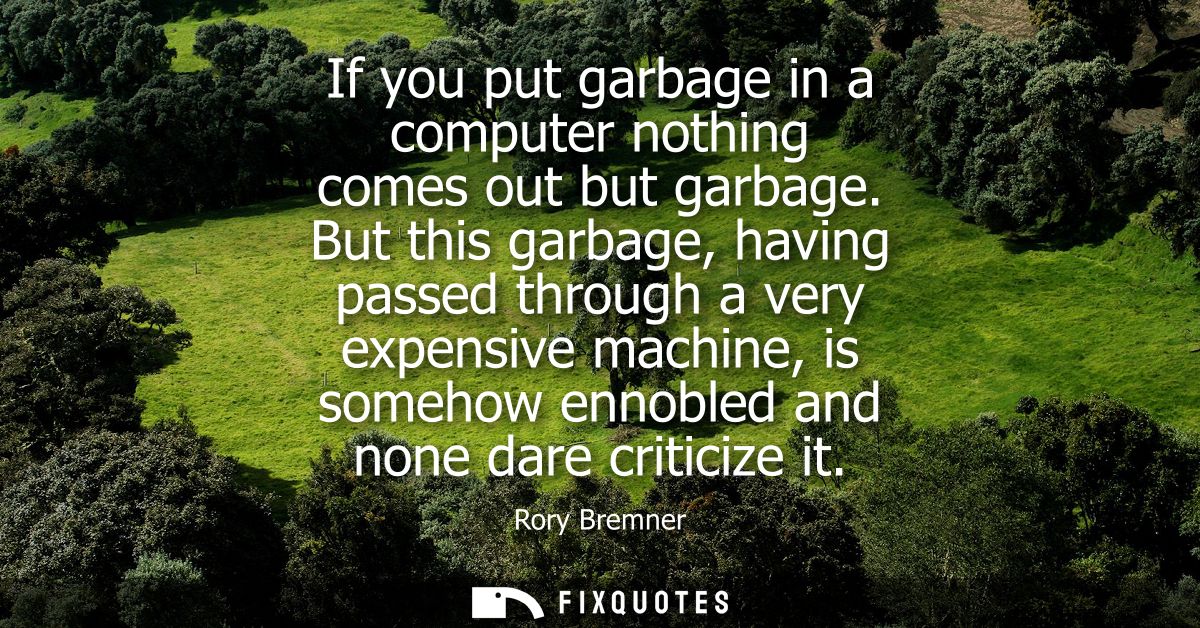
"If you put garbage in a computer nothing comes out but garbage. But this garbage, having passed through a very expensive machine, is somehow ennobled and none dare criticize it"
About this Quote
The joke lands because it punctures a very modern superstition: that technology doesn’t just process information, it blesses it. Bremner takes the old programmer’s warning, “garbage in, garbage out,” then twists the knife. The output isn’t merely wrong; it’s “ennobled” by the sheer cost and aura of the machine that produced it. That single word is doing heavy comedic work, mocking our reflex to treat computer-generated results as objective, sophisticated, even morally superior to human judgment.
The subtext is less about computers than about status. A “very expensive machine” isn’t just hardware; it’s an institution, a consultancy deck, an algorithm sold as inevitability. Bremner is needling a culture where skepticism gets socially penalized: “none dare criticize it.” That’s not a claim about logic, it’s a claim about power. Once a number shows up on a screen, disagreement can be framed as ignorance, technophobia, or emotional bias, even when the input data is sloppy, biased, or outright political.
As a comedian in late-20th-century Britain, Bremner is also speaking from inside a satirical tradition that distrusts officialdom and managerial language. His line anticipates today’s algorithmic deference: predictive policing, automated hiring, “AI says so” decision-making. The punchline isn’t anti-tech; it’s anti-credulity. The target is the human desire to outsource responsibility to a machine, then hide behind its glossy authority when the results inevitably stink.
The subtext is less about computers than about status. A “very expensive machine” isn’t just hardware; it’s an institution, a consultancy deck, an algorithm sold as inevitability. Bremner is needling a culture where skepticism gets socially penalized: “none dare criticize it.” That’s not a claim about logic, it’s a claim about power. Once a number shows up on a screen, disagreement can be framed as ignorance, technophobia, or emotional bias, even when the input data is sloppy, biased, or outright political.
As a comedian in late-20th-century Britain, Bremner is also speaking from inside a satirical tradition that distrusts officialdom and managerial language. His line anticipates today’s algorithmic deference: predictive policing, automated hiring, “AI says so” decision-making. The punchline isn’t anti-tech; it’s anti-credulity. The target is the human desire to outsource responsibility to a machine, then hide behind its glossy authority when the results inevitably stink.
Quote Details
| Topic | Technology |
|---|
More Quotes by Rory
Add to List