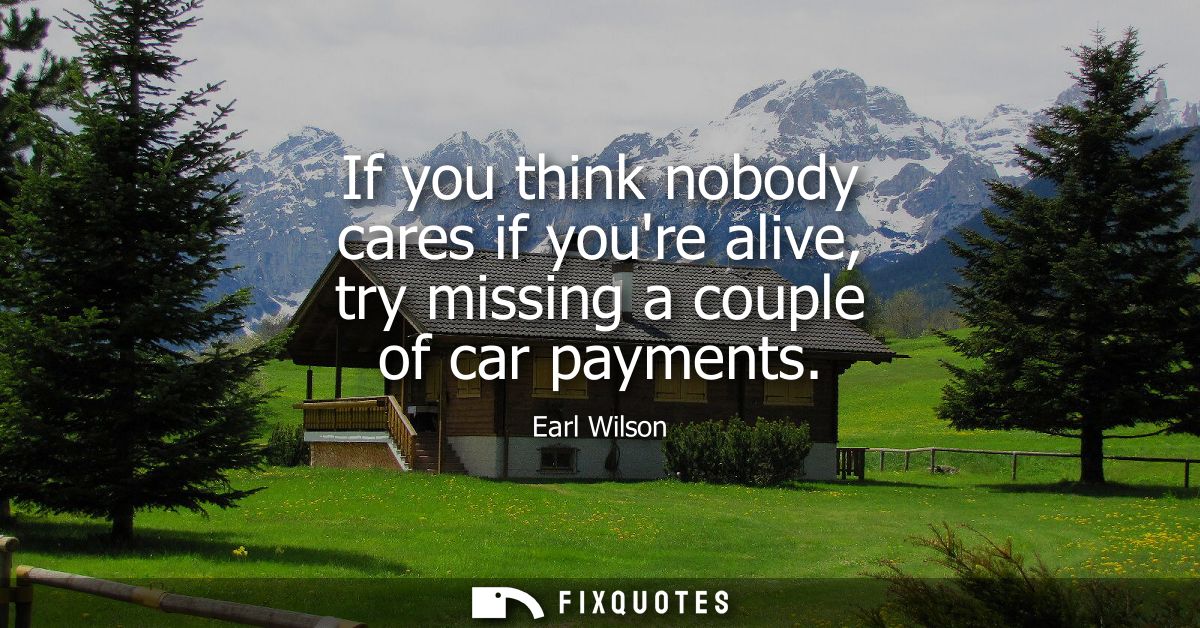
"If you think nobody cares if you're alive, try missing a couple of car payments"
About this Quote
Earl Wilson, the midcentury newspaper columnist known for wry one-liners, compresses a sharp social observation into a joke. When loneliness suggests that no one would notice your absence, the world of credit and contracts will prove otherwise fast. Miss a few car payments and the creditors, collection agencies, and repossession teams will find you. The result is funny because it is grimly true: modern life keeps score, and the ledgers rarely forget.
The joke works by juxtaposing existential invisibility with bureaucratic visibility. A person may feel unseen by friends or community, yet remains vividly present in databases, billing cycles, and credit reports. That presence is not the consoling kind; it is attention governed by money, deadlines, and collateral. The line toys with the double sense of interest. Institutions take an interest in you because they have an interest at stake.
Choosing car payments is pointed. In postwar America the car became both a symbol of freedom and a pillar of consumer finance. The road promised independence, but the monthly bill tethered drivers to lenders, a paradox Wilson exposes with a grin. Missed payments activate a whole apparatus of calls, letters, dings to your credit score, and, if it goes far enough, the van with a tow hook. You are undeniable to the machine that tracks obligations.
Beyond the punchline lies a broader critique of a culture that often measures significance by financial flows rather than by human bonds. The attention you get for defaulting is not care; it is enforcement. Yet the joke also offers a crooked kind of comfort: there is no true anonymity in a society organized by credit. Responsibilities bind us to others, even if the connection is transactional. Wilson turns a feeling of neglect into proof that you are, for better or worse, on the radar, and he nudges the reader to consider the difference between being noticed and being cared for.
The joke works by juxtaposing existential invisibility with bureaucratic visibility. A person may feel unseen by friends or community, yet remains vividly present in databases, billing cycles, and credit reports. That presence is not the consoling kind; it is attention governed by money, deadlines, and collateral. The line toys with the double sense of interest. Institutions take an interest in you because they have an interest at stake.
Choosing car payments is pointed. In postwar America the car became both a symbol of freedom and a pillar of consumer finance. The road promised independence, but the monthly bill tethered drivers to lenders, a paradox Wilson exposes with a grin. Missed payments activate a whole apparatus of calls, letters, dings to your credit score, and, if it goes far enough, the van with a tow hook. You are undeniable to the machine that tracks obligations.
Beyond the punchline lies a broader critique of a culture that often measures significance by financial flows rather than by human bonds. The attention you get for defaulting is not care; it is enforcement. Yet the joke also offers a crooked kind of comfort: there is no true anonymity in a society organized by credit. Responsibilities bind us to others, even if the connection is transactional. Wilson turns a feeling of neglect into proof that you are, for better or worse, on the radar, and he nudges the reader to consider the difference between being noticed and being cared for.
Quote Details
| Topic | Witty One-Liners |
|---|
More Quotes by Earl
Add to List