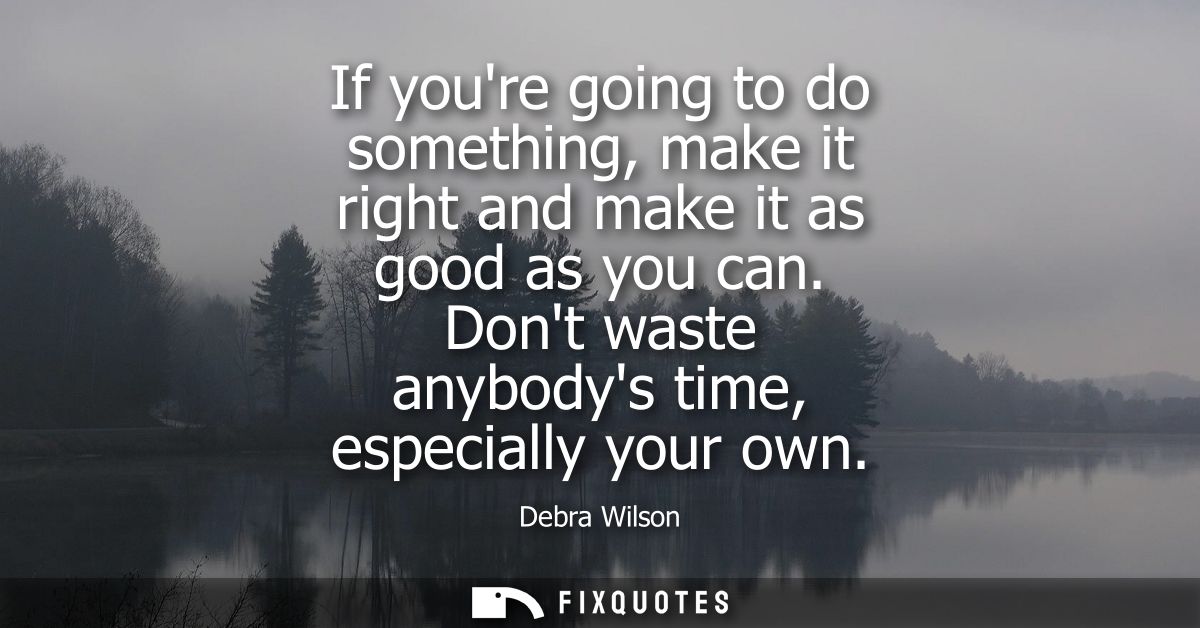
"If you're going to do something, make it right and make it as good as you can. Don't waste anybody's time, especially your own"
About this Quote
Debra Wilson’s line lands like a pep talk, but it’s really a comedian’s work ethic disguised as common sense. “Make it right” isn’t perfectionism for its own sake; it’s a warning about the most unforgivable sin in performance: making people sit through something that isn’t ready. Comedy is an attention economy where audiences pay with time, not just money, and Wilson’s phrasing treats that time as a moral contract.
The sharper edge is in the second sentence. “Don’t waste anybody’s time” sounds generous, even polite, until she snaps the focus inward: “especially your own.” That pivot exposes the real target: the seductive procrastinations and half-commitments that let you feel busy without being brave. For a comedian and actor, “wasted time” isn’t only inefficiency; it’s rehearsal time you didn’t use, drafts you didn’t refine, risks you didn’t take. It’s the long, quiet avoidance that shows up later as a weak set, a flat sketch, a role you didn’t fully inhabit.
There’s also an implied standard of respect. “Make it as good as you can” leaves room for limits - budget, skill, energy - but denies the alibi of not trying. Wilson isn’t preaching grind culture; she’s describing professionalism in a field that’s often dismissed as effortless charisma. The subtext is almost parental: if you’re going to step into the spotlight, earn it. Not with grandiosity, but with the discipline that keeps your audience from checking their phone.
The sharper edge is in the second sentence. “Don’t waste anybody’s time” sounds generous, even polite, until she snaps the focus inward: “especially your own.” That pivot exposes the real target: the seductive procrastinations and half-commitments that let you feel busy without being brave. For a comedian and actor, “wasted time” isn’t only inefficiency; it’s rehearsal time you didn’t use, drafts you didn’t refine, risks you didn’t take. It’s the long, quiet avoidance that shows up later as a weak set, a flat sketch, a role you didn’t fully inhabit.
There’s also an implied standard of respect. “Make it as good as you can” leaves room for limits - budget, skill, energy - but denies the alibi of not trying. Wilson isn’t preaching grind culture; she’s describing professionalism in a field that’s often dismissed as effortless charisma. The subtext is almost parental: if you’re going to step into the spotlight, earn it. Not with grandiosity, but with the discipline that keeps your audience from checking their phone.
Quote Details
| Topic | Work Ethic |
|---|
More Quotes by Debra
Add to List