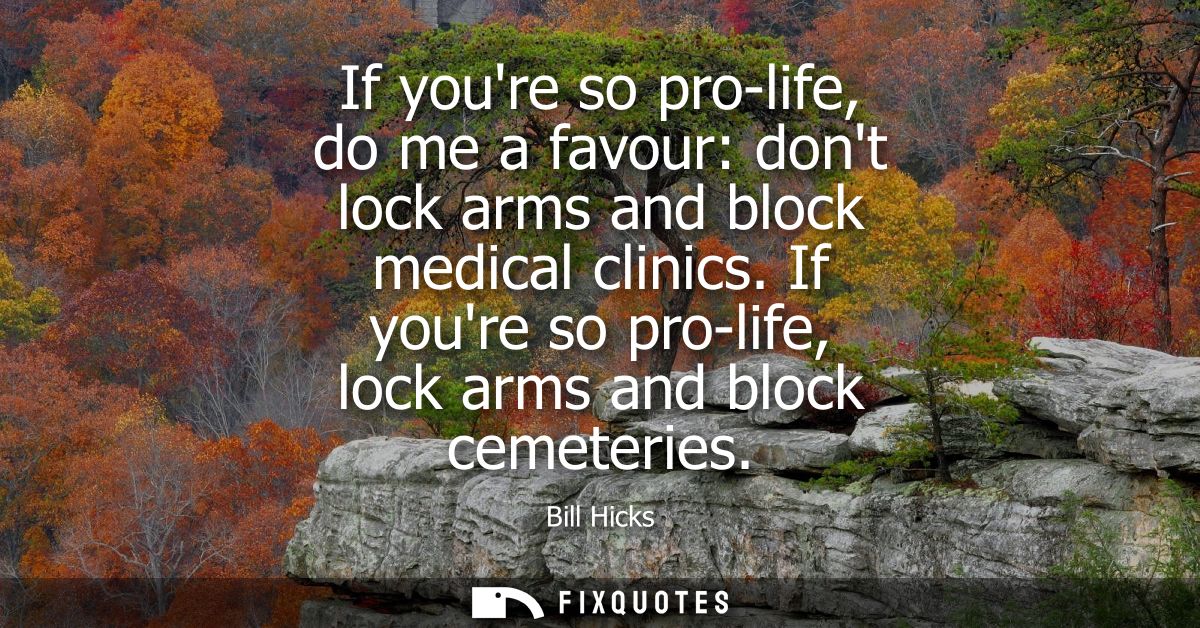
"If you're so pro-life, do me a favour: don't lock arms and block medical clinics. If you're so pro-life, lock arms and block cemeteries"
About this Quote
The subtext is less about debating abortion’s ethics than exposing where power is being exercised. Blocking clinics is framed not as reverence for life but as control over women’s decisions, performed in public, with coercion substituted for persuasion. “Lock arms” is crucial: it’s intimate, communal, almost tender, yet deployed as human barricade. Hicks spotlights that contradiction - sanctimony expressed through obstruction.
Context matters. Hicks was operating in a late-80s/early-90s America where clinic blockades were a signature tactic of the anti-abortion movement and culture-war language was hardening into identity. His persona - furious, lucid, allergic to platitudes - treats euphemisms as the enemy. By redirecting activism to cemeteries, he’s not proposing a policy; he’s puncturing a narrative. The laughter is the sound of a slogan failing a stress test.
Quote Details
| Topic | Human Rights |
|---|---|
| Source | Help us find the source |
| Cite |
Citation Formats
APA Style (7th ed.)
Hicks, Bill. (2026, January 17). If you're so pro-life, do me a favour: don't lock arms and block medical clinics. If you're so pro-life, lock arms and block cemeteries. FixQuotes. https://fixquotes.com/quotes/if-youre-so-pro-life-do-me-a-favour-dont-lock-30118/
Chicago Style
Hicks, Bill. "If you're so pro-life, do me a favour: don't lock arms and block medical clinics. If you're so pro-life, lock arms and block cemeteries." FixQuotes. January 17, 2026. https://fixquotes.com/quotes/if-youre-so-pro-life-do-me-a-favour-dont-lock-30118/.
MLA Style (9th ed.)
"If you're so pro-life, do me a favour: don't lock arms and block medical clinics. If you're so pro-life, lock arms and block cemeteries." FixQuotes, 17 Jan. 2026, https://fixquotes.com/quotes/if-youre-so-pro-life-do-me-a-favour-dont-lock-30118/. Accessed 2 Apr. 2026.