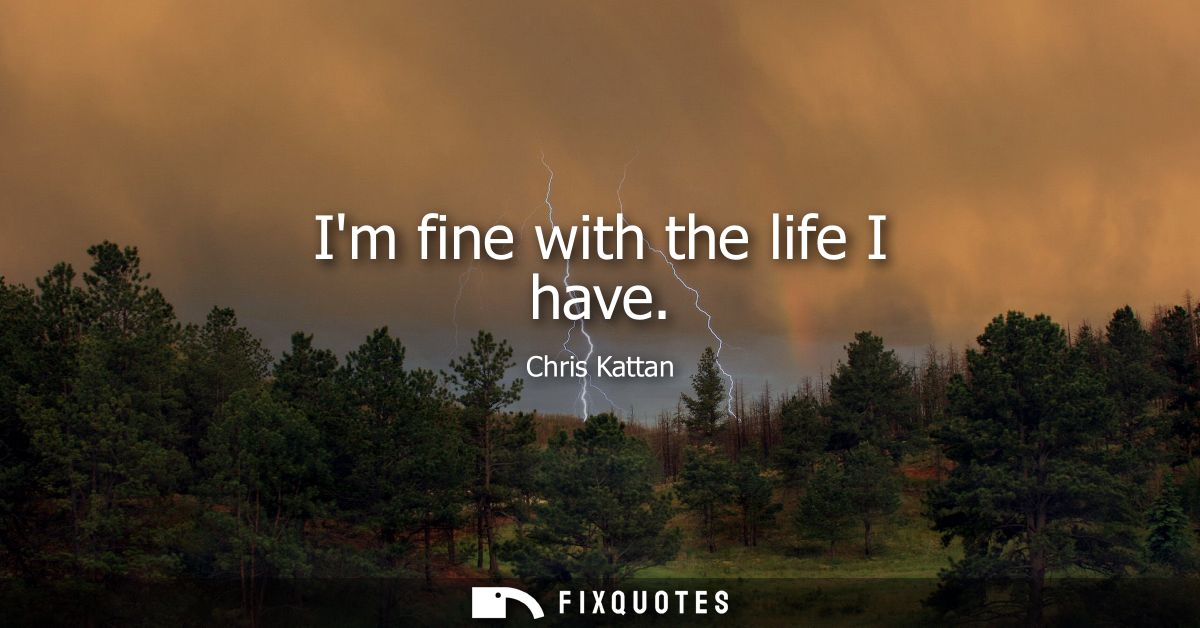
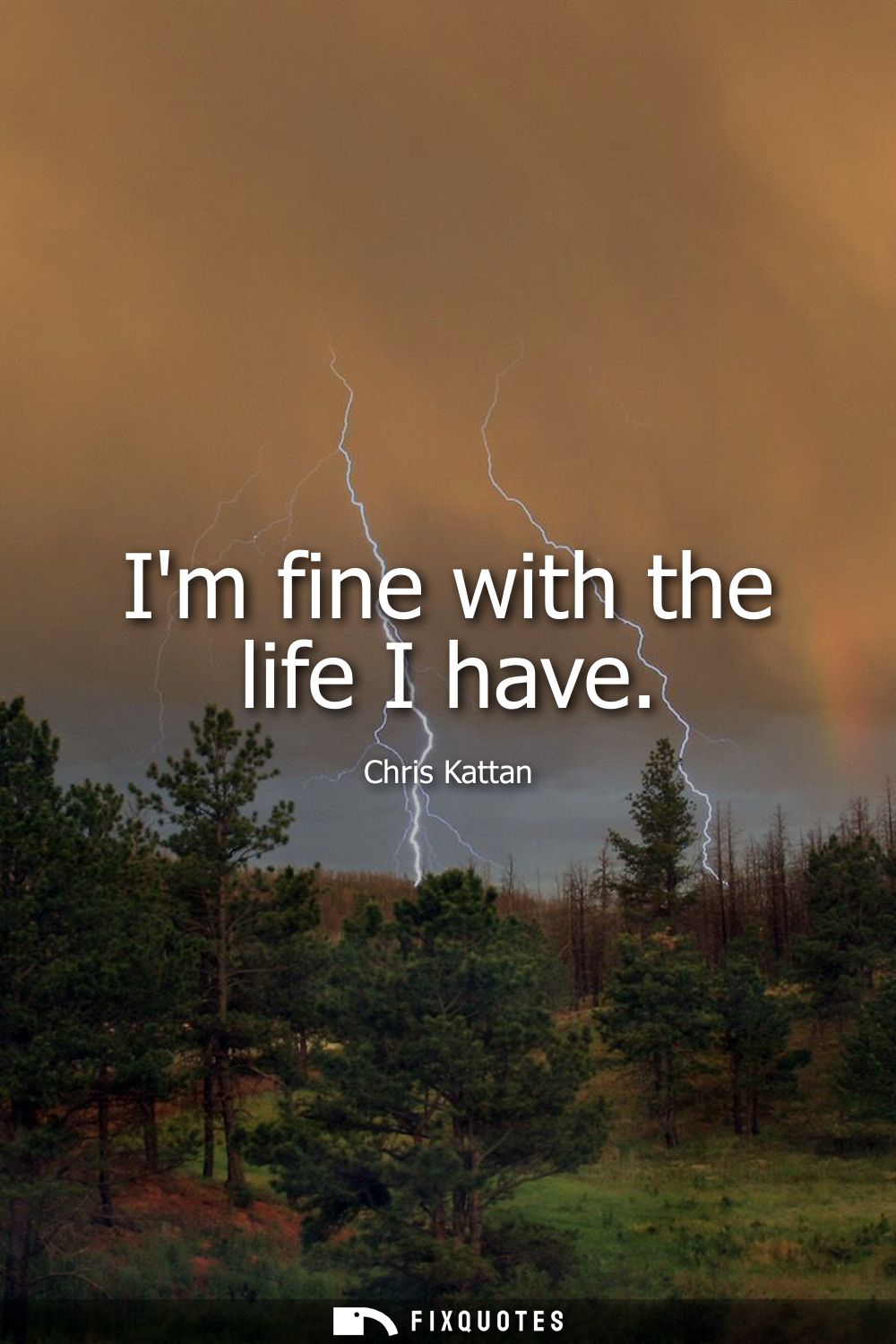
"I'm fine with the life I have"
About this Quote
"I'm fine with the life I have" lands with the sly, defensive simplicity of someone who knows the audience is waiting for either a brag or a breakdown. Coming from Chris Kattan, it reads less like a victory lap than a pre-emptive boundary: a comedian, forever measured against his peak visibility (SNL, early-2000s studio comedies), refusing to perform the culturally mandated narrative of either reinvention or regret.
The specific intent feels practical. "Fine" is doing the heavy lifting, a word that lowers the emotional temperature and dodges the trap of over-sharing. In celebrity culture, contentment is suspicious unless it’s packaged as hustle, glow-up, or trauma-to-triumph. Kattan chooses a smaller register: not "blessed", not "thriving", not "broken". Just fine. That modesty can read as resilience, but it also carries the subtext of fatigue with judgment - the quiet annoyance of being asked to account for where you are on the fame graph.
As a line from a comedian, it’s also an anti-joke with a punchline you’re supposed to supply. We’re trained to hear hidden sadness behind "I’m fine". Kattan weaponizes that expectation by staying flat. It’s a way of reclaiming agency: he doesn’t need to convince you he’s happy, and he won’t hand you pain as entertainment.
In an economy where public figures are pressured to constantly narrate their own worth, the refusal to dramatize is the point - a calm insistence that a life can be livable without being legible to strangers.
The specific intent feels practical. "Fine" is doing the heavy lifting, a word that lowers the emotional temperature and dodges the trap of over-sharing. In celebrity culture, contentment is suspicious unless it’s packaged as hustle, glow-up, or trauma-to-triumph. Kattan chooses a smaller register: not "blessed", not "thriving", not "broken". Just fine. That modesty can read as resilience, but it also carries the subtext of fatigue with judgment - the quiet annoyance of being asked to account for where you are on the fame graph.
As a line from a comedian, it’s also an anti-joke with a punchline you’re supposed to supply. We’re trained to hear hidden sadness behind "I’m fine". Kattan weaponizes that expectation by staying flat. It’s a way of reclaiming agency: he doesn’t need to convince you he’s happy, and he won’t hand you pain as entertainment.
In an economy where public figures are pressured to constantly narrate their own worth, the refusal to dramatize is the point - a calm insistence that a life can be livable without being legible to strangers.
Quote Details
| Topic | Contentment |
|---|---|
| Source | Help us find the source |
| Cite | Cite this Quote |
Citation Formats
APA Style (7th ed.)
Kattan, Chris. (n.d.). I'm fine with the life I have. FixQuotes. https://fixquotes.com/quotes/im-fine-with-the-life-i-have-64326/
Chicago Style
Kattan, Chris. "I'm fine with the life I have." FixQuotes. Accessed February 2, 2026. https://fixquotes.com/quotes/im-fine-with-the-life-i-have-64326/.
MLA Style (9th ed.)
"I'm fine with the life I have." FixQuotes, https://fixquotes.com/quotes/im-fine-with-the-life-i-have-64326/. Accessed 2 Feb. 2026.
More Quotes by Chris
Add to List