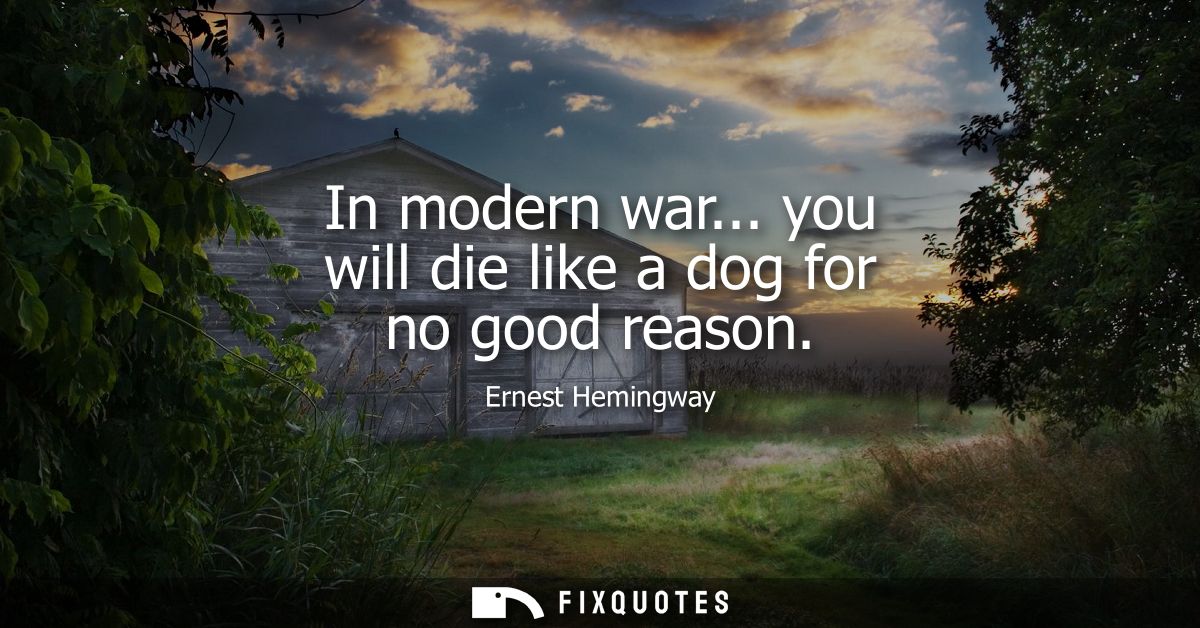
"In modern war... you will die like a dog for no good reason"
About this Quote
Hemingway’s line lands like a blunt instrument because it refuses war the one thing it most depends on: narrative dignity. “Modern war” is doing a lot of work here. It’s not Agincourt or the Alamo, not a stage for clean heroism or even coherent tragedy. It’s mechanized, bureaucratic killing - artillery, shelling, bad orders, random shrapnel - where the body’s end arrives without the consolation of meaning. “Like a dog” isn’t just cruelty; it’s an attack on the romantic grammar that turns soldiers into symbols. A dog dies unceremoniously, without ceremony or metaphysical upgrade, and that’s the insult Hemingway wants to preserve.
The subtext is personal and aesthetic. Hemingway was wounded in World War I and spent his career stripping prose down to what he thought truth could bear. The sentence mirrors that discipline: no ornament, no patriotic buffer, no therapeutic “sacrifice.” Even “for no good reason” is deliberately childish in its plainness, as if sophisticated justifications have already been tried and found morally bankrupt. It’s the language you use when you’re done being persuaded.
Context matters: early 20th-century war shattered 19th-century ideas of glory, and Hemingway became one of the writers tasked with making that shattering legible. The intent isn’t simply to horrify; it’s to de-glamorize. If the public keeps imagining war as purposeful, it stays sellable. If war is understood as the production line of meaningless death, the sales pitch collapses. Hemingway’s cynicism is a kind of ethical hygiene: don’t let death be prettied up into permission.
The subtext is personal and aesthetic. Hemingway was wounded in World War I and spent his career stripping prose down to what he thought truth could bear. The sentence mirrors that discipline: no ornament, no patriotic buffer, no therapeutic “sacrifice.” Even “for no good reason” is deliberately childish in its plainness, as if sophisticated justifications have already been tried and found morally bankrupt. It’s the language you use when you’re done being persuaded.
Context matters: early 20th-century war shattered 19th-century ideas of glory, and Hemingway became one of the writers tasked with making that shattering legible. The intent isn’t simply to horrify; it’s to de-glamorize. If the public keeps imagining war as purposeful, it stays sellable. If war is understood as the production line of meaningless death, the sales pitch collapses. Hemingway’s cynicism is a kind of ethical hygiene: don’t let death be prettied up into permission.
Quote Details
| Topic | War |
|---|---|
| Source | Help us find the source |
| Cite |
Citation Formats
APA Style (7th ed.)
Hemingway, Ernest. (2026, January 14). In modern war... you will die like a dog for no good reason. FixQuotes. https://fixquotes.com/quotes/in-modern-war-you-will-die-like-a-dog-for-no-good-43425/
Chicago Style
Hemingway, Ernest. "In modern war... you will die like a dog for no good reason." FixQuotes. January 14, 2026. https://fixquotes.com/quotes/in-modern-war-you-will-die-like-a-dog-for-no-good-43425/.
MLA Style (9th ed.)
"In modern war... you will die like a dog for no good reason." FixQuotes, 14 Jan. 2026, https://fixquotes.com/quotes/in-modern-war-you-will-die-like-a-dog-for-no-good-43425/. Accessed 12 Feb. 2026.
More Quotes by Ernest
Add to List